

About A Memoir Blue
On the day of her greatest achievement, champion swimmer Miriam is drawn back into childhood memories and her relationship with her devoted mother. The player moves through wordless interactive vignettes, handling photographs, household objects and small environmental tasks. Hand-drawn recollections and three-dimensional present-day scenes meet through music and water, connecting sporting success with the sacrifices and affection behind it.
A Memoir Blue centres on Miriam, a champion swimmer whose public achievement prompts a return to private memories. The story follows the relationship between a daughter and her devoted mother, looking back across Miriam’s childhood and the complicated feelings that connect those years to her adult life. Rather than explain the past through conventional dialogue, the game casts the player as an observer and occasional participant in a chain of remembered moments. A song from years ago acts as a trigger, and the framing shifts between the adult Miriam and the child she once was. The premise focuses on how memory changes as a person grows older: events that seemed uncomplicated to a child can acquire a different meaning later. Director Shelley Chen has described the story as drawing on her own childhood journey with her mother, while also adding imaginative elements to communicate what Miriam feels. That autobiographical starting point does not make the characters a documentary record; the game presents a fictionalized, magical-realist narrative about achievement, family pressure, sacrifice and affection. Its central question is emotional—how does Miriam understand the people and experiences that shaped her?—rather than a mystery solved through exposition.
The game advances through distinct vignettes rather than through continuous character navigation. Miriam’s adult present and her younger self’s recollections are linked by visual and musical transitions, with water serving as a recurring passage into the past. The player does not steer Miriam through a conventional platforming or swimming system. Instead, each scene presents a composed space and a small set of possible interactions. A rainy apartment, family photographs, household objects, a train journey, a ferry ride and a lakeside outing become moments to look at and activate. These locations are not large exploration zones; they are concise tableaux where the arrangement of objects and the timing of an action carry narrative meaning. A recollection may be approached through the image of a photograph, the shape of a room or a familiar object that can be manipulated. The player moves from one vignette to another by noticing and completing the interaction that the current scene makes available. This structure keeps attention on Miriam’s memories as fragments: rather than roam freely in search of lore, the player attends to a carefully framed moment until it gives way to the next.
Interaction is deliberately light but varied from scene to scene. The player may switch on lights, drag faded photographs, tune a radio, handle objects in an urban setting or make a simple choice that brings a memory into view. The action itself is often brief, yet the object supplies context: a photograph can be repositioned, a radio can be tuned, and a light can alter what is visible. Such gestures do not build a toolset or unlock a character skill tree. They serve as prompts to participate in a memory, turning an otherwise passive image into a moment that the player helps reveal. Some interactions resemble small puzzles because the player must identify what can be touched and what response follows, but they are not designed as difficult logic challenges. Their purpose is to pace the narrative and direct attention to concrete details. This distinction shapes the game’s progression: the player is not rewarded with weapons, statistics or branching dialogue options, but with the next image, action or scene that clarifies Miriam’s history. The limited action set also means the experience depends on looking closely and interpreting transitions, rather than on mastering demanding controls or repeatedly retrying a challenge.
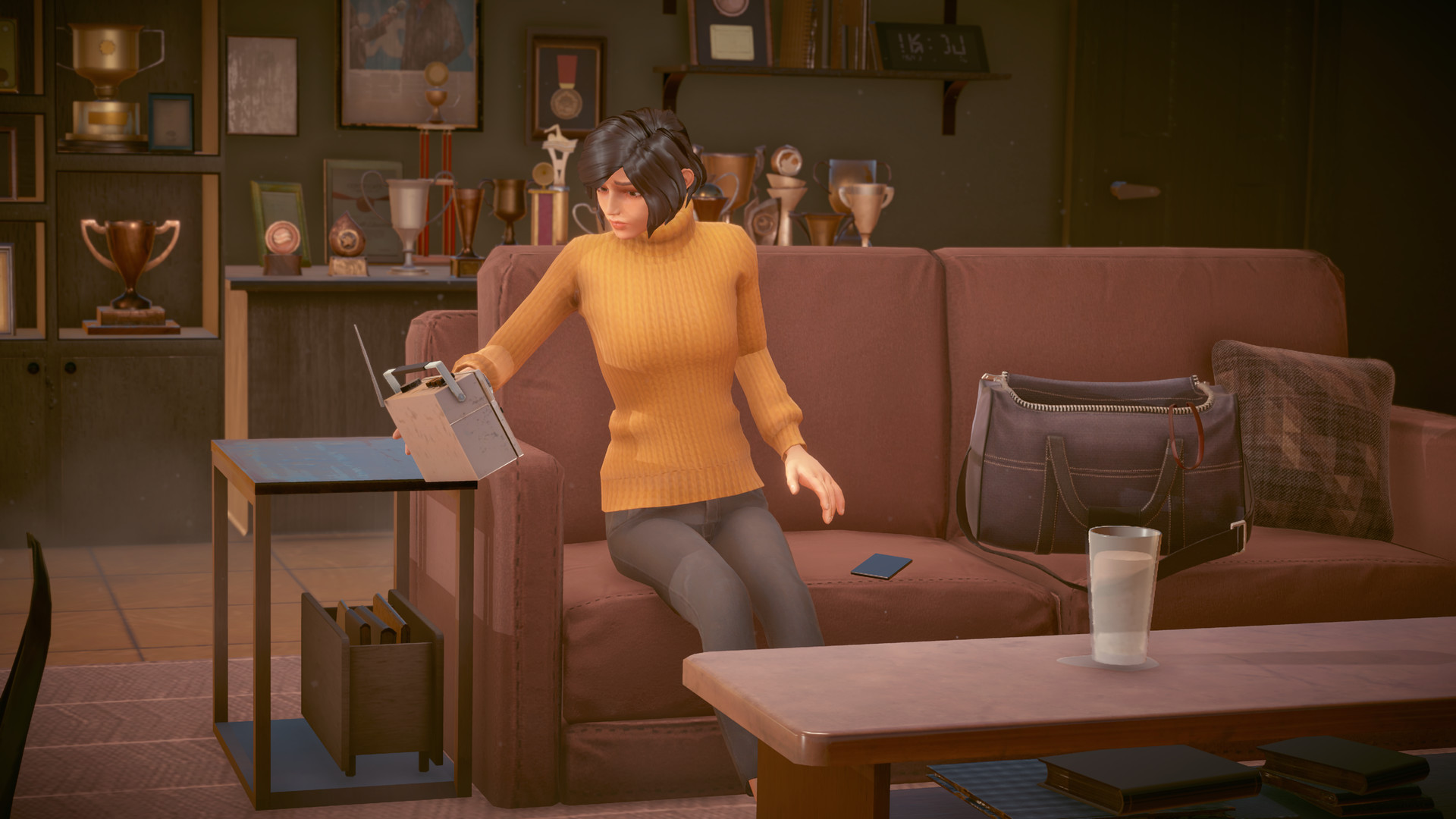
The memories build around everyday events that can carry different emotional weight when revisited. Chen’s account describes a childhood trip that Miriam remembers as a wonderful day away with her mother, while the adult perspective recognizes that the mother was fleeing home. The train, a scenic lake and a boat ride are among the recollections tied to that trip. Later, a cramped apartment with room for only one reading chair becomes another important setting; as a child, Miriam remembers it fondly as home. These details show how the game’s scenes work: spaces give physical form to what a person remembers. A ferry ride, unpacking boxes, arranging books or looking out at the water can communicate loneliness, resilience or closeness without naming those emotions in dialogue. The player encounters memories in separated fragments, and their significance comes from how they accumulate alongside Miriam’s adult present. By keeping the activities small and domestic, the game links the scale of childhood experience with the later scale of athletic achievement. Success in the pool and a family’s ordinary routines sit within the same life story, even when the adult Miriam initially experiences them as distant parts of herself.
There is no conventional combat, survival system or movement challenge described in the game’s interactions. The player’s route is instead a narrative sequence through memory, where each vignette offers an object or action that can expose another recollection. The child’s emotional world is sometimes expressed through imaginative undersea imagery, making the ocean a metaphorical space between remembered events rather than an explorable level with navigation objectives. Water can suggest being submerged or brought back toward the surface, and this visual pattern gives the episodes a connective thread. Individual memories operate like pieces in a larger portrait: they do not function as collectibles to complete a percentage track, but as scenes that reassemble Miriam’s understanding of her childhood and mother. The adult swimmer’s accomplishment frames the return to those memories, while the vignettes revisit the formative events and relationships behind her public identity. Progress is therefore linear and interpretive. The player discovers the next moment by interacting with the scene, then sees how its images, sounds or characters relate to what has already appeared. The game does not present a branching relationship meter or ask the player to choose between alternate versions of Miriam’s life; its emphasis is on recognition and emotional reconnection.
The visual language distinguishes time through a mixture of hand-drawn 2D animation and 3D environments. Adult Miriam appears in a more realistically modelled three-dimensional style, while her younger self and her mother are represented in hand-drawn animation. This contrast lets a scene move between the present-day frame and the child’s remembered world without relying on captions that announce each shift. The change of medium is meaningful but not a rigid boundary: transitions combine the styles, so the present and past can visually overlap as Miriam reflects. Everyday spaces—the apartment, transport, a boat or a room being unpacked—can acquire a surreal scale or flow into underwater imagery. The camera and composition guide the eye toward the object or expression that matters in each tableau. Because the narrative contains no spoken dialogue or explanatory text, gestures and musical cues carry much of the emotional information. Miriam’s adult presence, the mother’s actions and the child’s reactions are staged to be read through movement and rhythm. The game consequently asks the player to infer relationships from what is shown, while its color and animation keep the scenes expressive even when the action is quiet.
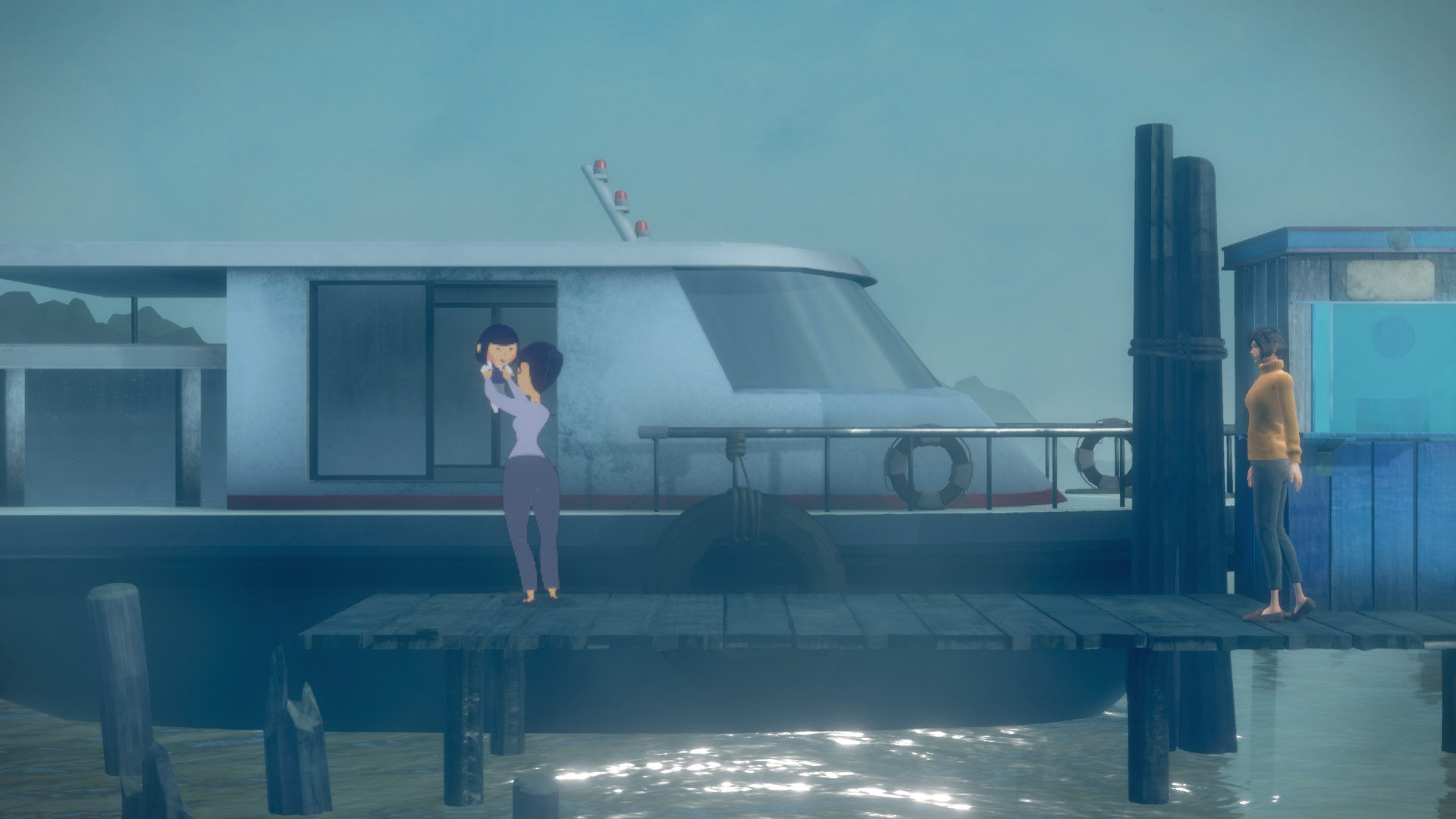
Music is the main audible thread through an otherwise wordless story. The soundtrack and songs take on a narrative role usually carried by spoken conversations, shaping how the player reads a memory and how one scene leads into another. Movement and melody communicate feelings, with a song conveying what the mother feels for Miriam. That makes audio more than background atmosphere: it helps establish emotional context when the image alone leaves room for interpretation. The game still uses environmental sound, but it does not turn music into a rhythm mechanic or ask the player to perform songs. The player listens as scenes unfold and combines those cues with the visual details and interactions. Together, the quiet controls, framed vignettes, mixed-media animation and recurring water imagery create a short interactive narrative about looking again at childhood from adulthood. A Memoir Blue is available as a standalone game on Steam and the publisher-listed platforms. It leaves out plot resolutions and treats the characters as part of the game’s fictionalized, autobiographical narrative rather than claiming that every scene reproduces a literal event.
- Developer
- Cloisters Interactive
- Genre
- Adventure / casual interactive narrative