

About 1000xRESIST
A millennium after an alien arrival devastates humanity, Watcher serves a society of clones sheltered in the Orchard and ruled by the immortal ALLMOTHER. Through Communions with the ALLMOTHER’s memories, she explores changing places and investigates the history behind her community’s beliefs.
The year is uncertain, and the people who remain live below ground. A thousand years after the Occupants arrive, their presence is remembered as the cause of a disease that has nearly erased humanity. The survivor Iris is immune and immortal; she has produced a population of clones who call themselves Sisters and call her the ALLMOTHER. Since the Sisters remain vulnerable to the air above, they shelter in the Orchard, an underground settlement built around the expectation that the Occupants may attack again. This is not an open-world wasteland: the setting is a contained society whose habits, institutions and shared history give the speculative premise its human scale. Watcher, the player character, begins as a committed servant of the ALLMOTHER, preparing for her first Communion, the ritual through which she enters and interprets Iris’s memories.
The Orchard is both home and the game’s central social space. Its Sisters have assigned functions, from Principal’s administration and Bang Bang Fire’s military command to Knower’s preservation of knowledge, Fixer’s engineering and Healer’s medical and cloning work. Watcher has a different responsibility: through the floating artificial companion Secretary, she experiences memories that provide the society with its official history. Between these sequences, the player can walk through the Orchard, encounter the other Sisters and find details that give the bunker texture beyond its role as a story backdrop. Its population consists of clones, but individual characters have their own relationships and ways of responding to the world. The game asks the player to listen and observe rather than manage the settlement’s resources or issue orders to its inhabitants. Everyday conversations and the changes visible in familiar rooms become part of how the larger history is pieced together.
The story’s initial rupture comes from Fixer, Watcher’s closest sister. Fixer challenges the account of the ALLMOTHER’s identity and is executed for treason, leaving Watcher to investigate the claims through further Communions. That premise makes the player’s access to the past an institutional privilege with political consequences: the same ritual that confirms the Orchard’s beliefs can also reveal inconsistencies in them. The memories are not simply detached flashbacks. They take Watcher into pivotal periods of Iris’s life, including her high-school years, the Occupants’ arrival, the Orchard’s creation and the birth of the first Sisters. The sequence is deliberately not a straightforward chronological biography. Characters and objects appear at different points in the history, so understanding a later scene can change how an earlier encounter reads. The narrative makes the investigation depend on the player’s attention to people, details and gaps in what the community says.
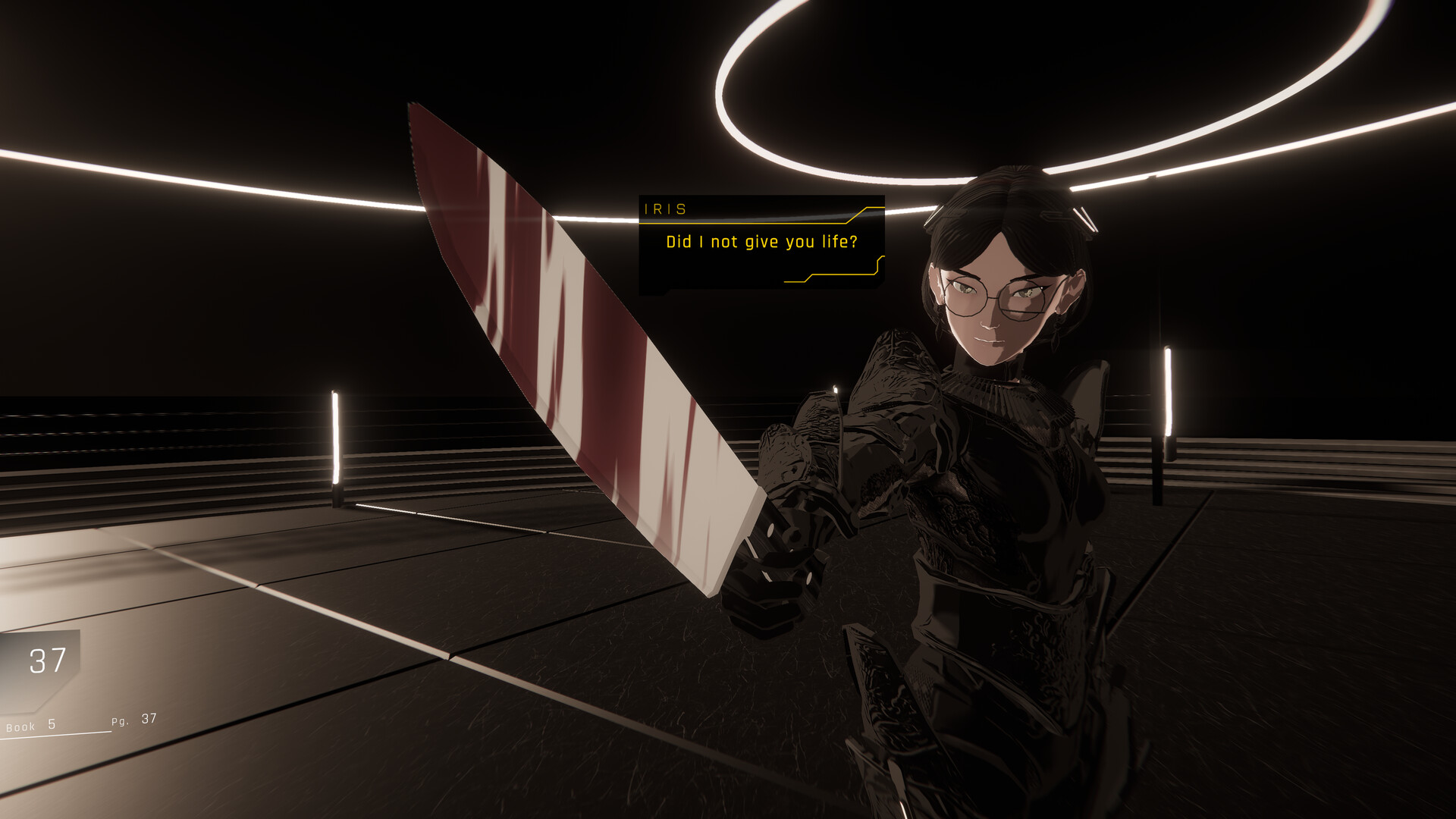
Communion gives the game its distinctive time-based exploration. Within a memory, Watcher can jump between moments separated by minutes, days or years, and revisit a shared place in different states. A blocked route in one interval may be accessible in another; a changed object, altered structure or different arrangement of people can expose a path or a secret. The player compares these versions and uses the transitions to cross spaces and solve environmental puzzles. These are not combat encounters or a general-purpose time-manipulation toolkit. They are story-linked interactions that make the movement between periods the means of progressing through a scene. The changing environments also convey events that happened between the selected moments: instead of presenting every development in a chronological cutscene, the game lets the player infer how a location and its occupants changed. That mechanic links navigation to the act of reconstructing a life and a society.
Moving through these spaces changes with the chapter. The game shifts between third-person adventure movement, first-person exploration, fixed-camera scenes and side-scrolling passages, with camera and control modes shaped around different story beats. Some sequences invite close inspection of a room and its objects while characters talk; others frame figures at a distance, like a staged tableau. Light platforming appears in some of the more abstract memory spaces, where characters can be propelled across large gaps. The player is not building a combat loadout or mastering a single platforming moveset. The immediate task is usually to move through a carefully composed environment, understand what its available time periods disclose and reach the next scene. The changes in viewpoint are part of the storytelling structure: the game uses shifts in spatial distance and control to alter how a scene is encountered, rather than maintaining one camera as a neutral window on the whole narrative.
Conversation and observation do much of the work that action systems perform in other adventures. The Orchard’s Sisters have roles within a collective, but the narrative follows personal ties, memory and conflicting interpretations as well as public doctrine. Dialogue can provide context for who was present at a historical moment, how someone’s position changed and what the community remembers or omits. Because the history is presented out of sequence, a minor figure in one period may matter in another; noticing those continuities helps the player assemble the chronology. Objects also gain significance through their lifecycles across time. The game’s mysteries are therefore explored through repeated encounters with people and places, not through a checklist of optional lore entries. Its story has limited branching across most of its length, with difficult decisions concentrated in the closing chapters. Earlier discoveries contribute to how the player understands those choices, while the narrative does not promise that each decision has a simple or wholly positive outcome.
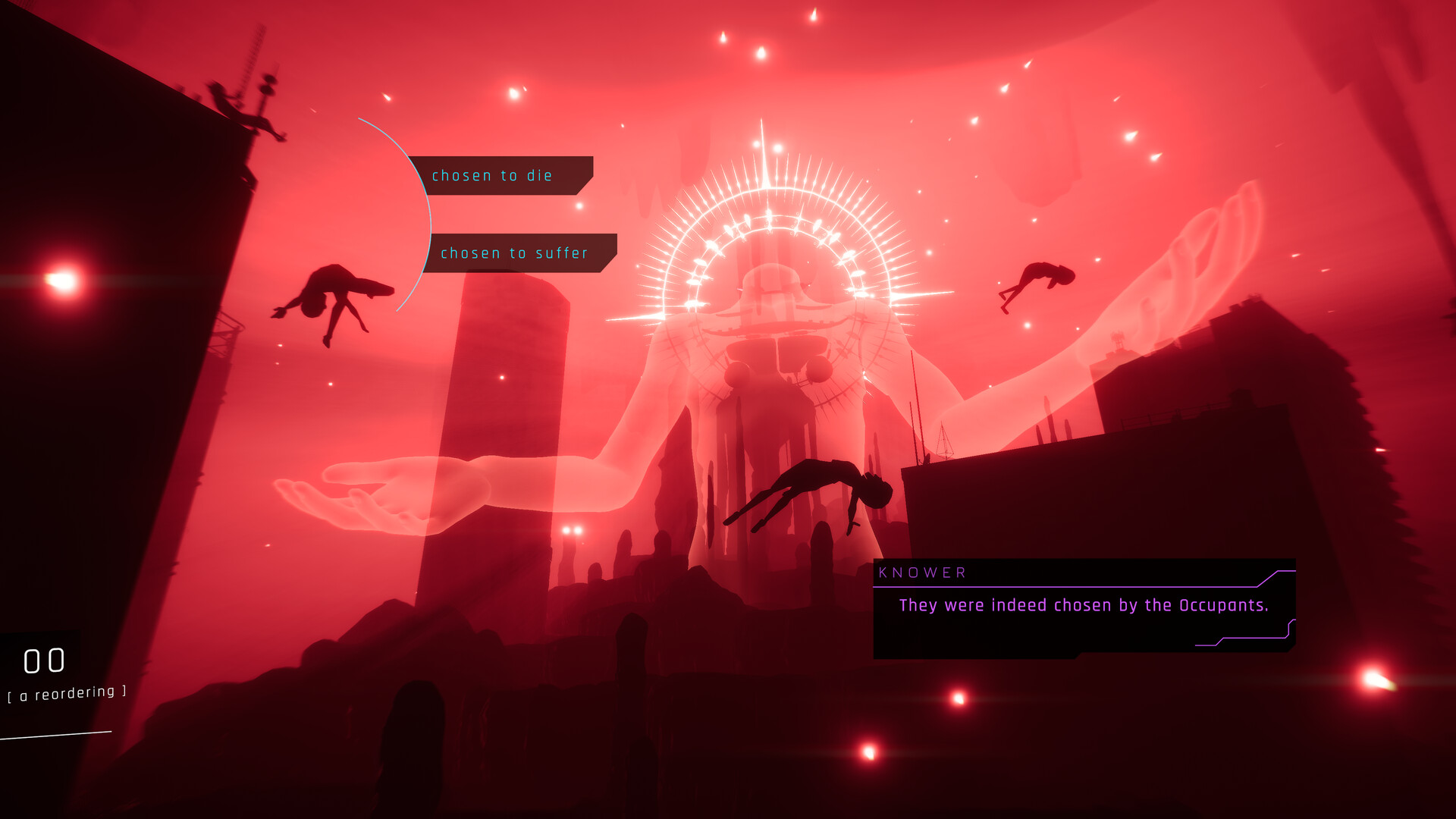
The audiovisual presentation supports that chapter-by-chapter approach. The Steam edition describes a fully voiced narrative with more than 15,000 lines of dialogue, performed by Asian-Canadian actors, and a soundtrack by two composers. That scale allows extended conversations and changes in performance to carry details that might otherwise be delivered through explanatory text. Visuals range from ordinary personal spaces, such as a childhood home, to the Orchard’s cavernous architecture and more abstract memory environments. The environments can feel expansive or confined, and their proportions shift to suit a scene. The complete game blends adventure exploration, visual-novel-like dialogue and first-person walking sequences; it contains no combat. On Steam, the listed product is the single-player PC edition developed by sunset visitor and published by Fellow Traveller. The story shifts its methods from chapter to chapter, and each change in form serves a particular period of Watcher’s investigation.
The game’s structure draws on a range of narrative forms without leaving the player outside its world. First-person passages can make a room feel intimate, while a side-scrolling scene can present a character’s experience at a greater remove. Shifts between these modes happen alongside changes in period and place, so the player learns to read the form of a scene as well as its dialogue. Repeated locations create a visual memory of their own: when a later Communion returns to a familiar setting, the difference between its versions carries information. This approach allows small actions and relationships to acquire consequences across decades, without turning the Orchard or the past into a map full of unrelated errands. The central activity remains interpretation—moving through a memory, speaking with people, comparing what has changed and deciding what that evidence means for Watcher’s understanding of the society she serves. The game’s music and fully performed dialogue also help distinguish the remembered past from the Orchard’s present. Performance gives the Sisters individual voices within a society built from copies, while recurring architectural details let the player recognize a place even as its occupants and meaning change. Both forms of continuity make the chronology legible without removing its uncertainty. The player remains responsible for connecting what the memories show with what Watcher hears in the bunker.
- Developer
- sunset visitor 斜陽過客
- Genre
- Narrative sci-fi adventure