
Behind the series
- First aired
- 2020
- Principal cast
- Eugene, Lee Ji-ah, Kim So-yeon, Uhm Ki-joon, Yoon Jong-hoon, Shin Eun-kyung, Kim Hyun-soo, Choi Ye-bin
- Story scope
- Season 1
About the series
Contains story spoilers.
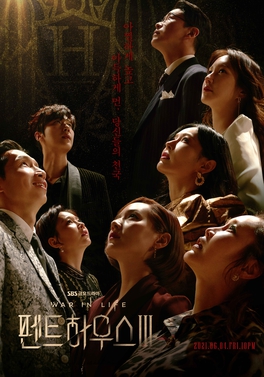
The first season of The Penthouse: War in Life sets its conflict inside Hera Palace, a vast luxury apartment tower in Seoul’s Gangnam district. Its residents occupy different rungs of wealth and inherited status, but they share a belief that success can be measured through access, reputation and the futures of their children. The building is both home and emblem: living high above the city signals arrival, while the residents’ competition keeps that security precarious. Nearby, Cheong-ah Arts School extends the same hierarchy into education, where auditions and awards determine which children receive recognition and whose parents can shape the rules.
Shim Su-ryeon appears to possess the ease that comes with family wealth. Her polished life at Hera Palace masks a history of losses and unanswered questions, and her concern for vulnerable people sets her apart from neighbours who treat compassion as a weakness. Cheon Seo-jin is a celebrated soprano and powerful figure at the school, accustomed to directing events around her own family. She wants her daughter Ha Eun-byeol to inherit artistic distinction and social standing. The contrast is not simply between a kind woman and a villain: Su-ryeon’s privileged position gives her leverage, while Seo-jin’s fear of failure helps explain why she protects the advantages she has built.
Oh Yoon-hee enters from outside the tower’s established circle. She is a single mother with musical ability and a painful history involving Seo-jin, whose career and social ascent make their old rivalry newly consequential. Yoon-hee wants a better future for her daughter Bae Ro-na, and sees Cheong-ah as a route into a world that has excluded them. Her ambition carries a genuine desire to give Ro-na opportunity, but it also draws her into tactics that compromise the moral distinction she once claimed. Her changing alliance with Su-ryeon becomes one of the season’s most unstable relationships: they share a grievance, yet neither can be certain how much the other is willing to sacrifice.
The season’s mystery begins with Min Seol-ah, a student whose precarious circumstances place her among children of the tower’s wealthiest families. She becomes entangled with the adults’ secrets and the students’ competition, and her death during a Hera Palace gathering turns the building’s social performance into a crime investigation. The residents’ first instinct is self-protection. They have reasons to conceal what they know, and each account is shaped by the danger of losing a child’s future, a public reputation or control of the household. The mystery therefore unfolds through overlapping motives rather than a single outsider investigating a sealed community.
The children’s stories mirror and intensify the adult contest. Eun-byeol faces pressure from Seo-jin to perform and win, while Ro-na seeks recognition in a school where family influence can matter as much as talent. Other Hera Palace teenagers, including Joo Seok-hoon and Joo Seok-kyung, carry their own family tensions into the classrooms and rehearsal spaces. Their friendships and rivalries shift under the expectations placed on them by parents. A child may be both beneficiary and victim of a family’s status: access opens doors, but it also makes every failure visible and turns affection into a form of pressure.
Seo-jin’s marriage to Ha Yoon-cheol adds another line of strain. Their household is organized around the demands of Seo-jin’s career and Eun-byeol’s future, while Yoon-cheol’s own professional standing and relationship with Yoon-hee complicate loyalties. Other residents, such as the families of the Joo twins, bring business and political influence into the tower’s social web. The series uses these marriages, parent-child bonds and old grievances to show how people trade information and allegiance. Confessions can become weapons; protection can look like complicity; and an apparent act of generosity may be designed to secure a later advantage.
Su-ryeon’s pursuit of answers becomes intensely personal when she discovers Seol-ah was her daughter. The girl’s death is no longer a distant injustice she can expose from the safety of her own family. Yoon-hee’s alliance with her then becomes a particularly painful betrayal: Yoon-hee remembers that she pushed Seol-ah to her death. A mother who wanted opportunity for her child has destroyed another mother’s child. Seo-jin’s own family loyalty also breaks under ambition when she quarrels with her father over control of the school and leaves him without help after his collapse. These revelations give the season’s arguments about status a physical cost, moving beyond gossip or competitive auditions into actions that cannot be repaired by winning the next confrontation.
The ending reverses the expected direction of justice. Dan-tae kills Su-ryeon and works with Seo-jin to frame Yoon-hee, who is sentenced for a murder she did not commit even though she is guilty of killing Seol-ah. Ro-na faces the public hostility directed at her mother, while the residents most able to buy protection continue their comfortable lives. Logan Lee removes Yoon-hee from the prison escort and confronts her about Seol-ah. She admits what she did and stabs herself, leaving her immediate fate unresolved at the season’s close. The school and tower still stand, but the women’s positions have changed violently. Parental ambition has helped turn the pursuit of a better future into a threat to the very children it was supposed to protect.