
About Total War: WARHAMMER III
Total War: WARHAMMER III combines a turn-based fantasy campaign with real-time battles. Lead a faction across a changing map, develop settlements, recruit armies, and command them in combat, with distinct campaigns centered on the Realms of Chaos and the larger Immortal Empires sandbox.
Total War: WARHAMMER III moves between two strategic scales. On the campaign map, you direct a faction across the Warhammer world, managing settlements, armies, diplomacy, and long-range objectives turn by turn. When armies meet, the game shifts to real-time battles in which formations, terrain, timing, and unit abilities decide the result. The central tension is that every victory on one scale creates new obligations on the other: an army away from home may win territory but expose a border, while a developed province can support future campaigns but still need protection. Its fantasy setting supplies the factions and characters, while the player determines how their campaign unfolds.
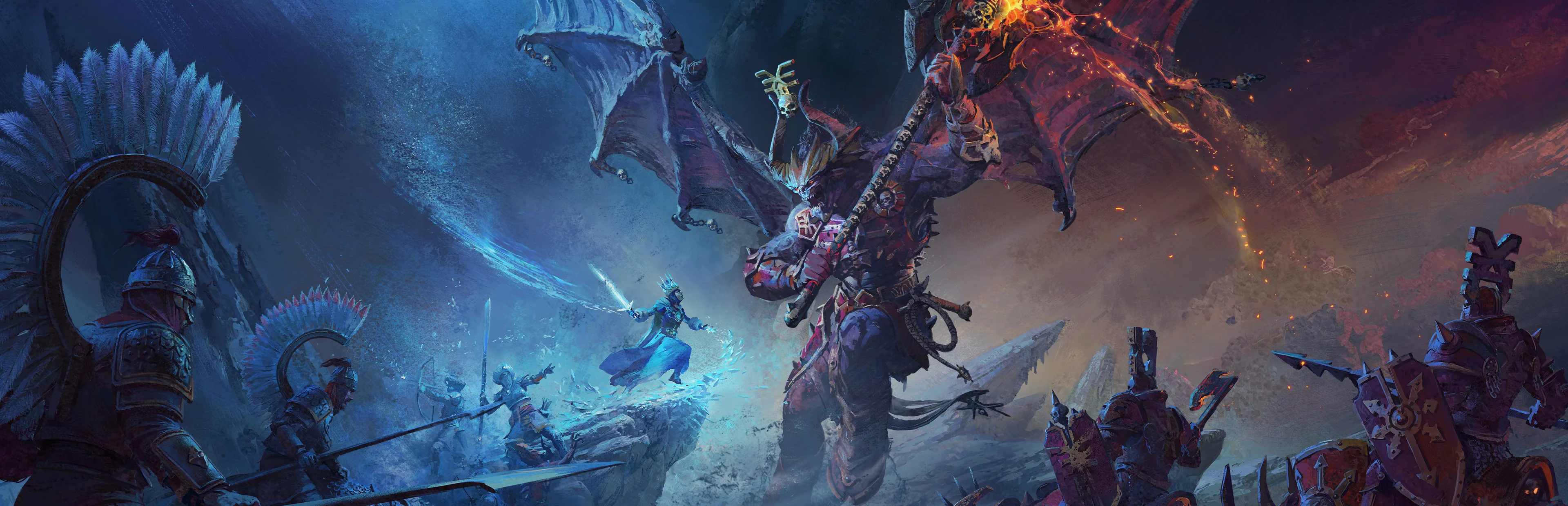
The Realm of Chaos campaign gives the game a defined central conflict. Kislev's bear-god Ursun has been captured, and rival mortal and daemonic forces seek to reach him through the domains of the four Chaos powers: Khorne, Nurgle, Slaanesh, and Tzeentch. Their realms are not simply regions to conquer; each presents a themed challenge and culminates in a survival battle. Those encounters place the army in staged defenses against waves of enemies, balancing dwindling supplies with capturing positions and using the battlefield to hold back attackers. This campaign structure gives the factions a shared race toward a narrative objective, though the route and results vary with the chosen Legendary Lord.
Faction choice changes more than the roster of units. The base game includes Kislev, Grand Cathay, the Daemons of Chaos, and the four Chaos-aligned factions, while other playable races and Lords depend on ownership of their corresponding games or content. Kislev's armies combine hardy human troops and supernatural allies; Grand Cathay fields disciplined formations and dragon-led leaders; each Chaos power emphasizes its own daemonic forces and battlefield identity. The Daemon Prince can be customized with gifts and parts associated with the Chaos gods, letting the player shape a leader's equipment and role. These differences carry into campaign objectives and recruitment, so the same map asks each faction to solve different logistical and military problems.
Immortal Empires offers a broad sandbox campaign that combines the trilogy's landmasses, factions, and Legendary Lords. Ownership of WARHAMMER III opens this campaign and its base races; other races and their Lords remain linked to the relevant prior game or downloadable content. On the campaign map, armies move between regions, besiege settlements, negotiate with neighbouring factions, and take territory needed for victory conditions. The larger world creates many possible frontiers, and expansion must be weighed against travel time, hostile borders, and the stability of a growing empire. A Lord's quests can offer optional rewards, while faction-specific victory objectives provide different goals beyond simply occupying more land.
Running a faction involves developing provinces and deciding where military resources should go. Settlements can be expanded with buildings that support recruitment, income, public order, or other needs; province geography and faction mechanics influence what is practical. Armies require upkeep, so adding another force can solve a threat while placing pressure on the treasury. Lords gain experience and can improve skills, acquire items, and complete quests, while units gain experience through campaigning. Diplomacy can create temporary opportunities, secure borders, or open a route against a mutual enemy, but agreements exist within an unstable world where rival powers keep moving. The campaign is therefore a recurring cycle of securing a base, choosing a target, and deciding when an army is ready to advance.
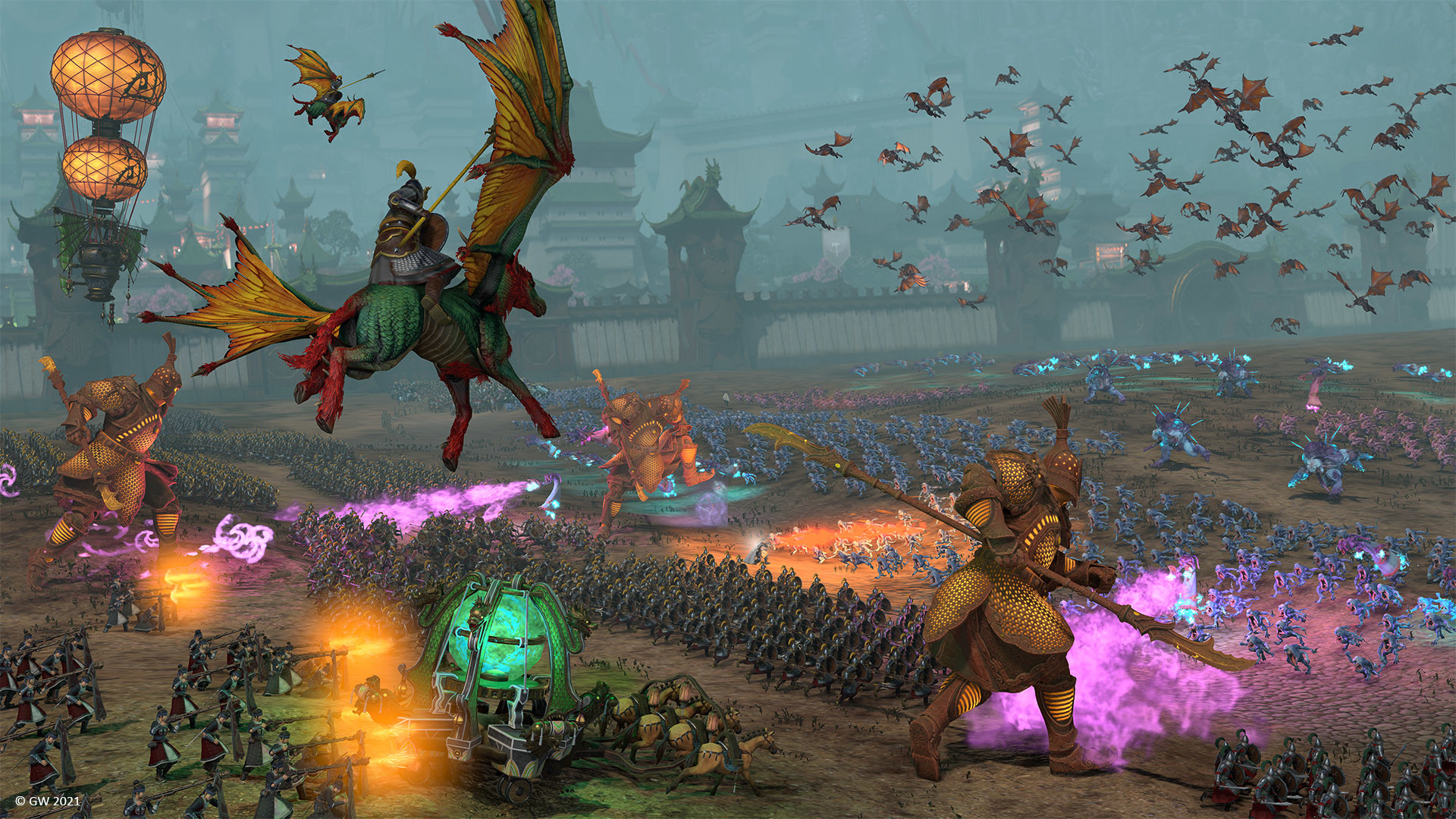
Real-time battles require the player to coordinate a varied force rather than issue orders to individual heroes alone. Infantry can hold a line, cavalry can exploit exposed flanks, missiles apply pressure from range, and monsters or specialist units may break formations or threaten particular targets. Terrain and elevation alter lines of sight and movement; fatigue, morale, and leadership affect whether troops stay in the fight. Lords and heroes can use spells, abilities, and direct combat to influence key moments, but their strength does not make the rest of the army irrelevant. Pausing and issuing orders allows players to manage several engagements at once, while formation placement before contact can decide how the first clash develops.
Sieges and minor settlement battles bring the real-time layer into built-up spaces. Attackers must approach defenses and find a way through walls or streets, while defenders use fortifications and available forces to protect key points. The battlefield can extend beyond the outer walls, turning streets and interior approaches into contested ground. The Realms of Chaos survival encounters use a different structure again: a limited force must hold and retake strategic positions while reinforcements arrive and enemy waves continue. Together, field battles, sieges, and survival missions give the combat layer distinct objectives instead of treating every encounter as a simple clash of two lines.
The game also supports multiplayer campaign and battle play, with exact content depending on ownership and mode. Cooperative campaigns let players pursue shared goals, while competitive setups create direct rivalry over territory and objectives. Immortal Empires supports campaigns with up to eight players; each participant can see Legendary Lords in the world even when they cannot select a Lord locked behind content they do not own. This lets friends with different collections share a map while keeping each player's playable roster tied to their own purchases. The shared campaign therefore changes both alliance planning and the way players coordinate battles across distant fronts.
Creative Assembly's third Warhammer game is also the entry point for the trilogy's whole roster, which makes the ownership rules part of the review rather than a footnote.
The two layers, and why they need each other
On the campaign map you are managing settlements, recruitment and the economy that pays for it, and the interesting failure state is not losing a battle but arriving at one with the wrong army. On the battlefield the same units become a real-time problem of positioning, matchups and morale, where a big monster is only as good as the flank it is standing on.
The relationship between those two layers is the series' foundation rather than a WARHAMMER invention, but the factions here are deliberately asymmetric, and that is what makes each campaign read differently. A roster built around monsters solves problems that a roster built around artillery does not, and the campaign layer has to support a different set of answers for each of them.
The decisions underneath are concrete. On the battlefield a unit is only as reliable as its leadership: a formation that takes a charge in the flank or the rear breaks far sooner than one holding a line, and the studio's own patch notes hand out attributes such as Devastating Flanker and describe units fleeing once they have had enough. Where a unit stands, and what it is standing next to, is a decision rather than a detail. The campaign layer is where that army is paid for and recruited, which is why arriving at a battle with the wrong composition is worse than losing one you had a chance in.
Seven races, ten lords, one narrative campaign
The base game's own pitch is the last roar of a dying god and a portal to the Realm of Chaos, with the four Ruinous Powers spilling out and Kislev and Grand Cathay standing against them. That is seven playable races and hundreds of units, with ten Legendary Lords to choose from, including the Daemon Prince, whose customisation is advertised with a suite of body parts and powers that Creative Assembly describes in terms of billions of combinations. It is the most overtly role-playing thing the series has done with a faction: your daemon is assembled rather than selected.
Immortal Empires: access is not ownership
The thing buyers ask about first is the trilogy-spanning sandbox campaign, and the store listing answers it directly. Immortal Empires combines the campaign maps, races and factions from all three games into one campaign, and the note attached to that listing, as it stands today, says all owners of WARHAMMER III can access it. The second half of the note is the part that gets missed: several of the races available inside Immortal Empires are unlocked only if you own WARHAMMER, WARHAMMER II or downloadable content across the trilogy.
The access model has also loosened over time. When the Tides of Torment content landed alongside patch 7.0, the studio's own announcement said Immortal Empires was unlocked for owners of the first two games as well. So the accurate way to think about it is that access to the campaign is broad while the roster you can actually play is a function of what you own. Buying WARHAMMER III gets you through the door; the armies behind the door are the trilogy you have collected.
Multiplayer is bigger than it sounds
The base game ships with more than a duel mode. There is an eight-player Realm of Chaos multiplayer campaign, which is the sort of feature that only exists because the campaign and battle layers were built to be played by more than one person at once. Alongside it are story-driven multiplayer campaigns built around Kislev and Grand Cathay, a 1v1 Domination mode, and ranked and custom battles. For a game that people mostly play alone, the co-operative campaign is the part worth flagging to friends.
Where the content line stands now
The value question with any Total War game is where the content line currently sits, and it is long, so the short version is better than an inventory. The base game is a complete strategy game with its own narrative campaign, and everything sold since then is a menu of factions, lords and characters rather than missing chapters. If you are the kind of player who wants every lord, the collection bundle exists and includes the whole line to date. The next pack, Lords of the End Times, brings Nagash, Thanquol, Boris Todbringer and the Glottkin alongside a game update and a free legendary lord, and it was still listed as a pre-purchase when we read the store entry, so treat it as announced rather than shipped.
Platforms and size
The store entry used here supports Windows, macOS and SteamOS with Linux, and it credits Creative Assembly and Feral Interactive as the developers, with Feral's own catalogue being a Mac and Linux operation rather than a console one. The listed minimum is 120GB of storage, which is the number to look at before buying anything, and the store notes that paid and free content may raise the requirement over time.
Should you play it
Yes, if you want a strategy game where the campaign and the battle are genuinely the same game rather than a board and a minigame. The faction asymmetry is the strongest argument for the trilogy, and WARHAMMER III is where the most varied rosters in it live.
Skip it if you want a clean, single-purchase roster, because the ownership rules are part of the design and the answer to what you can play is a list rather than a game. Skip it as well if a large install and a long campaign are not what you have room for right now.