
About Tom Clancy's Rainbow Six Siege X
Ubisoft's shooter has been running since 2015, and Siege X is the largest rebuild it has had: a free access tier, modernised maps, and a second six-versus-six mode sitting beside the original game. What keeps us coming back is the round itself — the rules around it keep moving, and the round is still where the game is at its best.
What you are actually playing
Siege is five attackers against five defenders, played out over rounds on a small, dense map. In Bomb, the objective the standard playlists are built around, the attack has to reach the site and plant a defuser; the defence has to stop the plant, or disable the defuser once it is down. A plant is not the end of the round — the defuser still has to be dealt with — and finishing off the attacking team afterwards does not win that round for the defence while it is sitting there live. The sides then swap and do it the other way around, and the first side to win enough rounds takes the match.
Bomb is not the only thing in the game, either: there is a Deathmatch playlist built around eliminations, and Ubisoft's Year 11 roadmap still has a Hostage rework on the schedule. Read the mode name before assuming a queue plays out the same way.
There are no respawns inside a round-based match, and that single rule is why the game feels the way it does. Dying ends your round, not your match: a player who is already out can still watch what the team can see and keep talking. Ubisoft's own material leans into that, from the drones an attack uses to find the site to the first-person shadows that give away where a player just walked. None of it guarantees an outcome — a call is only as good as the player acting on it.
Operators are the game inside the game
Every operator is a gadget plus a loadout. Defenders get reinforcements, barricades, traps and surveillance tools to turn a room into somewhere you would rather not walk into. Attackers get observation drones to find the bomb site before anyone commits, and breach tools to take the room apart instead of walking through the door. The five a side brings is the decision that shapes a round before anyone fires.
This season's new defender, Noor, shows how specific those answers get. Ubisoft describes him as a shield counter built to disrupt an attacking push, and his Horus Lance launcher fires five projectiles that pierce shields and destructible surfaces before erupting into flames. The projectiles work through floors and ceilings and from adjacent rooms, and they can be aimed at devices as well as people — Castle's armour panels and Azami's Kiba barriers are named as targets.
The walls are the map
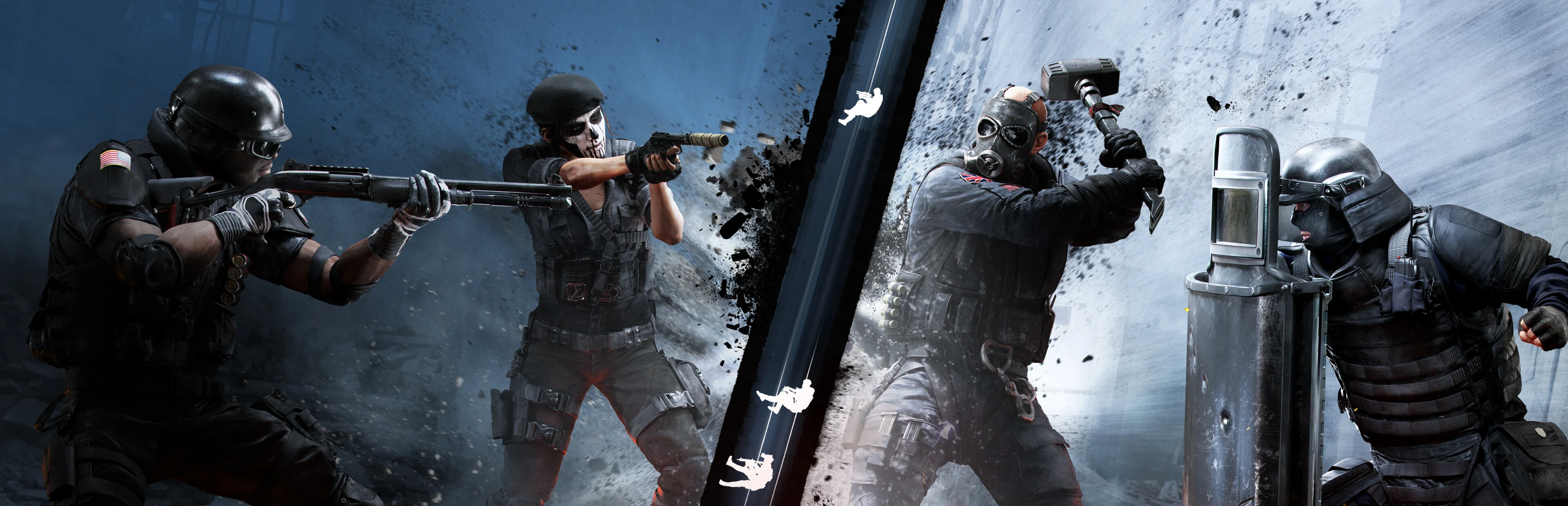
Destruction is what separates Siege from every other shooter with gadgets. The shorthand is that a surface is soft or reinforced: Sledge is described as a soft breacher who can break non-reinforced surfaces with his hammer, while a reinforced panel wants a hard-breacher with the right gadget. It is only a shorthand, though. Thermite's own tips point out that his charge opens hatches, floors and corners as well as reinforced walls, and Oryx can dash through breakable walls and climb through a hatch someone has already broken open.
The other half of that exchange is denial. Thermite's exothermic charge can be stopped by gadgets placed on the far side of the wall — Bandit's batteries, Mute's signal disruptors and Mira's black mirrors are the ones Ubisoft names — which is why a breach is usually a two-person job.
This season's targeted update to Villa moves a bomb site downstairs and turns the garage into an interior space, which rewrites the routes an attack can take through the east side of the building.
Vertical play runs on the same logic. Floors, ceilings and hatches can all be opened, so an attack can come from above or below, and rappelling lets a squad work the outside walls instead of queuing at a doorway. None of it is free: opening a wall is a loud way to announce where you are, which is why so many rounds come down to which team has to commit first.
Rounds, side swap and Pick & Ban
A core match is a series of rounds with a preparation phase before each one: defenders reinforce and hold, attackers drone and decide where to push. The attack wins a round by clearing the site or getting the defuser down, and the defence wins it by taking out the attackers or running the clock out.
Pick & Ban is part of the Ranked rule set, and Unranked runs the same rules. Both teams simultaneously ban one enemy operator per round, stacking up to six bans by the time the sides swap, at which point the banned operators reset; if a match goes to overtime, the previous bans carry over. It gives a squad a way to answer the operator that just beat them, and it means a five that only works with one star pick is a five that can be taken apart before the first shot. The arcade playlists are the exception — the current 3v3 mode has no operator bans at all.
The modes on the menu
Quick Match is the casual playlist, and Unranked is the version worth learning in: Ubisoft describes it as an exact copy of Ranked in rounds, timers, Pick & Ban and general settings, and it opens up at clearance level 20.
Dual Front is the second game that arrived with Siege X, and it does not work like the rest. It is a permanent six-versus-six mode on its own map, District, that puts attackers and defenders and their gadgets on the same team, adds respawns and in-match events, and sets both squads to secure and defend sectors rather than to win a single bomb round, with an Assignment that hands an advantage to whichever team completes it. It is still there — the current free access page lists it alongside Quick Match and Unranked — though the Year 11 roadmap marks its Season 1 Metal Gear-inspired assignment as the final Dual Front one.
Arcade rotates limited-time modes, and the current one is a 3v3 take on bomb: seven rounds at most, a thirty-second preparation phase, every attacker and defender available, no operator bans, and operator attrition. Siege Cup runs in-game tournaments on selected weekends, and there are training playlists and a shooting range for the parts you would rather practise alone. This season's event, Wasteland Circuit, leaves the shooting behind entirely and turns the game into drone racing from 23 September to 13 October.
Ranked, and who you get matched with
Ranked was rebuilt into what Ubisoft calls Ranked 3.0. There is no hidden rating any more, so your rank is what the matchmaker uses. A season starts with five placement matches, and after that every match moves your rank points based on the result and the relative strength of the two teams: beating a stronger squad pays more, and losing to a weaker one costs more. A demotion shield can hold you at zero points instead of dropping you a division. Ranked also limits who you can queue with — Copper through Emerald can play with anyone within three full ranks, while Diamond and Champion are held to two — and Champion itself now has five divisions.
Ubisoft has also announced Legend Division, a solo-queue-only playlist for the very top of the ladder, due to open at the season's mid-season update. Entry is meant to need Champion rank now and Platinum last season, a positive reputation standing, and a set of security requirements including two-step verification and the R6 ShieldGuard Secure Platform on PC. The Year 11 roadmap still lists both Legend Division and the Secure Platform as scheduled for that mid-season update, so we are treating them as an announcement rather than something we can describe as live.
One practical detail the ladder does not share: Ubisoft's own help pages note that a player's rank is different in PC matchmaking and console matchmaking, so a climb on one side of the fence does not carry across to the other.
What it costs
Access to Siege is free, and the split between free and paid is unusually clear. A free account gets Quick Match, Unranked and Dual Front with a starting selection of operators, and Ubisoft says other operators arrive as a player completes the tutorials and challenges built for newcomers. Ranked playlists, Siege Cup, additional operators and cosmetics are the parts Ubisoft lists as requiring payment.
Free does not mean stuck. Renown is earned by playing matches and can be spent on operators, and Ubisoft also runs a weekly rotating set of trial operators that anyone can try. The competitive layer is the part that stays behind the purchase, and the requirements are explicit: Ranked or Siege Cup needs a paid edition, at least clearance level 50, and at least ten attackers and ten defenders unlocked. The editions mostly sell the operator pool rather than the modes — Elite includes the 16 operators from Years 1 and 2, while Ultimate and the Ubisoft+ Premium edition include all 52 operators from Years 1 to 10, with the base operators in every tier including free.
Everything else is paid for in the game's two currencies, and this season three named operators got cheaper: Ubisoft cut Ram to 10,000 Renown or 240 R6 Credits, Skopos to 15,000 Renown or 360 R6 Credits, and Denari to 20,000 Renown or 480 R6 Credits. The current battle pass runs from 1 September to 1 December and hands out Battle Pass Tokens for completing multiplayer matches, with a premium pass at 1,200 R6 Credits and a membership above that. Not every cosmetic is behind a card, either: the community checkpoint notes that enabling two-step verification earns an Alpha Pack, and recent events have handed out items through Twitch drops.
The tradeoff is worth stating plainly. For nothing you can learn the maps, the operators you have and the whole rhythm of a round, which is a real demo rather than a trial timer, and Renown gives a free account a route to a wider roster over time. The ladder is the line: if Ranked and Siege Cup are what you are here for, that is the moment to pay.
Should you play it
Yes, if you want a shooter where the interesting decisions happen before the shooting starts: which operators you bring, which walls you open, and how much noise you are willing to make to get there. A round is short enough to lose and immediately want again.
Skip it if you want to respawn and keep moving — Dual Front and the arcade modes are the looser versions, but the round is the point. Skip it too if a paid competitive tier and a steep learning curve put you off, because that is the shape of the current deal.
Go deeper with V4mp
- Developer
- Ubisoft
- Genre
- Tactical shooter
Explore Tom Clancy's Rainbow Six Siege X further
Explore the wiki for detailed reference pages on the game's world, systems, items and locations.