
About Path of Exile 2
Path of Exile 2 has been in early access since the end of 2024 and it is still growing. The campaign runs four acts of a planned six, more classes and ascendancies are still to come, and the full release is announced for 11 December 2026, when the game goes free to play and the Duelist joins the roster. The endgame is already the deepest part of it: Atlas maps, league mechanics, trials and a working trade economy. This review covers the early-access game as it stands.
Four acts of a bigger story
Path of Exile 2 tells a new story rather than replaying the first game's. What is playable now is four acts of a planned six, plus the endgame, and two more acts are still to come. The pacing is different from the first game as well: your character grows in steps rather than leaps, the gear you find early matters, and almost every area ends with a boss that has one rule you have to learn.
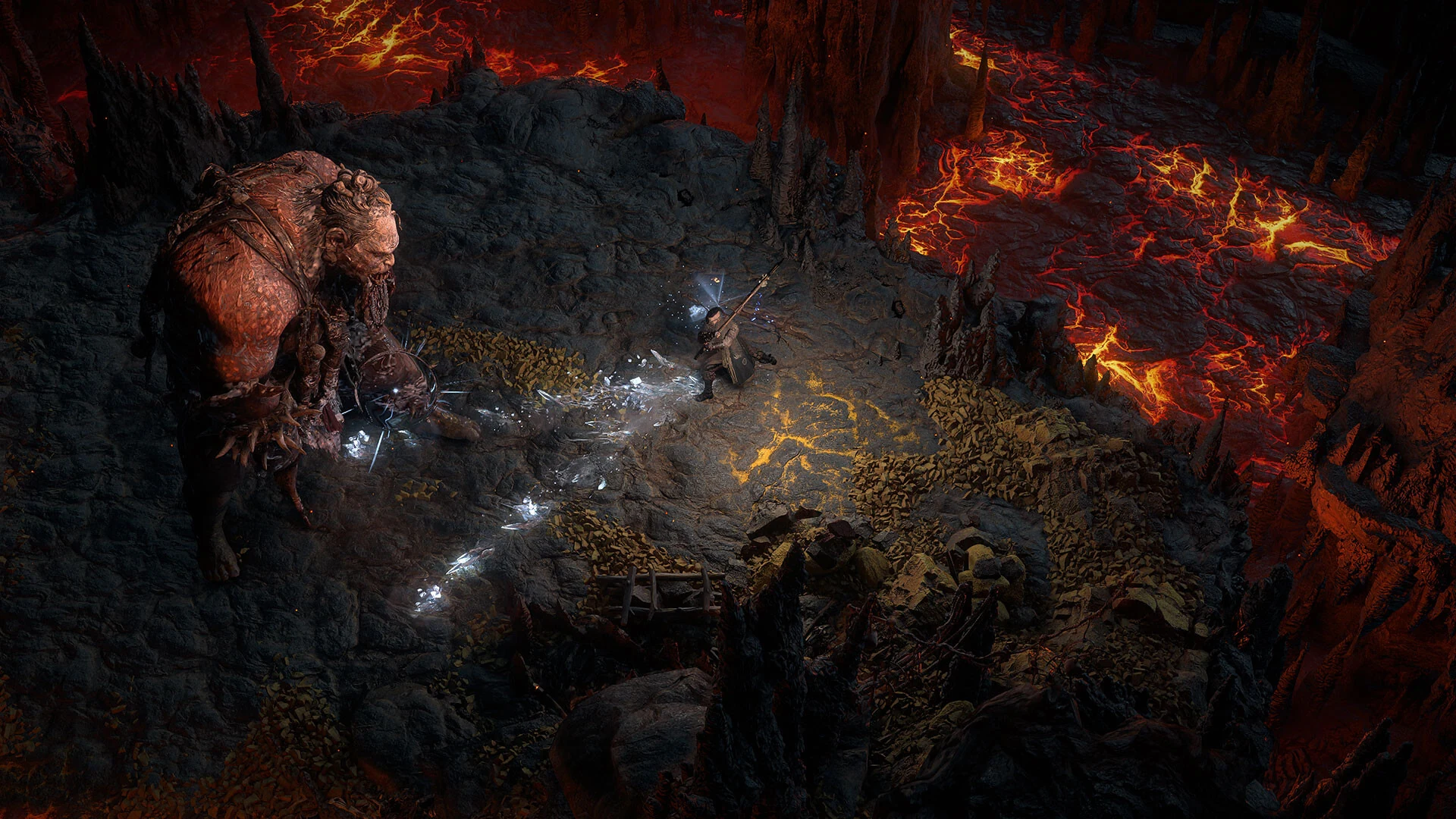
Those bosses are where the campaign earns its reputation. A fight usually asks you to read a pattern and leave the marked ground instead of trading hits until something falls over, and most of them will kill you once while you work it out. Dying puts you back at a checkpoint rather than out of the area, so the learning is cheap apart from your time.
Your class is a starting point rather than a cage. The classes come from the strength, dexterity and intelligence combinations, and you can pull skills from across them into one character, so the real decisions land on the passive tree and in the support sockets rather than at character creation.
The scale is there even in this unfinished version. Dozens of bosses are already in the game across the campaign and the endgame, and the areas around them are built to be read rather than rushed through.
What is different from the first Path of Exile
Path of Exile 2 is a separate game, and expansions are planned for both. That shows up in the systems more than the setting. Supports now socket into the skill itself instead of filling a slot on a piece of gear, so a single skill can carry a full set of supports and you are not hunting for a six-linked item to make a build work.
Your two weapon sets get their own passive points as well. Points allocated to a weapon or a damage type switch on when you use it, so a bow set and a melee set can each be specialised without paying twice.
The fight changed most. A dodge roll is a real action with a real recovery, sprinting carries its own risk, and the campaign expects you to move out of attacks instead of standing your ground. If the first game's speed was the part that never clicked for you, this is the part worth another look.
Combat starts with the roll
Dodge and sprint share a control by default: tap for the roll, hold and you keep going. That matters, because taking a hit while sprinting can knock you down. If you keep sprinting by accident, the dedicated dodge-only binding is a separate input you can assign, and it is worth doing before the fights get crowded.
A roll interrupts your own animation, which makes it the way out of a skill you should not have started. It is not protection, though, because large area attacks still land wherever they were aimed. Watch the windup, leave the marked ground, and take the opening after the swing.
Flasks are the other half of staying alive. You carry a Life flask and a Mana flask, each spending charges on use, and most Life recovery arrives over a few seconds rather than all at once. Kills refill charges and checkpoints refill the flasks, so running dry is usually something you can trace back a few rooms.
Gems, supports and a tree that swaps
Skills come from Uncut Skill Gems. The gem's level caps what it can offer, so an early one will not hand you a late-game skill, and you can also use a spare to upgrade something you already use. Put the skill on a control you can reach, then build around what it actually does.
Supports are chosen for one skill in the cutting interface, which lists what is compatible with it. Read the whole effect, because plenty of them change behaviour or add a cost rather than simply raising damage. If a support looks inactive, check your attributes first: falling short disables the support, not the skill, and the fix might be a different ring rather than a different plan.
The passive tree is the rest of a character. It brings back dual specialisation, so points can be committed to two sets that come and go with your weapons, and each class has ascendancy specialisations sitting on top. That roster is still filling out: the Duelist arrives with the full release, and more classes are planned.
Gear, resistances and the swap you regret
Base defences follow your attributes. Strength armour bases lean on Armour, dexterity bases on Evasion, intelligence bases on Energy Shield, and hybrid bases split the difference. An item's rarity does not tell you whether its modifiers suit your character.
Resistances keep you alive. Fire, cold, lightning and chaos each reduce their own damage type, and each has a cap. Your character panel shows the effective value with the uncapped total in brackets, and the bracketed number is not the one reducing damage, which is a trap worth knowing before you throw a good ring away.
Keep the old item while you try the new one. A piece that fixes a cold hole can open a fire one, and a weapon swap can drop an attribute below what a support needs, which quietly switches that support off. Soul cores socket into weapons and armour for another layer of small choices, and corrupted gear carries its own trade-offs.
The endgame is a separate game
When the campaign lets go, the Atlas takes over. You run Waystone maps, modify them, and connect them across a web of nodes, and Atlas passive trees let you push the mechanics you enjoy into being more rewarding and more dangerous. Master options sit on top of that, bending what a stretch of the Atlas spawns.
League mechanics return as sequels rather than ports. Breach, Abyss, Delirium, Ritual and Expedition each take an idea from the first game and rebuild the monsters, bosses, rewards and progression around it, and every one of them has Atlas options worth chasing.
Two trials run outside the map flow. The Trial of Sekhemas carries its own scaling so it stays relevant as your area level climbs, and the Trial of Chaos pays out in currency and soul cores for a run of rooms. Both have been reworked recently, and the Chaos trial is far less punishing than it was: you can leave a run and pick it up later, and every room now drops its own reward chest.
Bosses are the ceiling. The Arbiter fights and the Precursor Fortress are the kind of target you build a whole character around rather than stumble into, and they gate the Atlas progress the rest of the endgame assumes.
Most of the late game is gear improvement. Currency items are used on equipment as well as traded, so the work of turning drops into a character you can actually run is spent in the market as much as in maps.
Playing with other people
Groups of up to six can run the campaign and the Atlas together, and the shared content splits its rewards rather than pooling them: in Ritual, for example, each member of the party earns their own tribute and spends it on their own picks. That keeps a group from fighting over the payout, and it means a friend can bring a build that does not overlap with yours.
Leagues, fresh economies and your progress
Path of Exile 2 runs leagues the way the first game does. Every league starts a fresh economy, adds a mechanic, and sets its own challenges with league-only rewards. League characters and mechanics have different migration rules. A successful mechanic may become part of the core game, but that is not guaranteed for every league.
Forbidden Rites is the current event league. It arrived with the 0.5.5 patch, brings its own challenges and rewards, and runs until the full release, ending alongside the earlier Runes of Aldur league. You can play it on Standard, Hardcore or Solo Self-Found, and as a private league, and a Hardcore death drops you into the Standard version of the same league rather than sending you home.
The economy is part of the hobby. There is a trade site, currency items double as crafting materials, and prices move fast enough that any figure you read is stale by the time you log in. Treat the market as something to learn slowly rather than something to win.
What it costs
Right now you buy in with an early access supporter pack. After the full release the game is free to play, and nothing in the store sells power: the purchases are cosmetic, and they carry across between Path of Exile 2 and the first game.
Where it is rough
Early access means the ground moves. Within a few weeks of 0.5.5 the studio shipped two follow-up patches and ten hotfixes, and the changes were not cosmetic: the Trial of Chaos was reworked, Ritual changed, and a pile of Atlas options were reshaped.
Anything you read about a specific skill's numbers, the best mechanic to farm or what a currency item is worth is a snapshot of one patch rather than a rule. If you like the feeling of a meta settling down, this is not that game yet.
The campaign is unfinished by design. Four acts of six, more classes still to arrive, and an endgame that keeps adding mechanics faster than it retires them.
Should you play it
Start now if you like a campaign that makes you fight for ground, you enjoy planning a character more than copying one, and a league reset sounds like a fresh start rather than a punishment. The endgame is already worth the buy-in and there is enough of it to live in.
Wait for the full release if you want to start without buying early-access access. The announced launch is 11 December 2026, with more campaign content and the Duelist planned. Builds and systems will continue to change after launch.
Go deeper with V4mp
- Developer
- Grinding Gear Games
- Genre
- Action RPG
Explore Path of Exile 2 further
Explore the wiki for detailed reference pages on the game's world, systems, items and locations.