
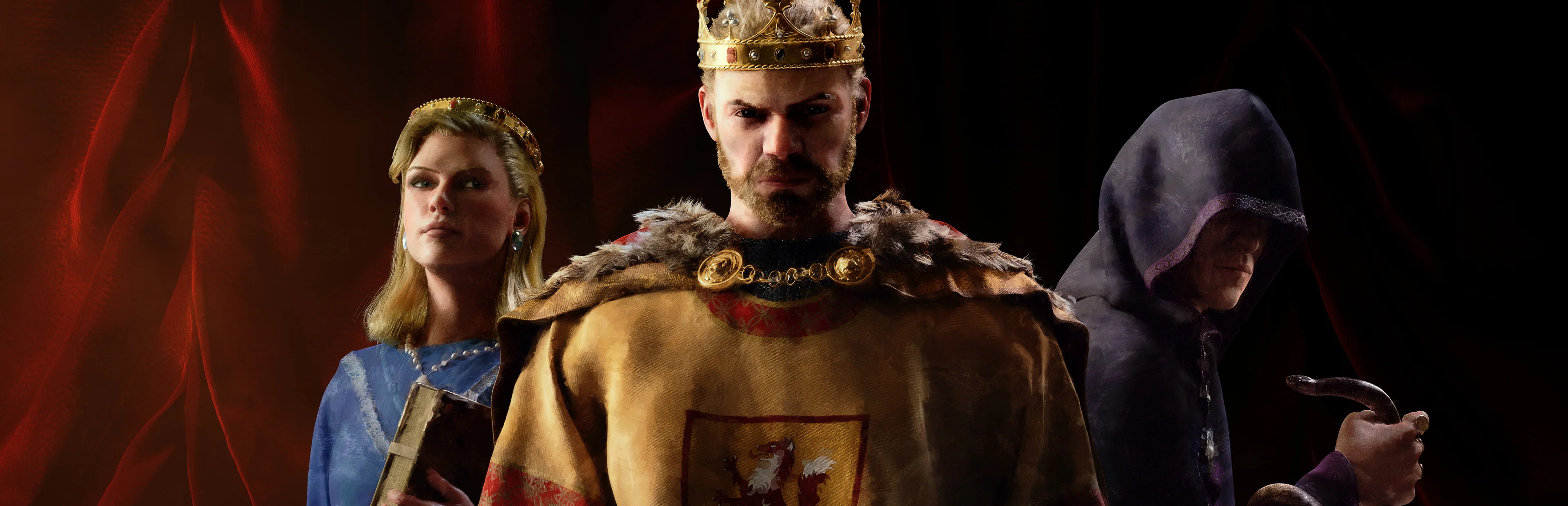
About Crusader Kings III
Paradox built a grand strategy game around people rather than units, and the decisions that follow from that are what you spend a campaign negotiating with.
The character is the instrument
The publisher's own summary of the pitch is a Middle Ages epic that spans generations, where war is only one of the tools available and real strategy needs diplomacy, mastery of your realm and cunning. Your ruler has traits and lifestyle choices that determine their actions and the schemes they can run, and the trait types are not interchangeable. The congenital ones are the bloodline traits, the genius or the lack of it that the studio's own copy says can be passed to your children. Personality and education are the other half, and they come from what a character does and how you raise them rather than from their parents. When your ruler dies, the lineage continues with new playable heirs whether you planned for them or not, and the traits you spent a life managing are partly what you are handing on.
That leads to the decisions that carry the most weight in a campaign, and the first one is succession. Titles pass by law rather than by will, and the law is something you can change: the patch notes name primogeniture and have added new succession laws over time, and the same system decides how your titles are distributed when you die. You groom your heir with guardians or educate them yourself, and if the result is not what you wanted, the game's own copy cheerfully points out that you can marry them off or despatch them by other means. Then you govern an evolving realm and hand out titles to whom you see fit, or try to usurp your liege instead. Titles given away are power held by somebody else, and that is the tension the whole game is built around.
Schemes, faith and culture
The layer under the throne is where most of a campaign actually happens. You recruit agents and unsavoury characters to undermine, blackmail or murder the people in your way, and seduction is offered as a route to power in its own right rather than a side story. Then there is religion. You can play the pious king and bring the religious powers to your side, or design your own faith, which is a system that turns a map of Christendom into something you can edit.
Culture works the same way, with innovations to bring to your people and castles and bastions to build for wealth, prestige and security. When your realm does go to war, it goes with men-at-arms units and knights, battlefield tactics, raiding, mercenaries and Holy Orders. All of those systems push on each other: a faith decision changes who will ally with you, and an alliance changes which heir is safe.
The layer that punishes you is the one under the throne. Vassals hold the land you gave them and owe you obligations in return, and the contracts behind those obligations can be renegotiated: trade a vassal's dues for their goodwill, or press a hook for something better and make an enemy. Stress is the other running cost. Your ruler has traits, and acting against them adds stress, which the studio's own diaries describe as the measure of how close a character is to a mental breakdown. A ruler who schemes against their own nature pays for it eventually, and a campaign is largely the business of deciding which payment you can afford.
Three start dates and a very long map
You begin in 867, 1066 or 1178, and the choice carries real weight. The map runs from the Nordic lands to the Horn of Africa and from the British Isles to Burma, with thousands of counties, duchies, kingdoms and empires to claim, conquer and rule. Because the campaign is generational, a start date decides who is powerful and which dynasties still have room to grow, and that is the argument for replaying the same bookmark with a different house.
Landless play is on the way in
The most interesting change in the game's recent history concerns players who have no land at all. Landless Adventurers arrived as a tertiary feature in the Roads to Power expansion, and the studio's game director has since written that they underestimated how strong the fantasy was: a custom 867-start landless adventurer became the single most popular campaign starting point by a significant margin. The response is that the Landless Adventurer character type will move into the base game, free, with the free update that accompanies the Silk & Silver expansion, which is still being documented in development diaries rather than sitting on the store as a finished thing. Some specialised camp purposes and contract types may stay with Roads to Power, and owners of that expansion keep its administrative government and Byzantine content.
It is a rare thing to see a studio take its most popular paid feature and move it into the core game, and the reasoning the director gives is the one that matters to a buyer: expansions should go deeper on what you already enjoy, never be a prerequisite for having a whole game.
Where the game stands now
Crusader Kings III is six years into a long content plan and the studio is still running development diaries for it. The most recent major base-game update, 1.19 "Scribe", is described as a maintenance and quality-of-life update that also prepares the game for the next chapter of expansion content, and it applies to all owners. Two expansions are in documented development rather than out: By God Alone, which rebuilds the Christian church and is dated for the end of September, and Silk & Silver, which adds merchants, republics and the Silk Road. Both are expansions in the sense the director describes, which is to say optional depth rather than missing pieces. The base game also ships with game rules, the toggles the studio keeps adding for individual systems, so several of the sharpest edges can be turned down before a campaign starts.
For buyers, the shape of the catalogue is worth knowing. There is a collection bundle that includes the base game plus every expansion, flavour pack and cosmetic released to date, and a starter edition that pairs the base game with one major expansion and one event pack. If you are new, the base game is a complete thing on its own, and that is a deliberate position rather than a marketing line.
Should you play it
Yes, if you want a strategy game where the interesting problem is a person rather than a build order. Succession, marriage and education are the systems you will spend the most time in, and the game is patient with players who want to spend a reign doing very little and see what happens.
Skip it if a game that interrupts your conquest with a nephew sounds like a nuisance rather than the point, or if you want the systems explained to you once and then left alone. War is a legitimate way to play, and the game will let you spend a whole reign on it; it just charges you for that in succession law, vassal management and stress rather than in battles alone.