
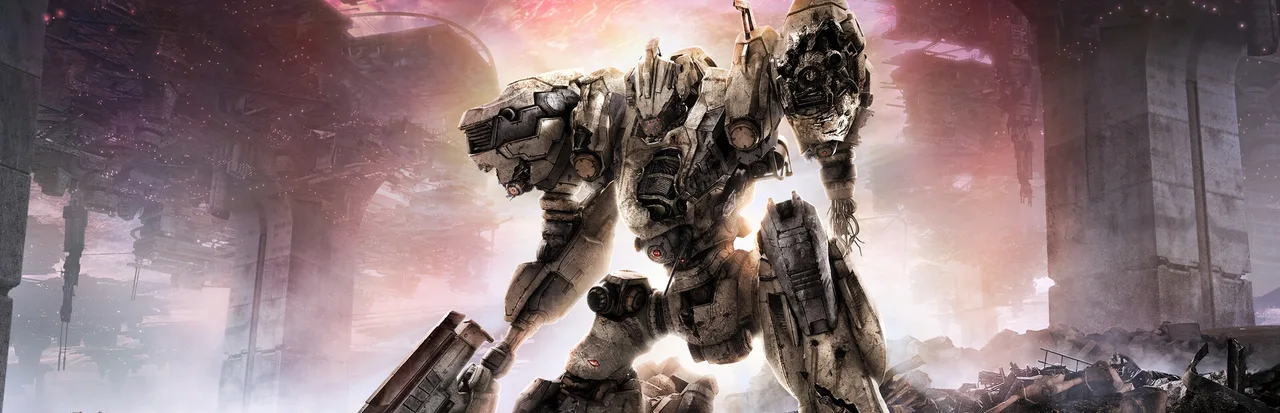
About Armored Core VI: Fires of Rubicon
Developed by FromSoftware and published by Bandai Namco Entertainment, Armored Core VI: Fires of Rubicon released on 25 August 2023 for PlayStation 4, PlayStation 5, Xbox One, Xbox Series X|S and Windows. This review covers the base game campaign and its online matches; FromSoftware has kept it alive with free updates rather than a paid expansion.
The mech is the character sheet
There is no character level in Armored Core VI. Everything your machine can do comes from the parts bolted to it: head, core, arms, legs, booster, generator and fire-control system, plus the four weapons you carry. Changing any one of those changes how the whole thing moves and fights, so the garage is part of solving a mission rather than a room you pass through on the way to one.
Two numbers decide whether a build is even legal. Every part adds weight and draws energy load, and if the generator cannot feed that draw the game will not let you launch. The weight limit is the softer of the two: go over what your legs can carry and you are grounded as well, unless you have spent chips on the Weight Control OS upgrade, which lets an overburdened machine sortie. Past that, the three damage types do different jobs. Solid rounds sit in the middle, explosives trade raw damage for impact that lingers, and energy weapons hit hardest while pushing least. A machine that feels wrong usually has one of those columns out of step with the fight in front of it.
Tuning it is cheap by design. A part you barely use sells back for exactly what you paid for it, so experimenting costs an evening rather than a save file, and the OS Tuning tree that unlocks extra actions runs on chips you win in the Arena. You can even reset that tree for COAM and take the chips back.
Boost is a second health bar
Nothing here rolls. Holding the jump to climb, a Quick Boost and an Assault Boost all pull from the EN gauge, which refills on its own and refills fast once you are standing on something. Quick Boost is the short shove: a few metres in the direction you are leaning, which is the difference between eating a missile and watching it go past. Assault Boost is the commitment, driving you at the camera or at whatever you have locked, strafing when you push sideways and cancelling when you pull back. While it runs, the small arms that fire without stopping your movement land with extra impact, and incoming hits land softer, so a charge across open ground can be a trade instead of a mistake.
The cost is that some attacks root you. Charge shots and the heavy shoulder cannons put most machines into a firing stance, and the fight keeps moving while you brace. Tank legs roll straight through it, and a tetrapod in hover mode fires the same heavy weapons without stopping, but on ordinary legs the pause is real. Learning which of your own weapons stops you is most of learning to survive.
Stagger is the whole argument
Almost everything you fire leaves a mark on the target's ACS, the attitude control system, and enough marks overload it. A staggered machine cannot act, and every hit landed while it is down counts as a direct hit for more damage. That one window is the difference between a fight that drags and a fight that ends.
Impact lands harder on an enemy that has not noticed you yet, which quietly rewards the scanner. Sweeping a level picks out enemies and containers through cover, marks the ones still facing away, and hands you the opening you want rather than the one you trip over.
Two systems keep you alive between those windows. AP is your health, and at zero the sortie ends. Repair kits are the healing button, carried in a fixed count, so every mission is partly a question of when you are willing to spend one. Your own mech carries the same downsides it inflicts: certain hits build system faults that make you easier to stagger, drain power from inside the frame, or knock out the lock-on and the radar. The HUD lists what is wrong with you. Ignoring it is how a build that looked fine starts to come apart.
Four slots and a briefing
You carry a right-hand weapon, a left-hand weapon and two shoulder units, and the two sides are not symmetrical: only the left arm takes melee weapons, and only the left shoulder takes a shield. The fire-control system then decides how well your shots track at range, so a build that wants to poke from distance and a build that wants to brawl are choosing the computer as much as the guns. Every mission is briefed before you launch, with the success condition spelled out and usually a bonus objective attached.
Then the campaign asks you to choose. Some contracts are Decisions: two clients, one slot, and finishing one locks the other out of that run. The rest of the map widens on a second and third pass, where new contracts appear and one conclusion only opens on a third playthrough.
Where Rubicon pushes back
The decision structure is the honest cost. A first run cannot show you the whole game, and it is not trying to; you are expected to come back with the knowledge and take the road you skipped. That is a strong second playthrough and a thin first one for anyone who does not replay games.
The balance has also been a moving target. Almost every post-launch note is a list of weapons being re-tuned, from the shotgun that carried launch builds through to the rifles, machine guns and coral weapons that followed it in and out of favour. A build that felt unbeatable a season ago is a build worth reading again. Online is the other wall: ranked play needs a subscription on PlayStation, and the build data you share with other players stays inside a platform family, so a PC pilot and a console pilot cannot simply hand each other a machine.
The pulse
Critics were warm on it. The platform scores landed in the mid 80s on PC and PlayStation 5 with the Xbox version a few points lower, and about nine in ten reviewers recommended it. It took Best Action Game at The Game Awards 2023 and an Award for Excellence at the Japan Game Awards the following year. On Steam it holds a Very Positive summary from more than 86,000 reviews, and it had sold three million copies by July 2024, making it the best-selling entry in a series that had been quiet for a decade.
FromSoftware has not left it behind, either. Ranked matchmaking and nameplates arrived in December 2023, balance and bug fixes kept coming through 2025, ranked seasons ran into September that year, and a PlayStation update in September 2026 tightened the game's network security. Three years on, it is the rare long-running series that came back and got its best chapter instead of its safest one.
Should you play it
Yes, if you like the shape of a FromSoftware wall and you would rather solve it in a menu than grind it down with the same weapon. The rebuild loop is the reason: lose once, change three parts, walk back in and watch the same boss fall apart. Put that against a stagger window worth building around and you have the most confident idea this studio has shipped that is not called Elden Ring.
Skip it if the world matters more to you than the fight. Rubicon 3 is a set of mission boxes rather than a place to wander, and its story mostly arrives as briefing text and radio traffic between people you never stand next to. The machines are the characters here, and the machine is the one you assembled.
On the edition question, the base game is the whole game and nothing has been held back for a season pass. A Digital Deluxe edition bundles a digital artbook and the soundtrack, and physical collector's editions were sold alongside it at launch. Everything that has come since has been a free update, so start with the standard version and put the difference into the garage.
Go deeper with V4mp
- Developer
- FromSoftware
- Genre
- Mech action
Explore Armored Core VI: Fires of Rubicon further
Explore the wiki for detailed reference pages on the game's world, systems, items and locations.