
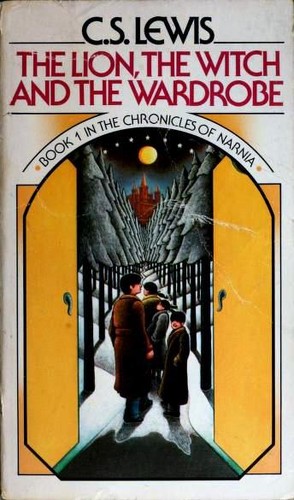
The Lion, the Witch and the Wardrobe
Four children are sent out of London during the bombing and end up in a country house with a wardrobe that opens onto a snow-covered world.
About
Spoiler notice: Full-book spoilers below, including major deaths, revelations and the ending.
The doorway into Narnia is hidden among coats in an ordinary wardrobe. Four children have been sent away from wartime London, and the house initially promises unfamiliar rooms rather than another country's fate. Beyond that cupboard, however, is a landscape whose winter is a condition of government. The White Witch has kept Narnia frozen, and the inhabitants who might resist her must live with the possibility of being turned to stone. Talking animals share the country with fauns and other mythical creatures, so a meeting in the woods can become an invitation to tea, an arrest or a political conversation. Peter, Susan, Edmund and Lucy arrive with all their sibling disagreements intact. Their usefulness is tied to a prophecy about human rulers, but finding a way into the country does not instantly make them understand its dangers.
Lucy discovers those dangers through Tumnus, a faun whose welcoming home contains a frightening obligation. He is supposed to deliver human visitors to the Witch. Tea and music become the setting for his confession, and helping Lucy escape puts him at risk himself. The others doubt Lucy because her adventure has taken no time in England. Edmund later enters Narnia and meets the Witch, who offers him enchanted Turkish Delight and the prospect of becoming a king. She needs him to bring his siblings to her, but makes that demand resemble a private opportunity for advancement. Edmund has seen enough to know Lucy was telling the truth, yet his attraction to the Queen's promises encourages him to dismiss what Tumnus has said about her. The magical temptation works alongside a recognisable wish to be more important than the other children.
Edmund makes matters worse by denying the shared discovery when they return, leaving Lucy isolated even though he knows the wardrobe leads somewhere real. The Professor takes her account seriously enough to ask whether the others have good reason to distrust her, and raises the possibility that another world might keep a different time. When all four children finally enter together, Lucy finds Tumnus's home damaged and learns that he has been arrested. A robin draws them towards a meeting with Mr Beaver, whose connection to Tumnus helps establish that he can be trusted. The Beavers explain the hope attached to Aslan, the great lion, and to the four thrones at Cair Paravel. Their private discovery becomes a responsibility towards people already suffering. Edmund slips away to find the Witch while the others realise they must leave before he can give them away.
The journey separates the Queen's salesmanship from what her rule actually offers. Edmund arrives expecting favour and receives cold treatment and poor food, while the Witch regards the missing siblings as a problem he has failed to solve. Her cruelty becomes unmistakable when she turns celebrating creatures into stone. Elsewhere, Peter, Susan and Lucy travel with the Beavers towards Aslan, and the returning signs of life suggest that the Witch's winter is losing its hold. Father Christmas brings gifts with practical uses: Peter receives a sword and shield, Susan a bow and a horn for calling help, and Lucy a healing cordial and a dagger. As the snow melts, the Witch's sledge becomes less useful. The landscape itself begins to frustrate the ruler who depended on keeping everything fixed beneath the same season.
Meeting Aslan does not remove the need for the children to act. Peter saves Susan from Maugrim, the Witch's wolf captain, and the pursuit of another wolf helps Aslan's followers reach Edmund. Once rescued, Edmund speaks privately with the lion, apologises and rejoins his siblings. The Witch nevertheless claims his life under the Deep Magic governing traitors. Aslan recognises the claim and bargains with her out of the children's hearing; they know Edmund is released, but do not know what the agreement costs. Lucy and Susan later follow the increasingly sorrowful lion towards the Stone Table. They witness his submission to the Witch's followers, who bind him, shave his mane and humiliate him before he is killed in Edmund's place. His willingness to go leaves the girls unable to understand how the figure everyone trusted can apparently have surrendered the country's best hope.
The rescue story carries a Christian pattern through that willing sacrifice, rather than simply giving the heroes a stronger weapon. It also keeps asking how wrongdoing can be recognised without making a person permanently identical with their worst act. Tumnus disobeys an evil command after admitting what he intended; Edmund must acknowledge his betrayal before returning to his family. His appetite for the Witch's sweets is entangled with envy and the desire for status, so responsibility is more complicated than saying magic made him do everything. Against her false hospitality, the Beavers' shared meal offers care without a concealed bargain. These differences give the talking-animal world a familiar moral texture. The children have to judge what welcome, loyalty and power mean in practice, while the lion's response makes forgiveness an action with a cost rather than a reassuring word.
At dawn, the Stone Table breaks and Aslan returns. He explains that a deeper law reverses death when an innocent victim willingly takes a traitor's place, a provision the Witch did not understand. With Lucy and Susan, he enters her castle and restores the petrified captives, including Tumnus, before bringing them to the battle. Edmund has broken the Witch's wand, preventing her from continuing to turn opponents to stone, but is badly wounded. Aslan kills the Witch, and Lucy uses her cordial to heal Edmund. The four siblings are crowned at Cair Paravel and grow into adult rulers over years in Narnia. Then a hunt for the White Stag leads them back towards the wardrobe, where they emerge as children into the same English moment they left. The ending preserves the reality of their long reign while removing its visible years. The country has changed them even though their family in England cannot measure the time they spent there.
Book details
- Author
- C. S. Lewis
- First published
- 1950
- Series
- The Chronicles of Narnia, book 1
- Subgenre
- Portal fantasy, Classic fantasy
- Primary genre
- Fantasy
- Tags
- No tags for this book.
- Reading order
- Also on this shelf: Prince Caspian (book 2), The Voyage of the Dawn Treader (book 3), The Silver Chair (book 4), The Horse and His Boy (book 5), The Magician's Nephew (book 6), The Last Battle (book 7)
Review
Editor profile
Baby Bat
Goodreads and social links will be added soon.
- Goodreads — link coming soon
- Social media — link coming soon