
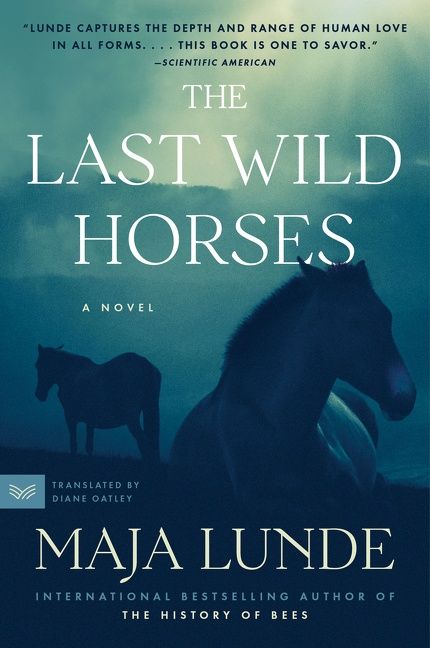
The Last Wild Horses
In 1881, zoologist Mikhail Kovrov sets out for Mongolia after encountering the remains of a rare wild horse.
About
Spoiler notice: Spoilers for the opening premise and the three timelines’ central conflicts; major late revelations and the ending are not disclosed.
The Last Wild Horses follows the fate of Przewalski’s horses through three very different periods. What begins as a nineteenth-century scientific search becomes, generations later, a conservation effort and then the daily work of protecting one pregnant mare. Maja Lunde connects these histories through the animal itself and through families whose obligations do not always agree. Across its three timelines, the book follows human attempts to understand, capture, conserve and live alongside Przewalski’s horses, animals known in the story by the name takhi as well. The changing settings give the species’ history a human frame: scientific curiosity in nineteenth-century Russia, conservation work in the late twentieth century, and a family’s precarious life in a climate-damaged future.
The earliest strand begins in St Petersburg in 1881. Zoologist Mikhail Kovrov is presented with the remains of a wild horse that resembles a lineage thought to have disappeared. The discovery unsettles the boundary between an object of study and a living animal population that may still exist elsewhere. Mikhail begins to imagine an expedition to Mongolia, where the horses may be found. His plans bring him into contact with the adventurer Wilhelm Wolff, whose expertise makes the journey possible and whose presence also challenges Mikhail’s assumptions about himself. The narrative links natural history with personal change: the expedition concerns the survival of a species, but the people undertaking it are not untouched observers.
A second strand takes place in Mongolia in 1992. Karin, a veterinarian, has devoted years to bringing Przewalski’s horses from Europe back to the country where they once lived in the wild. She travels with her son Mathias, whose reasons for joining the journey are bound up with their difficult relationship. Karin’s conservation work is not portrayed as a clean division between professional purpose and private life. Her commitment to the horses has shaped her choices as a parent, and Mathias arrives with his own history and needs. The field project therefore carries more than the practical question of reintroducing animals: it places a mother and son together in a landscape and mission that expose what each believes the other has given, or failed to give.
The future strand shifts to Norway in 2064, where ecological and social instability have made ordinary security fragile. Eva remains on her family’s farm while her teenage daughter Isa wants them to leave and join other people seeking a more sustainable place to live. Eva is also caring for a pregnant wild mare, and the approaching foal makes the decision immediate rather than theoretical. The farm is not simply a possession to defend; it contains the animals and responsibilities that give Eva reasons to stay. Yet remaining also has costs for her daughter. Their disagreement gives the speculative future a domestic scale, with climate disruption registering through food, power, movement and competing ideas of what a family can protect.
Louise’s unexpected arrival adds a further uncertainty to Eva’s already difficult position. Louise needs a place to stay, yet her intentions are difficult for the family to read. Her presence may alter the relationships on the farm at a moment when Eva and Isa already disagree about whether to remain there. Her arrival also brings the novel’s central concerns into the household. The people who need care, the animals under Eva’s protection and the future Isa wants cannot be treated as separate questions, even when their needs pull in different directions.
The three periods are connected by more than the recurrence of a particular animal. Each asks what it means to act for a species whose survival depends on human decisions, and each gives those decisions a different context. Mikhail encounters the horse through scientific remains and the possibility of discovery; Karin works directly on a planned return to Mongolia; Eva faces the daily obligations of caring for a mare and foal in a collapsing environment. The shifts in time also change the meaning of intervention. Exploration, conservation and care may all be undertaken with good intentions, yet the relationships around them can be unequal, costly or difficult to sustain. The novel places those complications alongside the urgency of preventing loss.
Lunde’s structure lets the wild horses function as a thread between histories without making the human stories interchangeable. The nineteenth-century expedition has the movement of travel and natural inquiry; Karin’s 1992 journey joins conservation to a strained family bond; Eva’s future is shaped by displacement, scarcity and a decision about home. In each case, people respond to a vulnerable animal population while also negotiating their own attachments and limits. The result is a multigenerational environmental novel whose scope runs from Mongolia to Russia and Norway, and from the past into speculative climate crisis. Its recurring question is not only whether the horses can survive, but how human care changes when responsibility reaches beyond one household, one generation or one place.
Book details
- Author
- Maja Lunde
- First published
- 2019
- Series
- The Climate Quartet, book 3
- Subgenre
- Climate fiction, Historical fiction, Post-apocalyptic
- Primary genre
- Sci-Fi, Historical Fiction, Literary Fiction
- Tags
- No tags for this book.
- Reading order
- Also on this shelf: The End of the Ocean (book 2), The Dream of a Tree (book 4)
Review
Editor profile
Baby Bat
Goodreads and social links will be added soon.
- Goodreads — link coming soon
- Social media — link coming soon