
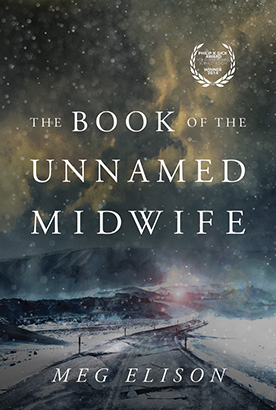
The Book of the Unnamed Midwife
After a fever devastates the world and makes childbirth deadly, an unnamed midwife wakes to a landscape where women are scarce and few are safe.
About
Spoiler notice: Contains premise spoilers and discussion of sexual violence, trafficking and reproductive danger, as flagged by the author. This account does not reveal the novel’s later journey or ending.
The Book of the Unnamed Midwife begins after a fever has broken the world. The protagonist falls asleep before the catastrophe and wakes to find civilization devastated. The illness has killed women and children in enormous numbers, and childbirth has become dangerous for both mother and infant. That imbalance reshapes every ordinary question of safety, movement and community. Rather than treating the end of the world as a neutral backdrop, Meg Elison makes its effects unequal: the same collapse that removes familiar institutions also changes how women are valued and what risks follow them. The central character is a trained midwife, so the crisis reaches directly into the work she knows how to do and the future others expect her to serve.
The woman at the centre of the novel is never given a personal name. Her profession supplies the title, while her anonymity becomes part of how she moves through danger. The publisher describes her travelling through the remains of the world, dressing in men’s clothing, using false names and avoiding people when she can. These measures are practical responses to a landscape where women are scarce and groups of men may seek control over survivors. The disguise does not erase the danger or make her invulnerable; it gives her ways to manage what strangers can know about her. The book’s premise therefore ties identity to survival: names and appearance can be withheld, changed or used strategically when being recognized may carry a cost.
Midwifery places care and bodily risk at the centre of this speculative disaster. The fever makes childbirth itself deadly, while the remaining women face threats of coercion and violence. Elison’s 2014 introduction to the novel explicitly warns readers about rape, gang rape, human trafficking and female genital mutilation. Those subjects are part of the work’s territory, not incidental atmosphere, and the notice matters for readers deciding whether to enter the story. The protagonist’s skills are connected to birth and reproductive health, but the premise does not reduce her to a symbol of motherhood. She is also a person trying to preserve her own freedom in a world that treats women as resources for other people’s plans.
Elison has described the novel as a response to a gap she saw in post-apocalyptic fiction: the collapse of law and modern infrastructure does not affect women in the same way it affects men. In her account of the book’s origins, she connects the premise to lost access to birth control, the loss of bodily autonomy and the possibility that women might be hunted as commodities. That framing helps explain why this is not simply a survival story about food, shelter and physical endurance. Questions of who controls bodies, who can move safely and whose needs count become part of what survival means. The imagined disaster magnifies social structures that can otherwise be mistaken for permanent or natural.
The novel’s world is organized around scarcity, but scarcity does not produce one uniform response. The publisher’s description points to clans of men who seek control over the few women who remain, and it presents the protagonist’s solitary precautions as an effort to keep her independence. At the same time, its framing promises that her path will lead beyond the pursuit of a pale imitation of freedom. That tension gives the premise its larger direction: survival may require avoiding other people, yet rebuilding a future cannot be accomplished by isolation alone. The story asks what kinds of social arrangements might emerge after established protections disappear, while leaving readers to follow the character’s choices rather than offering a simple blueprint for a better order.
The title’s emphasis on an unnamed midwife also places the work of recording and remembering in view. In a later author’s note about the series, Elison refers to the midwife’s diaries as the material that a later character, Flora, reads. That detail shows how one person’s account can outlast the world in which it was written and become part of how later communities understand the past. The book’s first-person premise is not established by the publisher’s short description, so this account does not assume a specific narrative form or describe diary passages. What can be said is that the series treats the midwife’s record as consequential beyond her immediate journey: experience becomes evidence that can be carried forward.
The Book of the Unnamed Midwife is the first volume in Elison’s Road to Nowhere series. Elison has said that the series moves through dystopia toward whatever may exist on its other side, a description that places this novel’s ruined setting within a longer question about what people build after collapse. Its award recognition followed quickly: the author identifies the novel as her debut and notes that it won the 2014 Philip K. Dick Award. Those facts help locate the book as both an early work in a continuing fictional world and a novel that brought its author wider attention. The selected 47North paperback appeared later, in 2016, distinct from the novel’s initial 2014 publication by Sybaritic Press.
The result is a post-apocalyptic novel whose central danger is not only the loss of familiar comforts but the reordering of power around gender, reproduction and movement. Its unnamed protagonist must decide how much contact with others she can risk, what her knowledge is for, and whether preserving herself can coexist with helping humanity continue. The publisher’s description points toward a role larger than escape, while Elison’s own explanation makes clear why the premise centres women’s autonomy. Readers should expect material about sexual violence, trafficking and reproductive danger, alongside a question that extends beyond catastrophe: when old institutions fail, who gets to shape the rules that replace them?
Book details
- Author
- Meg Elison
- First published
- 2014
- Series
- The Road to Nowhere, book 1
- Subgenre
- Dystopian, Post-apocalyptic
- Primary genre
- Sci-Fi
- Tags
- No tags for this book.
- Reading order
- Also on this shelf: The Book of Etta (book 2), The Book of Flora (book 3)
Review
Editor profile
Baby Bat
Goodreads and social links will be added soon.
- Goodreads — link coming soon
- Social media — link coming soon