
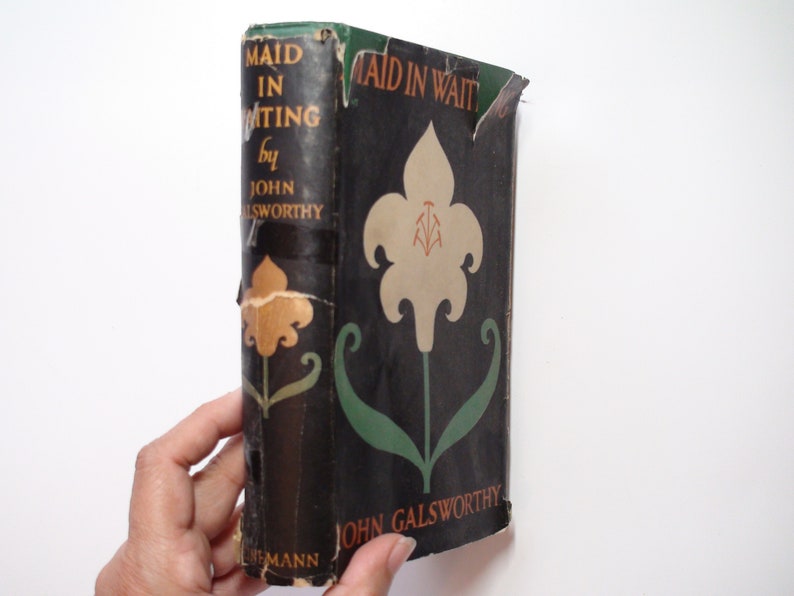
Maid in Waiting
After the Bishop of Porthminster dies, the Cherrell family gathers at Condaford as Dinny becomes caught up in two crises.
About
Spoiler notice: This overview discusses Hubert’s extradition case, Captain Ferse’s death and Dinny’s position at the ending.
Maid in Waiting opens beside a dying bishop, whose last concerns include the conduct of his relatives and the reputation of their name. Cuthbert Cherrell has spent decades representing the Church, and even his farewell to his nephew Adrian becomes advice about duty, marriage and avoiding public scandal. John Galsworthy makes this an introduction to a family whose traditions provide both solidarity and restrictions. The Cherrells move between their country home at Condaford and a London of clubs, drawing rooms, government offices and personal connections. They understand themselves through generations of service, but that inherited confidence will encounter institutions that cannot simply accept a family’s assurances. Published in 1931, the novel begins the End of the Chapter trilogy, with Dinny Cherrell increasingly at the centre of its entangled responsibilities.
Dinny’s importance comes through her ability to attend to other people. She listens, carries messages, makes visits and notices the feeling behind a composed expression. Her humour helps her move among relatives whose assumptions are not identical, although they share a strong attachment to their circle. Sir Lawrence and Lady Mont bring affectionate comedy into this world, while Adrian’s private situation exposes the difficulty of reconciling inherited rules with immediate sympathy. The title gathers meaning around Dinny’s availability: she is a young woman with a future of her own, yet emergencies repeatedly make her the person who waits, mediates and supports. Condaford offers emotional belonging as well as obligations, and the prospect of being uprooted from it is more disturbing to her than outsiders necessarily understand.
The most public emergency concerns her brother Hubert. He wants to marry Jean Tasburgh, but learns that the authorities are pursuing his extradition to Bolivia on a murder charge. He says that the man he shot attacked him, and a scar on his arm appears to support his account of self-defence. The family’s conviction that he is innocent does not settle the legal question. Conflicting statements must be assessed, and evidence supplied from abroad can change the position between hearings. Professor Hallorsen’s assistance and the testimony surrounding the expedition become important, while relatives search for influential people willing to listen. Galsworthy lets their loyalty be moving without concealing its social resources: this family knows names, doors and intermediaries that many defendants would have no means of reaching.
Jean refuses to let the case suspend every decision about her life. She marries Hubert while the danger remains and pursues help with a directness that can unsettle the people she approaches. Her energy gives Dinny an ally, though it also makes extreme action imaginable when official channels appear inadequate. Alongside this struggle, another household needs protection. Diana Ferse’s husband returns with behaviour that frightens the people around him; his control of communications and his confinement of Jean in a room make the danger immediate. Dinny becomes involved in finding safety for Diana and the children. Adrian’s affection for Diana gives the situation a further complication, connecting the bishop’s opening warning about an unavailable woman to the practical question of how anyone should respond to suffering within a marriage.
Captain Ferse’s disappearance ends in an inquest. Dinny must describe what she witnessed, taking private fear into the formal setting of testimony. The jury finds that Ferse died by falling into a chalk pit, and the coroner records death by misadventure. That conclusion supplies a public classification without turning the preceding distress into an uncomplicated episode. The novel repeatedly places people in rooms where another person’s decision will define what can happen next: a magistrate considers evidence, a minister must decide whether to surrender a prisoner, and a coroner’s proceedings organize a household’s ordeal into an official account. Dinny’s knowledge comes from care and proximity, but she still has to translate it into forms that these authorities can hear.
Hubert’s later hearing brings the distinction between loyalty and legal procedure into sharp focus. The magistrate explains that he is considering the requirements for extradition, rather than conducting a trial that establishes Hubert’s guilt, and commits him to prison pending the surrender decision. Alan Tasburgh and Jean prepare a possible escape scheme if the authorities will send him away. It remains a contingency, involving daring arrangements that would expose others to serious consequences. Dinny meanwhile helps put Hubert’s diary before the Home Secretary and answers questions about whether it was written at the time of the expedition. Her distress does not magically determine the outcome: Ferrar tells her that the minister had already reached his decision, with the magistrate’s involvement important. Hubert will be released through the official process.
The final chapter changes the emotional atmosphere from waiting to relief. Dinny returns to Condaford exhilarated by Hubert’s freedom, her parents’ reprieve and Jean’s happiness. The unused escape plan can now be discussed with an almost comic attention to its expense and ingenuity. Alan’s hopes for Dinny remain less settled; she offers affection and a promise to see him again, rather than an engagement that closes her story. Galsworthy ends with another sort of observation when Dinny sits for a miniature painter commissioned by Sir Lawrence. A woman who has spent the novel attending to others is briefly its visible subject, though even this scene turns towards her pleasure in music. The family crisis has ended, while the life of the person who helped carry it remains open.
Book details
- Author
- John Galsworthy
- First published
- 1931
- Series
- The End of the Chapter, book 1
- Subgenre
- Literary fiction, Modern classics
- Primary genre
- Literary Fiction
- Tags
- No tags for this book.
- Reading order
- Also on this shelf: Flowering Wilderness (book 2), Over the River (book 3)
Review
Editor profile
Baby Bat
Goodreads and social links will be added soon.
- Goodreads — link coming soon
- Social media — link coming soon