
Build a First Base You Can Keep Supplied
On this page
Build a small base you can finish and keep supplied. Leave space for a Sleeping Bag, storage and a Tool Cupboard, then secure the enclosure before adding extra rooms. These steps cover vanilla Rust on PC; server settings can change upkeep and other rules.
Place the shell and secure access
Equip the Building Plan and use its right-click menu to select construction pieces. Equip a Hammer and right-click a building piece to choose an upgrade. Before filling the room with storage, walk between the entrance and the space reserved for your cupboard. Keep that route usable.
Before treating the shell as finished, use the Hammer’s upgrade menu on its twig foundations, walls and roof pieces. Choose a material you can supply for upkeep; stone is a useful starter target if you can keep stone in the cupboard. Check each piece rather than leaving a twig section in an otherwise upgraded enclosure. The Hammer handles material upgrades, while the TC guide explains the materials each structure consumes.
Finish the enclosure and entrance before expanding. Consider a two-door entrance, often called an airlock, so you can shut one door before opening the other. Practise walking through it and closing each door. It gives you another barrier at the entrance, but it cannot guarantee the base will survive an attack.
A Key Lock can secure a door. The player who placed it can open and close the door without carrying a key; keys can be created for other players, and a lost key can give someone unwanted access. Facepunch explains the owner-access rule here. For shared access, a Code Lock uses a four-digit code. Check the lock is locked before leaving.
Put the cupboard inside your defences
The Tool Cupboard, or TC, costs 1,000 wood, needs no workbench and is known by default. Place it inside and lock it. You are automatically authorized when you place it; teammates must authorize separately. Check that each intended builder has access instead of assuming team membership handles it.
The TC’s inventory shows your upkeep cost per 24 hours and the remaining protected time. Supply the materials it asks for. Building parts add upkeep; Sleeping Bags do not. Check that display again after expanding or upgrading. The Tool Cupboard guide explains authorization, upkeep and decay.
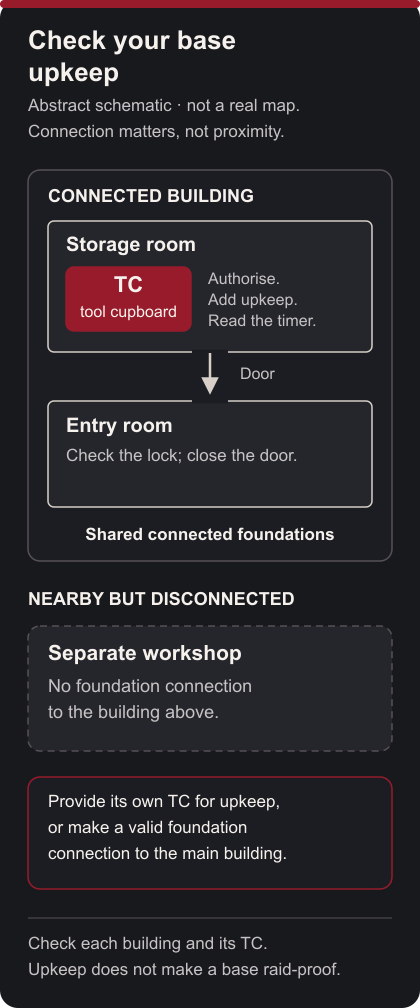
Check what your cupboard actually covers
Building privilege follows the foundations of the connected building. A separate nearby building needs its own TC or a foundation connection. Proximity alone does not maintain a detached workshop. Players without authorization can still place twig floors and wooden ladders, so building privilege is not a complete shield around your base. See the privilege and separate-building examples.
Allow for shared access when checking upkeep
Default upkeep includes an extra group charge for larger groups. The first four counted players add no group tax. The count includes TC authorization, code-lock access including guest codes, and players removed from either within the previous 24 hours. Hover over the TC’s upkeep cost to see the group tax. Server owners can change or disable this scaling. Facepunch’s group-upkeep explanation covers these rules.
Before logging off, close the doors, check their locks, and inspect the TC’s protected time. If the base needs more upkeep, finish that supply trip before starting another room. Keep your early gathering goals small, then budget for workbench progression once you can maintain what you already own.