
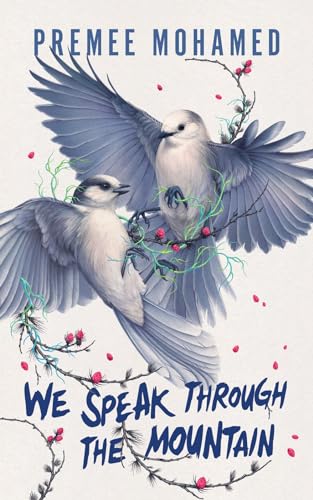
We Speak Through the Mountain
Nineteen-year-old Reid Graham crosses Alberta’s climate-ravaged Rocky Mountains to reach Howse University, a domed refuge preserving resources and institutions from before the collapse.
About
Spoiler notice: Spoilers are limited to the publisher-described premise and early conflicts: Reid’s journey to Howse, her arrival and adjustment there, the university’s withholding of resources, and news from home. This account avoids later revelations and the ending.
We Speak Through the Mountain continues the story of Reid Graham after the decision that ended The Annual Migration of Clouds. At nineteen, Reid travels alone through the climate-damaged Rocky Mountains of Alberta to reach Howse University, one of the domed enclaves that preserve fragments of pre-collapse society. The journey is a physical passage into a world she has imagined as a place of learning and possibility. She expects that education will give her knowledge she can eventually carry back to help her community. The sequel moves the series’ focus from the cost of leaving to the responsibilities that begin once Reid reaches the place she had hoped to enter.
Howse is not simply a safe destination. Its resources and preserved systems distinguish it sharply from the communities beyond its dome, where the consequences of climate crisis and social collapse remain immediate. Reid arrives as an outsider with direct knowledge of that wider hardship, while the people who have grown up inside the enclave have a different relationship to scarcity and risk. Her transition into classes and student life therefore involves more than learning unfamiliar routines. She must understand the assumptions that make Howse’s order seem normal to its residents, and decide what she can accept when that order depends on a boundary between those protected inside and people left outside.
Her place at Howse gives Reid a route toward a future, but it does not erase what she has left behind. She carries guilt about events before her departure and worries about her family and the people who made a home with her. The university’s promise of education is tied to a plan she has formed for herself: learn as much as she can, then use it beyond Howse. This intention makes her a student with a purpose that reaches outside the institution. As she settles in, the question becomes whether the university sees knowledge as something that should travel, or as a resource whose value depends on keeping it within the dome.
Reid’s questions concern the material gap as much as the social one. Howse possesses resources that could matter to people living beyond its walls, yet the institution deliberately withholds what it has from the rest of humanity. That refusal makes the enclave’s claim to be a refuge harder for Reid to accept without qualification. A place can preserve learning and provide care to those admitted while still maintaining conditions that deny similar help to others. The story uses Reid’s position between these worlds to make institutional choices visible: withholding aid is itself an action, even when it is described as policy, protection, or simply the way things have always been done.
Her encounters with other students sharpen this conflict. Reid must form connections in a community whose habits and priorities differ from the cooperative life she knew at home. She is trying to study and adapt, but she also watches how people around her interpret the world outside the dome. The contrast is not just between comfort and hardship; it is between ways of understanding obligation. Reid’s experience makes it difficult for her to treat distant suffering as an abstraction. Meanwhile, the sheltered students’ relative security gives them room to regard the existing arrangement as stable. Their everyday interactions turn the ethical problem into a social one that Reid has to navigate rather than solve from a distance.
Cad, the parasitic fungus associated with Reid’s chronic illness, remains part of this story, but her situation at Howse changes the context in which it is understood. The university’s medical knowledge and health systems give her access to care that was unavailable at home. That possibility brings relief, while also raising questions about dependence and power: who controls treatment, what knowledge is shared, and how much agency a patient has inside an institution that sets the terms. The sequel develops the illness as more than a private obstacle or a marker of vulnerability. It connects Reid’s body to the broader struggle over who receives the benefits of preserved science and medicine.
News from home presses the distance between Reid’s two lives into the foreground. Her choice is no longer only about whether she belongs at Howse or whether she can complete her studies. She has family ties and commitments beyond the dome, and what happens there matters even as she learns how the university operates. The publisher’s description frames the resulting decision as one involving Reid herself, her family, and the damaged world around them. That framing preserves the difficulty of her position: returning, staying, or trying to change Howse each carries consequences for people she cares about, and none can be considered apart from the unequal conditions that shaped the choice.
As the second volume in The Annual Migration of Clouds series, We Speak Through the Mountain expands the setting from a struggling community to the institution that holds knowledge and resources behind its walls. It follows Reid’s movement through a protected world without treating arrival as a simple resolution. Her education, illness, relationships, and obligations all become ways of testing what the dome is for and whom its security serves. This account stays with the publisher-described setup and central conflict; it does not recount the later course of the story. Its defining tension is already clear in Reid’s situation: whether a future built on learning can be separated from the responsibility to share what that learning makes possible.
Book details
- Author
- Premee Mohamed
- First published
- 2024
- Series
- The Annual Migration of Clouds, book 2
- Subgenre
- Climate fiction, Post-apocalyptic, Literary fiction
- Primary genre
- Sci-Fi, Literary Fiction
- Tags
- No tags for this book.
- Reading order
- Also on this shelf: The Annual Migration of Clouds (book 1)
Review
Editor profile
Baby Bat
Goodreads and social links will be added soon.
- Goodreads — link coming soon
- Social media — link coming soon