
The Annual Migration of Clouds
After climate disasters have fractured society, Reid Graham lives in an Alberta community where food is scarce, industry has ended and an unusual fungal parasite called Cad affects people’s bodies and minds.
About
Spoiler notice: Spoilers are limited to the publisher-described setup and publicly described early conflicts: Reid’s acceptance, Cad’s effects, her mother and Henryk, and the community’s seasonal survival work. This account does not cover the novella’s later events or ending.
The Annual Migration of Clouds is set in an Alberta where climate collapse has become the conditions of ordinary life. Reid Graham and the people around her make a subsistence living on the remains of a university campus, while the land brings dust storms, landslides, wildfires and sudden changes. The novella’s post-apocalyptic frame therefore works through local pressures: how to get through another season, how to maintain a community with limited resources, and how to imagine a future when much of the old social order has disappeared. The story focuses on Reid as she weighs a place at a distant university against her commitments at home.
That choice has a concrete geography. Reid already lives among the remnants of a campus, repurposed by people who have made a home from what survived. The institution that accepts her is far away, secretive and resource-rich; it promises access to education and a different set of possibilities. The two campuses place learning in two distinct contexts: one embedded in a community’s daily work, the other beyond its reach. Reid’s decision is consequently about more than leaving a familiar place. It asks what kind of future can be built where she is, what the distant institution can offer, and what it means to seek individual opportunity when the people around her still need her contribution.
The novella also ties social pressure to Reid’s body. She lives with Cadastrulamyces, or Cad, a fungal illness that can remain dormant and later cause involuntary muscular responses and audio-sensorial effects. Her mother is affected as well. The possibility that Cad may influence Reid’s behaviour makes her effort to judge her own wishes harder: leaving might be her considered choice, an impulse shaped by fear, or something she cannot confidently attribute to herself. The question of agency is not detached from the community dilemma. Reid has to decide what she wants while also considering how her illness affects the people who may depend on her.
Reid’s relationships give that uncertainty a domestic shape. Her mother argues with her about the future, and her bond with her best friend Henryk changes as the possibility of departure becomes real. These are not merely reactions around a single opportunity: each relationship contains its own history of reliance and affection. The story places personal growth beside mutual obligation and lets the two pull in different directions. The available descriptions emphasize uncertainty rather than a simple answer. Reid can value the people who make her home and still want to discover what lies beyond it; her illness and the material limits around her make both sides of the choice more difficult to separate.
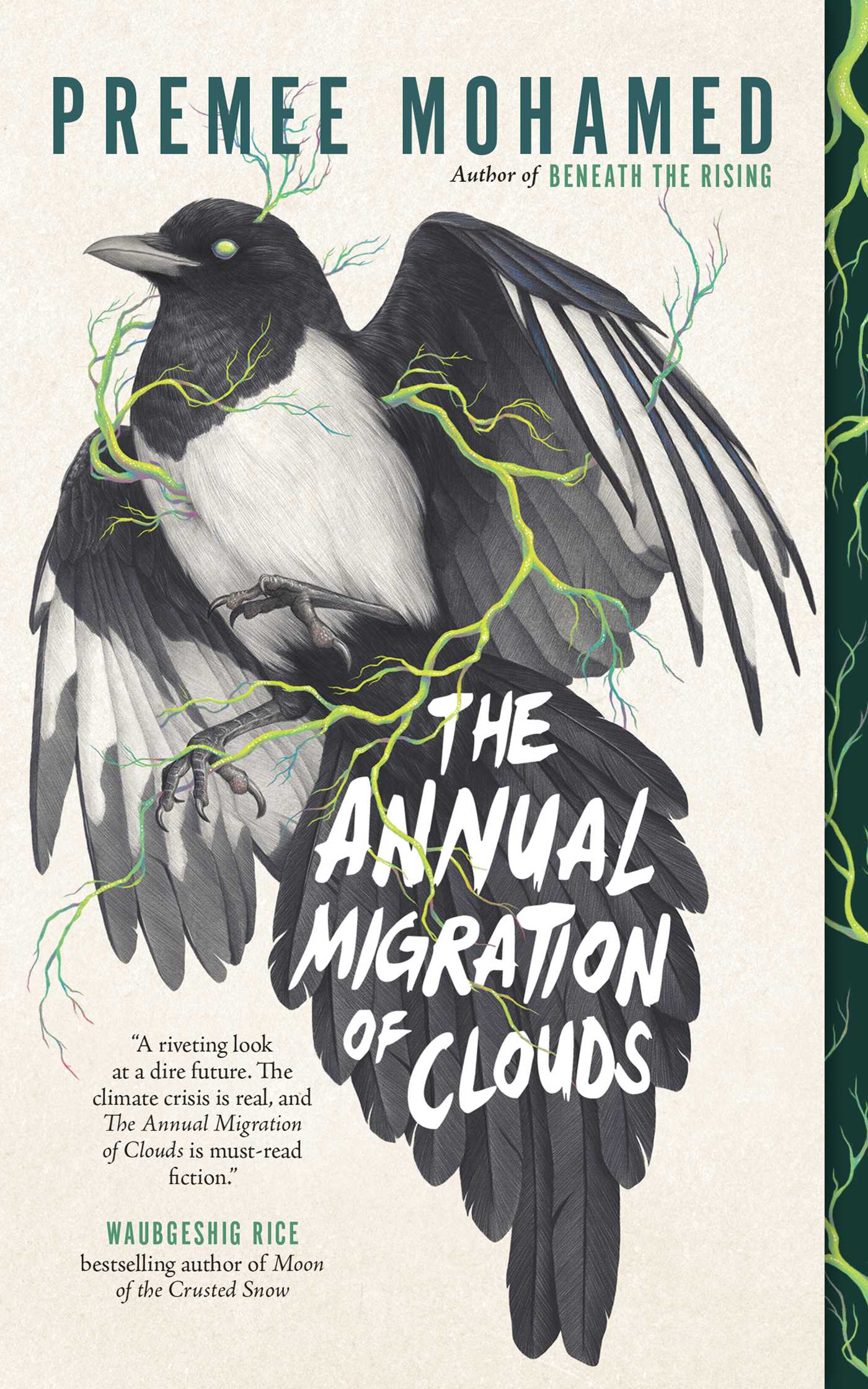
Survival in Reid’s community also follows a seasonal rhythm. The approach of spring, called the Thaw, brings shared duties for getting through the year. A community credo that no one can be spared gives that work a moral edge: each person matters because the group’s survival depends on people taking part. The novella’s small details, including resilient birds such as sparrows, pigeons, chickadees and magpies, sit within this same world of endurance. They offer recurring images of life continuing in a damaged landscape. The story’s title and its attention to returning clouds bring the environment into view as a changing presence rather than a distant backdrop.
The clouds appear in sharply different circumstances: a cloud of dust can gather when the community’s topsoil blows away, while clouds also form part of the background to a magpie painting Reid receives. This pairing brings environmental change into contact with memory and art. The natural world can threaten the conditions of daily life, yet it also supplies images people notice, preserve and use to think about their surroundings. The title’s migration suggests recurrence and movement, while Reid’s world is marked by forces that do not stay fixed. That pattern extends to people and institutions too: a campus can become a home after its original purpose has ended, and a supposedly secure future elsewhere may be inaccessible to most.
Cad complicates the boundaries between an individual and the world they inhabit. Its effects make Reid question which thoughts or impulses are entirely her own, while the illness is also hereditary and shared within her family and community. In this way, physical vulnerability and social responsibility meet: no one is wholly separate from the ties, histories and conditions that shape them. The novella does not reduce that entanglement to a neat answer about whether Reid should stay or go. Instead, its speculative premise puts pressure on familiar ideas of independence, progress and self-determination, asking how choices can remain personal when they are made within relationships and material limits.
The Annual Migration of Clouds is the first volume in a series of the same name, but this account stops at the conflicts established in the novella’s opening premise. Those include Reid’s acceptance to a distant university, the changing relationship with her mother and Henryk, Cad’s uncertain influence, and the community’s seasonal work. Together they give the story a close focus within a broad climate-altered setting. The disaster is visible in the land and in the scarcity around the characters, but the central questions emerge from everyday life: who can leave, who is needed, how knowledge and opportunity are shared, and what forms of care make a future possible.
Book details
- Author
- Premee Mohamed
- First published
- 2021
- Series
- The Annual Migration of Clouds, book 1
- Subgenre
- Climate fiction, Post-apocalyptic, Literary fiction
- Primary genre
- Sci-Fi, Literary Fiction
- Tags
- No tags for this book.
- Reading order
- Also on this shelf: We Speak Through the Mountain (book 2)
Review
Editor profile
Baby Bat
Goodreads and social links will be added soon.
- Goodreads — link coming soon
- Social media — link coming soon