
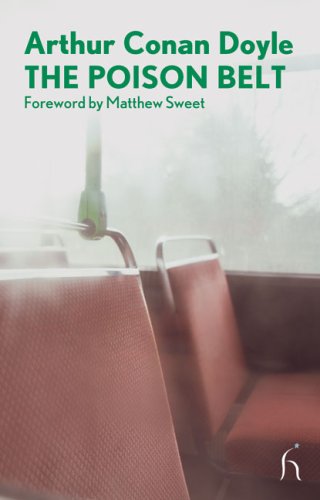
The Poison Belt
Journalist Edward Malone joins Professor Challenger, Professor Summerlee and Lord John Roxton at Challenger's Sussex home, where an expected cosmic catastrophe soon becomes immediate.
About
Spoiler notice: This overview discusses the apparent extinction, the return of consciousness and losses reported at the ending.
Edward Malone returns to Professor Challenger's company under circumstances very different from the expedition in The Lost World. The Poison Belt reunites him with Challenger, Professor Summerlee and Lord John Roxton, but brings the danger to an English house instead of sending the companions into a remote landscape. Malone again supplies the account, this time as a journalist trying to preserve what may be humanity's final experience. The reunion initially leaves room for familiar arguments and the comedy of Challenger's certainty. A strange request to bring oxygen cylinders also gives it an urgency the visitors do not yet fully understand. Ordinary travel towards a country-house gathering gradually becomes an approach to a catastrophe nobody can avoid by travelling somewhere else.
Challenger's warning begins with a change in the appearance of spectra. He reasons that the common alteration must involve the medium through which the light passes, then proposes that the planetary system is entering a poisonous region of the ether. That is the story's speculative scientific premise, giving its characters a cosmic danger to investigate rather than a realistic account of chemistry or space. Summerlee challenges the reasoning, while Malone observes what argument alone cannot settle. Changes in behaviour and alarming reports make it harder to dismiss the warning as another display of the professor's grandiosity. Challenger may be difficult company, but the possibility that he is right makes his preparations something on which everyone else's immediate future depends.
At the house, Challenger's wife joins the four men as the outside world begins falling silent. The oxygen supply and an enclosed room let them remain conscious while people beyond it collapse. Their apparent safety is temporary, measured against a resource that will run out. The setting gives the catastrophe an intimate scale: immense claims about the universe are debated by people who must decide what to do with the remaining hours. Each brings a recognisable temperament into the room. Roxton's directness, Summerlee's scepticism and Challenger's authority remain active even when social rivalry seems absurd beside extinction. Malone watches both the danger beyond the windows and the different ways his companions prepare to meet it.
The night becomes a period of waiting that Malone records in a diary. Writing preserves an experience for a reader who may never exist, turning his professional habit into an uncertain act of duty. Conversation ranges through death, the future and whether intellectual work retains a purpose when nobody is expected to survive. Challenger continues investigating rather than surrendering curiosity altogether. His microscope reveals a living amoeba in a prepared slide, providing a small exception to their growing picture of universal death. The discovery permits hope for life beyond humanity while doing little to guarantee the observers' own survival. Something can remain alive without making human importance as secure as the companions had previously assumed.
When they are able to leave the room, the question shifts from how long they can survive to whether anyone else has done so. A drive towards London brings familiar roads and public places into a terrifying stillness. The scale of the apparent loss cannot be understood entirely from one house, and the journey gives Malone a succession of scenes to record. The city is particularly disturbing because its ordinary purpose depends on movement, crowds and countless separate activities happening together. Without those people acting, its structures become the remains of a life that seems to have ended. The companions have to consider what being survivors would mean if survival offered neither a community to return to nor other witnesses to confirm their experience.
The reversal comes through motion returning to the world. People and animals begin taking up interrupted actions, with no awareness of the interval the observers have lived through. An American reporter arriving to question Challenger provides a comic and revealing example. He believes he has made an ordinary journey, while questions about departure times and his stopped watch expose the twenty-eight hours he has spent unconscious in a cab. Challenger can now explain an event whose extent its participants have scarcely begun to notice. Malone's apparently final record of the species becomes a report that can be read by an audience again. The same observations change their meaning once the people who seemed dead are understood to have been insensible.
Recovery does not cancel every consequence. The closing account includes destructive fires and losses from accidents during the interruption, so the return of consciousness cannot be treated as a restoration without casualties. Malone's newspaper story gives him an extraordinary professional success, and Challenger and Summerlee produce a scientific paper within the fiction. The ending then moves beyond that triumph to a reflection on human vulnerability, framed through a newspaper editorial. The world has resumed its activities after learning that its continuity was never guaranteed. Doyle leaves that chastened perspective beside the sensational pleasure of reporting the event. The companions have gained another adventure to recount, but their survival also exposes how little control even the most confident of them had over its arrival or duration.
Book details
- Author
- Arthur Conan Doyle
- First published
- 1913
- Series
- Professor Challenger, book 2
- Subgenre
- Classic science fiction, Survival fiction, Adventure fiction
- Tags
- No tags for this book.
- Reading order
- Also on this shelf: The Lost World (book 1), The Land of Mist (book 3)
Review
Editor profile
Baby Bat
Goodreads and social links will be added soon.
- Goodreads — link coming soon
- Social media — link coming soon