
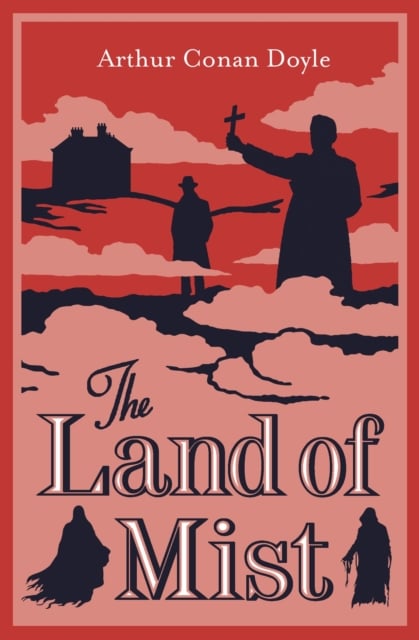
The Land of Mist
Enid Challenger and journalist Edward Malone begin investigating London’s spiritualist meetings while Professor Challenger dismisses their subject.
About
Spoiler notice: This overview discusses Silas Linden’s fraud, the private message that changes Challenger’s position, Enid and Malone’s marriage and the final conversation about catastrophe and spiritual renewal.
Professor Challenger begins The Land of Mist with an absence he cannot overcome by force of personality. His wife has died, and the loud, combative scientist has lost some of the energy that once made him so formidable. His daughter Enid helps draw him back into life by finding subjects that provoke him into argument. She is also seeking work of her own in journalism, assisted by Edward Malone of the Daily Gazette. Arthur Conan Doyle’s 1926 novel brings these familiar adventurers into London’s spiritualist circles, where the possibility of communication with the dead becomes both an investigative assignment and a personal question. Challenger rejects the subject, but his bereavement gives the story a point of pressure beneath the exchanges about reason, evidence and what a scientist ought to consider possible.
Enid and Malone’s visit to a Spiritualist church begins among crowded streets, impatient people at the door and a cab driver who dismisses the whole enterprise. Their press credentials win them entry, although the organizers are suspicious of how newspapers usually treat them. Inside, the meeting brings together religious practice, claimed clairvoyance and people looking for messages that matter to them personally. The reporters have to decide how to describe an experience that their audience may already regard as ridiculous. Doyle makes the investigation an encounter with a community as well as a series of unusual events. Its members discuss public hostility, organize meetings and defend one another. The story steadily draws Malone away from the comfortable position of observing a strange subject without becoming involved in the lives around it.
That involvement does not mean every person claiming powers is treated as trustworthy. The Linden brothers provide a deliberate contrast. Tom is presented sympathetically, while Silas, a former prizefighter, tries to use supposed mediumship as a source of money. Algernon Mailey discovers evidence of his trickery by cutting a piece from the white garment in which he has impersonated a spirit. He then recruits Malone and Lord Roxton before confronting Silas, anticipating that the meeting may become violent. The episode gives physical action to an argument about how fraud damages the movement’s reputation. Within the novel’s reasoning, exposing one deception does not disprove the other manifestations. That distinction is part of Doyle’s case for spiritualism, and the scene places committed believers among the people determined to catch an impostor.
The investigation broadens in Paris at Dr. Maupuis’s Institut Métapsychique. Its rooms contain laboratory apparatus, a camera and investigators who discuss how an experiment should be controlled and recorded. The narrative depicts disturbing materializations before moving to an attempt to preserve a physical trace of one. A figure is asked to dip its hand into liquid paraffin and then cold water, leaving a delicate wax glove after it disappears. Maupuis is delighted, believing the object will answer those who deny that anything substantial has occurred. The discussion that follows concerns what absent readers will accept and how they might explain away what the witnesses believe they have seen. These are supernatural events as the novel presents them, with the scientists’ conclusions forming part of its fictional argument rather than independent proof for the reader.
Challenger’s own decisive encounter begins in resistance. At a sitting involving Tom Linden, he believes he has exposed another fraud and is ready to take the matter to the authorities. Then Enid becomes unresponsive and begins speaking in a trance. A message attributed to Challenger’s dead wife refers to knocking he heard after her cremation, an experience introduced earlier in the book. He initially interprets even this as a conspiracy involving his daughter. The reversal comes when two names, Aldridge and Ware, are followed by a private message concerning a grey powder. Malone remains while others leave the room. The encounter reaches beyond Challenger’s public arguments because it touches something he has kept secret, and his confidence in explaining everything through other people’s deception begins to break.
Afterwards, Challenger tells Enid and Malone that he once administered an experimental drug to two hospital patients who subsequently died. He feared that he had killed them, and the message has told him their disease was responsible. His relief gives the change in his thinking an intensely personal basis. He withdraws his accusations against Linden and accepts that Enid possesses a power he cannot explain through his former assumptions. At this stage he still warns Malone against announcing a public conversion. The distinction matters: the sitting unsettles his certainty before the final chapter shows him taking up the spiritualist cause openly. Doyle follows the change from a private burden lifted to a public position defended, while leaving Challenger recognizable in the force and sometimes intolerance with which he argues.
The ending joins that conversion to a new household. Enid and Malone marry, and Challenger places the management of his business interests in Malone’s hands after the journalist loses his newspaper position. Their wedding gathers people encountered during the investigations into a community around the couple. The final scene then moves away from celebration to a threatening sky over the Channel. Malone and Enid discuss Miromar’s predictions of catastrophe and spiritual renewal, asking what might become of a society whose technical knowledge serves destruction. Their answer rests on the belief that genuine love survives death. The novel therefore closes with the couple facing uncertainty through the convictions their experiences have produced. Its movement from reporting to belief, and from grief to reassurance, gives the supernatural investigation a domestic destination while extending its religious hopes and warnings to the wider world.
Book details
- Author
- Arthur Conan Doyle
- First published
- 1926
- Series
- Professor Challenger, book 3
- Subgenre
- Classic science fiction, Occult and possession
- Tags
- No tags for this book.
- Reading order
- Also on this shelf: The Lost World (book 1), The Poison Belt (book 2)
Review
Editor profile
Baby Bat
Goodreads and social links will be added soon.
- Goodreads — link coming soon
- Social media — link coming soon