
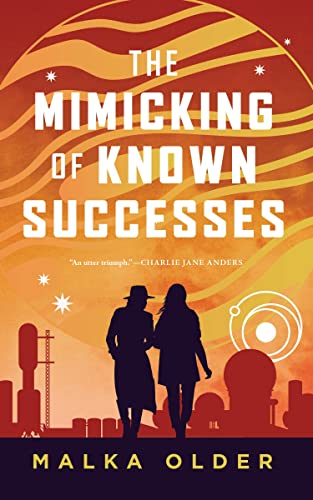
The Mimicking of Known Successes
On Giant, humanity's settlement in Jupiter's atmosphere, Investigator Mossa is sent to a remote platform after a scholar disappears.
About
Spoiler notice: Spoilers follow for the disappearance, the investigation's links to other events, and the changing relationship between Mossa and Pleiti.
The Mimicking of Known Successes begins with a disappearance at the far end of a rail line on Giant, humanity's settlement in Jupiter's atmosphere. Investigator Mossa travels alone to a remote platform where a man has gone missing during a period with no arriving or departing railcars. Others regard a fall, suicide or murder as the likely explanation and see little reason to spend five hours investigating it. Mossa persists. The case brings her to Valdegeld University and back into the company of Pleiti, a Classics scholar she has not seen in years. The opening makes the mystery concrete while showing how fragile the ordinary assumptions of the setting are: a person can vanish at the edge of an inhabited platform, and the planet's immense, shifting atmosphere lies just beyond it.
Pleiti narrates the story, so the investigation arrives through someone who knows Mossa intimately but does not share her profession or habits. Their reunion is awkward from the start. Mossa comes on official business, asks for Pleiti's help, and moves quickly from tea and scones to questions about the missing scholar. Pleiti is at once curious, wary and still emotionally attached. Their history is present in pauses and changes of tone rather than a separate account of their past. This arrangement also gives the reader two ways to approach the case: Mossa watches people for discrepancies, while Pleiti understands the university's customs, academic rivalries and personal reputations. Their cooperation becomes necessary because neither set of knowledge is enough on its own.
Giant is a lived-in human world assembled from platforms linked by railcars, with transit routes crossing a landscape of fog, pressure changes and storms. The opening rail journey and Pleiti's return to Valdegeld make travel feel both routine and precarious. A storm can buffet the station and its cars, and the local weather changes the colours of the fog as it closes in. At the university, old buildings, steep lanes, tea shops and scholarly rooms sit on infrastructure built from salvaged material and machinery. Newer platforms have a different, more uniform construction. Details such as a seam in the floor that reveals an old satellite panel connect the settlement's atmosphere of familiar academic life to the improvised technology that keeps it aloft.
The story's past is also present in Pleiti's work. She studies the history and ecosystems of Earth, and her research belongs to a wider project aimed at making a return to the planet possible. The Koffre Institute for Earth Species Preservation maintains reconstructed plants and animals as part of that effort. This is not simply a background scientific mission: the people of Giant disagree about what returning should mean, how long restoration will take and whether rebuilding an earlier Earth is even a coherent goal. The university divides knowledge into fields whose names suggest different intellectual commitments, and its factions do not share one account of the colony's future. Pleiti's work gives the case stakes that reach beyond the fate of a single missing scholar.
As Mossa and Pleiti follow the case, the disappearance connects with other unsettling events, including a death and missing biological material. The clues lead through professional relationships and a university where a scholar's standing can shape what others will say about him. Bolien Trewl, the missing man, is not remembered warmly by Pleiti and her friends; Mossa treats that dislike as information to examine rather than a verdict. She asks what people know, where Trewl travelled and why he went to the preservation institute before reaching the remote platform. The investigation therefore depends on ordinary social evidence as much as technical expertise. Pleiti's familiarity with the institution makes her a guide, but her personal history with those involved can also complicate what she notices.
The mystery and the ecological debate echo one another. Investigators try to reconstruct events from partial traces, while the scholars of Giant try to understand a damaged planet from records, preserved organisms and incomplete knowledge of the past. The book's title points toward the risk in treating an earlier success as a template for the future: a remembered system may not be recoverable in its old form, and copying it can conceal the conditions that made it work. The debate does not reduce to a simple choice between patient planning and individual initiative. A collective undertaking can become rigid, while an impulsive intervention can endanger work that others depend on. Through Pleiti's position within the Classics faculty, the argument stays close to people whose research, careers and relationships are caught up in it.
Mossa's investigative focus and Pleiti's more openly reflective voice give the novella a paired rhythm. Questions about the case move the women through stations, university rooms and encounters with colleagues; between them, the narration notices hospitality, food, weather and the discomfort of resuming an old closeness. Mossa's reserve does not erase her attachment to Pleiti, and Pleiti's affection does not stop her from questioning Mossa or forming her own ideas about the evidence. The relationship develops alongside the inquiry rather than pausing it. By bringing the two strands together, Older makes the search for truth both public and personal: it concerns what happened to Trewl, what future Giant should pursue, and what these two women can ask of one another after years apart.
Book details
- Author
- Malka Older
- First published
- 2023
- Series
- The Investigations of Mossa and Pleiti, book 1
- Subgenre
- Detective fiction, Climate fiction, Post-apocalyptic
- Primary genre
- Sci-Fi, Mystery & Thriller
- Tags
- No tags for this book.
- Reading order
- Also on this shelf: The Imposition of Unnecessary Obstacles (book 2)
Review
Editor profile
Baby Bat
Goodreads and social links will be added soon.
- Goodreads — link coming soon
- Social media — link coming soon