
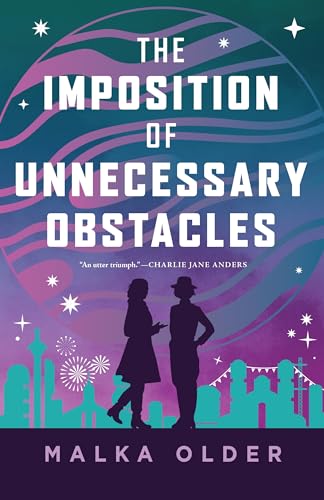
The Imposition of Unnecessary Obstacles
When Investigator Mossa returns to Valdegeld University to find a missing student, she and scholar Pleiti uncover a pattern: seventeen students and staff have vanished without the institution noticing.
About
Spoiler notice: Spoilers follow for the university disappearances, the investigation’s connection to Io, and developments in Mossa and Pleiti’s relationship.
The Imposition of Unnecessary Obstacles brings Investigator Mossa and scholar Pleiti back together after their first case in The Mimicking of Known Successes. Mossa returns to Valdegeld University to investigate a missing student, and once again needs Pleiti’s knowledge of the institution and its people. The problem is larger than either woman first expects: seventeen students and staff members have disappeared, but the university has not recognized the pattern. Pleiti narrates from within the campus, where a lecture, a familiar room, and a visit from Mossa sit beside the unsettling possibility that people have been slipping away unnoticed. The mystery begins as a question about one person and becomes a test of what the community is able to see.
The setting gives disappearance a particular meaning. Humanity lives on platforms amid the clouds of Giant, their name for Jupiter, with rail lines connecting the settlements. The atmosphere is dense and difficult for communication; beyond a platform lies a vast and dangerous planetary expanse. A person can leave one community and become difficult to trace, while the people remaining behind may not know whether they have moved, started over, or died. Mossa’s work as an Investigator developed to fill gaps between people and settlements. Her task is not simply to identify a culprit. She has to make scattered accounts add up, and the scale of the missing-person pattern makes that work urgent in a place where distance and weak communication already obscure ordinary lives.
Pleiti’s perspective changes how the investigation proceeds. She knows Valdegeld’s scholarly customs, colleagues and rivalries, but familiarity can also create blind spots. Learning that people outside the circles she usually notices have disappeared forces her to reconsider whose absence registers as a problem. Mossa, by contrast, follows the case across social boundaries and asks what the university has failed to connect. Their different habits make them useful to one another: Pleiti can interpret a campus and its relationships, while Mossa presses past assumptions that might otherwise look natural. The investigation moves from a student’s disappearance toward a wider pattern, and its clues lead beyond Valdegeld to Io and the history of Jupiter’s original settlements.
That outward journey also touches a fault line in Giant’s society. The colonies carry old differences between residents of the planet and descendants of wealthy settlers from Io. Those histories shape status and belonging, including the stories people tell about who endured hardship and who deserves authority. Valdegeld’s academic community has its own delicate balance, dependent on personalities and principles that do not always align. The disappearances expose the cost of treating a divided institution as though it were coherent. They also make the mystery more than a sequence of clues: Mossa and Pleiti must ask how people can be overlooked within a settlement that depends on cooperation to survive.
The case develops while Pleiti is confronting uncertainty about her own work. In the first book, her scholarship on Earth’s past and its ecosystems connected to a larger effort to imagine a return to the damaged planet. Here, her confidence in that life’s work has become precarious. She is still drawn to the past, but the distance between preserved knowledge and a future that might be built from it feels harder to bridge. The case’s look toward Giant’s beginnings and Io places that private doubt beside collective choices about settlement and memory. The book does not treat the old history as a ready-made instruction manual; what a community remembers can guide it, but inherited stories can also hide the decisions and inequalities that shaped them.
Mossa and Pleiti’s relationship is another history they have to interpret. Their earlier reunion has brought them close again, yet renewed intimacy does not instantly settle what each expects from the other. Pleiti wonders whether she understands what Io means to Mossa and whether Mossa can see how much Pleiti’s own ambitions have changed. Those uncertainties run alongside the investigation rather than interrupting it. Pleiti’s warm, reflective narration notices the texture of academic life and private conversation; Mossa’s presence brings sharper questions and movement. Their difference is not a simple division between feeling and reason. Both women revise their understanding as they learn more about the case, their society and each other.
The title names a pattern that reaches from personal hesitation to public life: people can turn inherited difficulty, status and self-deception into obstacles that seem inevitable. The mystery’s resolution brings the hidden pattern into view, while its consequences leave Pleiti reconsidering what she believes about her work and the communities around her. By connecting the missing people to the history and social divisions of the Jovian settlements, Older makes detection an exercise in attention: noticing who has disappeared, whose account is trusted and which assumptions have gone unexamined. The result continues the first novella’s blend of speculative setting, investigation and romance while shifting its central concern toward how people recognize one another and decide what kind of future they can build together.
Book details
- Author
- Malka Older
- First published
- 2024
- Series
- The Investigations of Mossa and Pleiti, book 2
- Subgenre
- Detective fiction, Space opera, Post-apocalyptic
- Primary genre
- Sci-Fi, Mystery & Thriller
- Tags
- No tags for this book.
- Reading order
- Also on this shelf: The Mimicking of Known Successes (book 1)
Review
Editor profile
Baby Bat
Goodreads and social links will be added soon.
- Goodreads — link coming soon
- Social media — link coming soon