
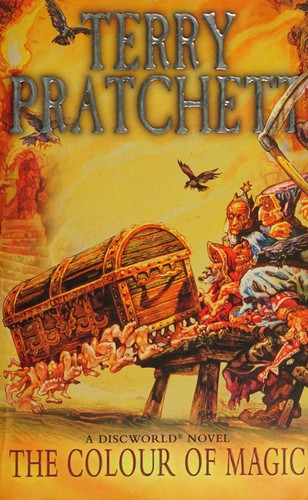
The Colour of Magic
Discworld is a flat world carried through space on the back of four elephants standing on a turtle, and its first tourist is Twoflower, a property insurance salesman who has read a book about the place that was wrong in every important line.
About
Spoiler notice: Spoilers follow for the complete first novel, including its ending; later volumes are not covered.
The Colour of Magic introduces a world whose impossible geography is a practical fact for the people living on it. The Disc travels through space on four elephants carried by the enormous turtle Great A’Tuin, while its seas pour over the edge. Terry Pratchett begins the Discworld sequence here with a journey through that landscape rather than a history of its kingdoms. The book follows Rincewind, an unsuccessful wizard, and Twoflower, a visitor determined to enjoy himself in places where enjoyment is rarely the sensible response. Its four connected adventures move from a crowded city into supernatural ruins, a dragon stronghold and the machinery of an expedition beyond the world's rim. The travelling companions supply the continuity: wherever they arrive, one expects a wonderful discovery and the other starts looking for an exit.
Rincewind knows enough about danger to recognise it everywhere. He wants an uneventful life, has little appetite for heroic sacrifice, and survives by responding faster than people who insist on behaving courageously. Twoflower comes from the Agatean Empire with a much more generous view of strangers. He assumes difficulties can be explained away and often treats a threat as another interesting encounter. That optimism is active rather than merely foolish: he will try to help someone or rescue his possessions when Rincewind would prefer to run. Their disagreements put two different journeys into the same scene. Twoflower thinks he is exploring a fascinating foreign country; Rincewind feels trapped inside an accumulating emergency. Neither wholly changes into the other, and the story repeatedly makes their incompatible instincts necessary to their survival.
Their partnership begins in Ankh-Morpork, where Twoflower's spending attracts attention from people who understand gold better than they understand tourists. His Luggage is an enchanted wooden chest that follows him on numerous little legs, making it a particularly difficult possession to steal. Rincewind can translate for him, but his education at Unseen University has left him with one dangerous spell lodged in his mind and little usable magic. The city's ruler orders him to protect the visitor, tying his own survival to a job he would rather abandon. Twoflower's professional knowledge also has consequences: when the innkeeper Broadman learns about insurance, he sees a profitable reason to burn his own establishment. The resulting fire spreads through the city. Their departure is consequently an escape from a catastrophe that an ordinary commercial arrangement has helped create.
Outside the city, the gods are literally playing with lives. Lady Luck and Fate move pieces resembling the travellers across their game board, and apparently random encounters become part of their rivalry. Separation on the road leads Twoflower into the temple of Bel-Shamharoth, whose association with the number eight makes even saying that number dangerous. Rincewind arrives in the same place through an encounter with tree spirits, while Hrun the Barbarian is pursuing the Luggage. Hrun's talking sword, Kring, is less careful about forbidden words than the frightened wizard. Once the creature beneath the temple awakens, conventional fighting offers no neat solution. Twoflower's picture-taking apparatus produces the flash that interrupts the attack, allowing the companions to flee the collapsing building. A tourist's equipment becomes more immediately useful than the impressive weapons and magical identities surrounding it.
The Wyrmberg changes what a dragon actually is. In its powerful magical field, imagination can give a creature physical existence, although that existence depends on the mind sustaining it. The mountain's riders have made a society around this ability, and its ruling family is caught in a succession struggle. Liessa wants Hrun as the formidable husband who can remove her brothers and help secure her position. Twoflower, meanwhile, imagines a dragon of his own, Ninereeds, and uses it to escape captivity and save Rincewind from a fight suspended beneath the cavern roof. The rescue remains unstable because the dragon is tied to its maker's consciousness. When Twoflower passes out at altitude, it disappears. Rincewind and Twoflower are left falling, and an extraordinary detour through another reality eventually returns them to the Disc's sea.
The final adventure takes them to Krull, where a barrier around the world's edge collects wreckage and people swept towards the Rimfall. The kingdom treats these survivors as resources, and the travellers discover that luxurious hospitality can precede a planned execution. Krull's astronomers are preparing a vessel to travel beneath the Disc and investigate Great A’Tuin; Fate requires the pair as sacrifices to accompany the enterprise. Escape therefore means disrupting a scientific launch as well as evading guards. Wearing the expedition's suits, they reach the vessel, but its machinery sends it over the edge with Twoflower inside and Rincewind clinging outside. Even the last apparent respite fails: Rincewind lands in a projecting tree, then its branch breaks. The novel ends with him falling into space, leaving the continuation to The Light Fantastic.
Across these episodes, Pratchett brings the concerns of ordinary work into places usually reserved for legendary adventures. Ankh-Morpork has criminal organisations with economic interests, a tourist introduces an unfamiliar business product, and the scholars of Krull combine technical preparations with obedience to an actual god. Magic is frequently discussed as if it has rules that can be investigated, even when those rules make the outcome absurd. The comedy grows from people acting quite practically within an impractical universe: profit, institutional power and a wish to avoid getting hurt keep reshaping the adventure. Twoflower's curiosity and Rincewind's suspicion give those pressures a human scale. This first Discworld book consequently establishes both an extraordinary physical setting and a habit of examining what its inhabitants do with it, without tidying the journey into a completed heroic victory.
Book details
- Author
- Terry Pratchett
- Published
- 1983 (earliest confirmed edition)
- Series
- Discworld, book 1
- Subgenre
- Classic fantasy, Sword and sorcery
- Primary genre
- Fantasy
- Tags
- No tags for this book.
- Reading order
- Also on this shelf: Wintersmith, A Hat Full of Sky, The Wee Free Men, The Light Fantastic (book 2), Equal Rites (book 3), Mort (book 4), Sourcery (book 5), Wyrd Sisters (book 6), Pyramids (book 7), Guards! Guards! (book 8), Eric (book 9), Reaper Man (book 11), Witches Abroad (book 12), Small Gods (book 13), Lords and Ladies (book 14), Interesting Times (book 17), Maskerade (book 18), Feet of Clay (book 19), Hogfather (book 20), The Last Continent (book 22), Carpe Jugulum (book 23), Going Postal (book 33), I Shall Wear Midnight (book 38), The Shepherd's Crown (book 41)
Review
Editor profile
Baby Bat
Goodreads and social links will be added soon.
- Goodreads — link coming soon
- Social media — link coming soon