
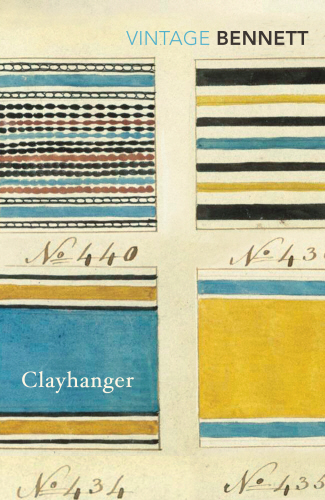
Clayhanger
Edwin Clayhanger leaves school in Bursley with ambitions that run up against his father's plans for the family printing business.
About
Spoiler notice: This overview includes Darius's death, Hilda's circumstances and the final reconciliation.
Edwin Clayhanger leaves school in the summer of 1872 and stops on a canal bridge, with the industrial Five Towns stretching around him. Barges carry the clay and manufactured goods on which the district depends; chimneys, railway lines and muddy paths connect work with ordinary movement through the landscape. A last wager in marbles with his friend Charlie Orgreave belongs to the childhood he is supposed to be leaving behind. The future feels more formidable, particularly the conversation waiting at home with his father. Arnold Bennett's 1910 novel makes that transition substantial through the things Edwin notices and the things he barely understands. Becoming an adult will require more than finding a suitable occupation. He must learn to interpret other people, recognize the limits of his own judgment and act despite the authority that has governed his life.
His father Darius owns a printing business and assumes that Edwin needs business training. Edwin's imagination is drawn toward architecture, which offers him images of another kind of work and another scale of existence. An illustrated book of European buildings discovered in the shop excites him, and he buys paints before attempting to copy a view of Paris. The practical uncertainty of the drawing matters as much as his ambition: wanting to produce something beautiful does not immediately supply the skill or discipline. When he finally tells Darius that he would like to become an architect, the response redirects him toward the business. Edwin feels relieved simply to have spoken. That relief helps explain how a life can settle into a course before its supposed owner has made a deliberate choice.
Darius's expectations carry a history that his son does not know. As a boy, Darius endured poverty and the terror of the workhouse, until Mr. Shushions helped rescue the family and found him a place in printing. The successful father's authority rests partly on experiences he has never explained at home. Edwin therefore encounters the result without understanding its origins. Later, when Shushions himself dies in the workhouse, Darius's grief appears excessive and sentimental to his son. The reader has the knowledge Edwin lacks and can see why the event devastates the older man. Bennett does not use that history to make every act of paternal bullying reasonable. It makes the family's failures of understanding more painful, because neither its security nor its affection has produced the conversation that might connect their different experiences.
The Orgreave household gives Edwin a different atmosphere in which to test his growing sense of himself. Charlie's easy manner can make him feel awkward, while Janet's welcome offers reassurance without the familiar pressure of home. An invitation to supper feels like a major social adventure to someone who has barely learned how to enter another family's rooms. Hilda Lessways, Janet's friend, becomes a particularly powerful presence within that widening world. Edwin's anticipation of meeting her shows how much of an encounter can be shaped before it takes place. He imagines an exceptional woman and then feels afraid of his own image. Attraction promises escape from his confined routines, but it also exposes the hesitation that makes him an uncertain participant in his own hopes.
The printing business and family money bring that hesitation into sharper conflict. Darius scrutinizes the accounts after noticing books Edwin has bought, suspecting a theft where there has actually been expenditure from Edwin's own money. The accusation finally provokes open anger. His son can name the injustice of being poorly paid and then mistrusted, but a confrontation does not settle their relationship. Darius's later decline turns the struggle over authority into the demands of care, and after his death Edwin inherits responsibilities as well as greater freedom. The changed household contains an uncomfortable echo: he can now be curt with Maggie, protect his own convenience and avoid admitting an obvious mistake. Having suffered under a father's manner does not prevent him from beginning to reproduce parts of it.
Hilda remains the great unsettled attachment of his life, even after years apart. The arrival of her son George, introduced through Janet, disturbs Edwin before he can pretend to be casually interested. He is told things about Hilda's situation that later prove incomplete, and his understanding develops through awkward conversations rather than a complete account supplied at once. His affection for the boy becomes important in its own right. During George's illness, Hilda finally tells Edwin that the boy's father was imprisoned for bigamy and that she was never legally married to him. The disclosure changes the meaning of facts Edwin thought he understood. It also makes clear how much of another person's life can remain hidden behind a socially acceptable description, including the descriptions friends offer with kindly intentions.
In the final chapter, Edwin is himself recovering from influenza when Hilda comes to say goodbye. Their meeting takes place in the chair that once belonged to Darius, giving the father's familiar space an unexpected new significance. Hilda speaks about the silence that followed their earlier attachment and about feelings that have continued through the intervening years. She has given George the middle name Edwin and says that, if wishing could have made the boy his, she would have wished it so. Their reconciliation opens the prospect of marriage without depicting the married life that might follow. Edwin recognizes that problems remain, but they no longer seem reasons to withdraw from living. The novel closes with his willingness to accept that burden, after showing how long becoming capable of such a decision has taken.
Book details
- Author
- Arnold Bennett
- First published
- 1910
- Series
- Clayhanger Trilogy, book 1
- Subgenre
- Literary fiction, Modern classics
- Primary genre
- Literary Fiction
- Tags
- No tags for this book.
- Reading order
- Also on this shelf: Hilda Lessways (book 2), These Twain (book 3)
Review
Editor profile
Baby Bat
Goodreads and social links will be added soon.
- Goodreads — link coming soon
- Social media — link coming soon