
Behind the series
- First aired
- 2020
- Creators / development
- Oh Choong-hwan, Park Hye-ryun
- Principal cast
- Bae Suzy, Nam Joo-hyuk, Kim Seon-ho, Kang Han-na, Kim Hae-sook, Kim Do-wan, Yu Su-bin, Stephanie Lee
- Story scope
- Season 1
About the series
Contains story spoilers.
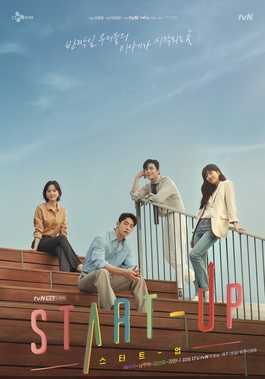
Start-Up begins with sisters whose parents’ divorce puts them on different paths. Seo Dal-mi stays with their father; Seo In-jae leaves with their mother. Years later, Dal-mi challenges her now-successful sister at a startup event and claims to have a brilliant business partner, Nam Do-san. The name comes from letters that comforted her as a teenager. Her grandmother Choi Won-deok had asked Han Ji-pyeong, a boy she sheltered after he left an orphanage, to write them under an assumed identity. Dal-mi has built her memory of first love around someone she has never met.
The family’s losses also complicate Ji-pyeong’s gratitude. Dal-mi’s father pitches a delivery business after a traffic accident, secures investor interest, then dies on the bus home. Ji-pyeong believes Won-deok has funded the venture with his savings, until she proves the money was hers. In adulthood he becomes a venture-capital investor whose sharp assessments conceal his attachment to the woman who helped him. Returning to her life means confronting the correspondence he left behind. Protecting Dal-mi from disappointment now requires him to find the actual Do-san and persuade him to impersonate a childhood friend.
Do-san, meanwhile, is a gifted programmer whose company Samsan Tech has spent years failing to turn its founders' skills into a viable business. His childhood reputation as a mathematics prodigy sits uneasily beside his present embarrassment: his parents once took pride in him, but now fear the venture is wasting his talent. When Ji-pyeong asks him to help sustain Dal-mi's mistaken belief, Do-san agrees and meets her at a networking event dressed to resemble the person she has imagined. The deception begins as a short-lived favor but becomes entangled with real affection, business decisions and Do-san's wish to be valued in his own right. A confrontation with In-jae's stepfather, Chairman Won, also shows that Do-san will reject a lucrative project when its terms reduce Samsan Tech to gathering data rather than building the solution it wants to make.
Sand Box, a startup incubator in Seoul, gives the relationships a competitive setting. Dal-mi enters with practical confidence rather than elite credentials, and assembles a team by persuading designer Jung Sa-ha to join her alongside Do-san and his programmer friends Kim Yong-san and Lee Chul-san. During a hackathon, the team develops a handwriting-analysis idea and has to revise its machine-learning approach under time pressure. The competition tests whether their work can become a workable business, not merely a technically impressive demo. In-jae's team, backed by greater resources and professional experience, becomes both rival and mirror: the sisters have different advantages, but each wants recognition on her own terms. Ji-pyeong mentors Dal-mi's team and offers a fallback investment, even as his unspoken feelings and the false identity behind the letters complicate his advice.
A more personal business idea emerges when Do-san learns that Won-deok is losing her sight. The team combines image recognition with the Yeong-sil voice system to create NoonGil, an app intended to describe surroundings for visually impaired users. Ji-pyeong questions how the company can afford a service whose users cannot easily be reached through conventional advertising. Dal-mi starts seeking corporate partners while the programmers demonstrate the technology. An unexpected celebrity endorsement then sends usage sharply upward, creating bills the young company is poorly equipped to pay. Won-deok gives Do-san written feedback, and Dal-mi discovers both the reason he proposed the app and the condition her grandmother has kept from her. She responds by promising to keep developing it. A working product now carries an obligation to a particular person, alongside the problem of finding sustainable funding.
The fiction around the letters eventually breaks. Dal-mi learns that Ji-pyeong wrote to her as a teenager and that the adult Do-san is not the boy whose words helped her through the separation. The revelation changes how she reads her memories and the relationship she has built with Do-san; his apology cannot simply restore the old version of their story. At the same time, a proposed acquisition by Silicon Valley company 2STO exposes the difference between a headline-making opportunity and a sustainable future for Samsan Tech. The contract brings Do-san, Yong-san and Chul-san to California while Dal-mi and Sa-ha are excluded, and NoonGil's purpose is threatened by the buyer's priorities. The setback forces the founders to confront what they sold, what they still control and whether the product can continue serving the person it was designed for.
After a time jump, the characters return with more distance from the choices that divided them. Dal-mi and In-jae begin to rebuild their relationship while pursuing their own professional paths; Ji-pyeong's bond with Won-deok remains a source of care that is not measured by financial success. Do-san and his former teammates return to Korea and rejoin Dal-mi's work, now under the company name Cheongmyeong. In the final stretch, a ransomware attack and a bid for a public project test whether the team has learned to assess risk before leaping at opportunity. Dal-mi takes a more active role in handling a reporter's questions, and the company advances through the bidding process. The closing arc brings the startup's ambitions, the sisters' unresolved history and the letter writers' long-delayed honesty toward separate forms of resolution, without making career success a substitute for repairing relationships.