
Behind the series
- First aired
- 2021
- Principal cast
- Michela Luci, Callum Shoniker, Lyon Smith
- Story scope
- Season 1, Season 2, Season 3, Season 4
About the series
Contains story spoilers.
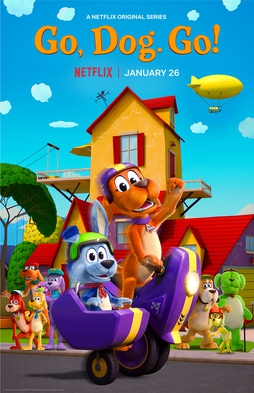
Go, Dog. Go! is a preschool animated comedy set in Pawston, a busy city inhabited by dogs. Six-year-old Tag Barker is an inventive pup, skilled with mechanics and drawn to anything that moves; her friend Scooch Pooch joins her on adventures around town. The show adapts P. D. Eastman’s children’s book into a 3-D series produced by DreamWorks Animation and WildBrain. Its episodes turn neighborhood errands, competitions, celebrations, and mishaps into playful problems for Tag and Scooch to solve. Vehicles and movement are part of the world’s visual language, but the stories also depend on cooperation: a plan works best when the friends listen, improvise, and make room for other residents. The premise gives young viewers a recurring pair and a welcoming setting that can generate new small-scale challenges.
Tag’s mechanical skill does not make her a solitary problem-solver. Scooch is her close companion, and their adventures often depend on combining ideas, sharing tasks, and adapting when the first plan fails. Pawston’s citizens create the local texture: dogs work, travel, celebrate, compete, and ask for help in a town organized around getting around. Helping a neighbor gives the friends a reason to turn an interesting idea into something they can actually use. The format makes a useful distinction between being clever and being considerate. Tag may devise a vehicle or a route, but the story still has to account for the people affected by it. That gives the upbeat machinery of the setting a social purpose beyond simply racing from one gag to the next. That pattern is especially clear when Tag’s inventiveness meets a deadline or a friend’s competing need. Scooch can contribute practical support, while neighbors supply a reason for the task to matter beyond winning. The stories tend to make the challenge visible through objects, routes, and group action, giving young viewers clear cause and effect as the dogs try, adjust, and finish together. The cheerful pace leaves space for the characters’ reactions as well as the solution.
The early episodes establish the show’s everyday scale through specific tasks. Tag and her new friend Scooch cross town to attend a party in a tree; mail carrier Gerald needs help while being chased; Tag supports Scooch with chores so they can attend a concert; and the pair begin pursuing a place among the Race Cadets, with Scooch serving as crew chief. Other stories center on a talent show with Tag’s Grandpaw, a car show, or a beach clean-up that becomes difficult when Frank and Beans keep making a mess. These plots make the city’s routines legible to younger viewers: going to work, helping a friend, preparing for an event, and cleaning a shared place can all become comic adventures when the details are dog-sized and the solutions inventive.
The recurring interest in vehicles gives Tag a recognizable specialty and helps organize the show’s physical comedy. A race challenge or trip across town supplies a clear goal, obstacles that can be understood visually, and opportunities for friends to take different roles. The short paired-adventure format allows several short adventures to share an episode while returning to Pawston’s familiar characters. Bright 3-D animation supports quick shifts between streets, workplaces, parks, and gathering places; the setting can feel busy without becoming difficult to map. The movement remains purposeful because it usually connects to a neighbor’s need or a shared event. That link between mobility and community makes the show’s world more than a succession of vehicles: Pawston is a place where being on the go creates chances to participate.
The Race Cadet ambition gives Tag and Scooch a practical division of responsibilities. Tag wants to take part as a driver, while asking Scooch to become her crew chief makes his contribution part of the same goal. That arrangement allows friendship to be expressed through preparation and attention rather than only through a declaration that they are best friends. A task such as finding Sam Whippet's keys can matter alongside the faster, more spectacular activities. The small errand still requires the dogs to notice what is happening around them and coordinate what they do next. Pawston's competitions therefore remain connected to its streets and neighbors, rather than existing as a separate world where only the winner matters.
The result is a low-stakes adventure format designed around curiosity, movement, and helpfulness. Tag’s ingenuity supplies momentum, Scooch’s friendship makes the plans collaborative, and Pawston offers a repeating map of places where other dogs need a hand. Short problems can resolve within an episode, letting the series introduce practical ideas such as sharing responsibilities or trying another approach without turning them into formal lessons. The dogs’ city is intentionally welcoming: work and play sit side by side, and an errand can become an occasion for a race, a performance, or a group effort. A shared place can become more familiar through each visit without requiring a single story to settle its future. The dogs finish one activity and find another reason to get together, allowing the city to remain both understandable and full of things to try.