
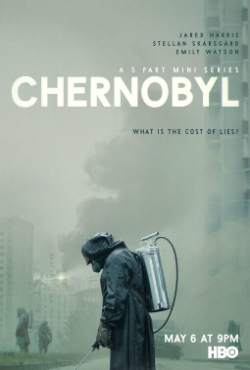
Behind the series
- First aired
- 2019
- Creators / development
- Craig Mazin
- Principal cast
- Jared Harris, Stellan Skarsgård, Emily Watson, Paul Ritter, Jessie Buckley, Adam Nagaitis, Con O'Neill, Adrian Rawlins
- Story scope
- Season 1
About the series
Contains story spoilers.
The miniseries opens with Valery Legasov recording an account of Chernobyl before taking his own life, then moves back to the night the reactor explodes. Plant managers insist the disaster is contained even as firefighters and workers approach a burning building without understanding what has happened. The choice to begin with Legasov’s final act makes the viewer aware that the events will be remembered through a struggle over evidence. The damaged reactor is both an immediate physical danger and a problem of language: those in authority treat the possibility of a core explosion as impossible, so the first warnings are dismissed as panic or incompetence.
Legasov, a nuclear physicist, is sent to advise the Soviet government, while Boris Shcherbina arrives as the deputy prime minister responsible for directing the response. Their first relationship is one of friction. Shcherbina expects a manageable industrial accident and distrusts the scientist’s dire statements; Legasov has technical knowledge but must persuade a political official who controls people and equipment. When they reach the plant, measurements and visible evidence force Shcherbina to confront the difference between official reassurance and the scale of the radiation. He agrees to evacuate nearby Pripyat, where residents have been told to continue ordinary life even as the danger grows.
Ulana Khomyuk is the scientist whose investigation turns suspicion into a chain of evidence. She works across institutions, trying to reach Legasov and reconstruct the reactor’s failure from what operators and officials are willing to say. Her inquiry follows the emergency response into hospitals, where firefighter Vasily Ignatenko and his wife Lyudmilla experience the human cost that technical briefings cannot contain. Khomyuk warns Lyudmilla about radiation exposure, but the young woman stays near her husband. When Khomyuk interviews plant workers, their testimony links the catastrophe to an emergency shutdown mechanism that was supposed to make the reactor safe. The story makes her persistence confront surveillance and political pressure at every step.
The response depends on laborers who are often barely visible in the official account. Workers drain water from the basement to prevent a possible steam explosion; miners dig beneath the reactor; soldiers and civilian liquidators clear debris and kill contaminated animals. Legasov and Shcherbina attempt to use a German robot to clear radioactive graphite from the roof, but radiation disables the machine. The Soviet officials supplied false radiation measurements to its German designers, so the technical failure exposes another consequence of managing appearances instead of reporting conditions honestly. The cleanup then demands brief, dangerous missions by people with improvised protection. Each solution prevents a worse immediate outcome while creating a new burden for those assigned to carry it out. The crisis shows how bureaucratic decisions become bodily risk for people who have little power over the information used to justify those decisions.
By the time the investigation reaches the reactor design, the series has made secrecy part of the technical failure rather than a separate political subplot. Khomyuk discovers that the AZ-5 emergency shutdown can briefly increase reactivity because of a design flaw. Legasov already knows that a colleague warned the Kremlin years earlier, but the state dismissed the warning. At the same time, the authorities prepare to make plant director Bryukhanov, chief engineer Fomin and deputy chief engineer Dyatlov stand trial as if misconduct by a few men were the whole cause. Shcherbina understands that admitting the broader flaw could have consequences for him and the government, yet he also sees that suppressing it risks another disaster.
The final episode reconstructs the hours before the explosion and the operators’ decision to continue a safety test after it had been delayed. At the trial, Legasov describes their mistakes, then goes beyond the permitted account and explains the AZ-5 flaw, acknowledging that his earlier testimony in Vienna concealed it. Khomyuk’s research and the surviving workers’ accounts give the explanation human and documentary weight. The state strips Legasov of his titles and isolates him from the scientific community. His eventual suicide is followed by the circulation of his memoirs, which helps force public acknowledgment and reactor retrofits. The miniseries’ ending makes truth costly and incomplete, but it treats testimony as an action that can still change what institutions do.
The figures at the center represent different forms of responsibility. Khomyuk is a fictional composite rather than a historical individual; she lets the story gather work performed by many scientists into one character who can move between scenes. Legasov and Shcherbina are based on real people, though the drama shapes their exchanges and timing for television. Lyudmilla’s story, the plant workers and the liquidators keep the disaster from being reduced to a debate among officials. Across five episodes, the story shifts from the reactor building to evacuation, cleanup and courtroom, connecting technical design with ordinary choices about what to report, whom to protect and who will bear the danger when leaders refuse to hear a warning.