
Behind the series
- First aired
- 1998
- Creators / development
- Peter Hannan
- Principal cast
- Jim Cummings, Tom Kenny, Carlos Alazraqui, Billy West, Maria Bamford
- Story scope
- Season 1
About the series
Contains story spoilers.
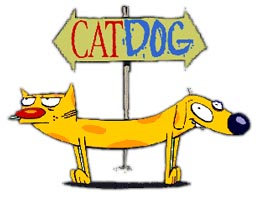
CatDog takes the familiar pairing of a cat and dog and removes the space that would normally keep them apart: the brothers share one body, with a head at either end. Nickelodeon’s premise depends on that contradiction. They cannot simply walk away from one another, yet approach the same problem with opposing instincts. Cat plans, protects his comfort and seeks recognition; Dog acts on appetite, curiosity or whatever catches his attention. Because each decision physically involves both, an ordinary disagreement can become a shared journey, embarrassment or contest over who steers. The surreal design supplies a practical engine for the stories: errands become tests of patience, status and cooperation, with both brothers negotiating consequences even when they want opposite things.
“The Island” begins with Cat and Dog cycling to the airport for a tropical holiday. Cat, absorbed in the vacation brochure, misses their turn; his late swerve to avoid a truck sends them crashing onto a traffic island. Cat’s impatience then destroys the crosswalk signal, and his effort to call Winslow for help ends when anger makes him smash the phone. Dog instead uses debris to build a hut like the one in Cat’s brochure, while Cat turns a “No Littering” sign into an invitation that gets passing drivers to throw them food. A street sweeper wipes away their improvised paradise, so they make a boat from salvaged material and launch it into traffic. The escape becomes another chain of collisions, ending with the pair stranded on a high billboard beside the holiday picture they had hoped to reach. Cat’s planning repeatedly worsens the predicament; Dog’s practical improvisation helps them endure it.
“Flea or Die” begins at the beach, where Dog’s chase after a ball disrupts a rat and sends the fleas on it onto CatDog. Rancid confirms the infestation and offers a flea bath, but Cat’s fear of water leads him to choose a flea belt instead. The belt protects whoever wears it, so moving it between the brothers sends the fleas back and forth as they struggle over who gets relief. Cat finally returns to Rancid after Dog is overwhelmed, and Cat submits to the bath that kills the fleas. Their return to the beach supplies the last reversal: flea belts have become fashionable while they were away, leaving Cat embarrassed that he is no longer wearing one. The episode makes a minor treatment choice drive the entire chain: Cat’s fear sets up the belt, the belt makes relief positional, and his concern for Dog brings him back to the cure he first rejected.
“Diamond Fever” starts when a gopher disrupts Cat’s garden. Dog surfaces with shiny pieces in his nose, Cat mistakes them for diamonds and digs deeper, drawing both brothers into mining what looks like a fortune. Dog names the stones and becomes attached to Joey; when the favorite is missing the next morning, he accuses Cat, and their quarrel carries them into a mine-cart chase. They emerge as the mine collapses and their supposed diamonds tumble away. The gopher eats some of the stones and reveals that they are rock candy. Cat’s hope of getting rich has made both brothers misread the find, while Dog’s affection for Joey persists even after its value changes. Cat sees the explanation, but Dog immediately wants to keep mining because he likes the candy. The episode moves from gardening trouble to imagined wealth, then gives the brothers a cause for conflict and a physical consequence before its final reveal.
In “Full Moon Fever,” Dog is drawn into the Greasers’ game of throwing Eddie the Squirrel, torn between treating Eddie as a ball and rescuing him. When the full moon changes him into a wolf-like form, Dog asks to join the Greasers, and Cat lets him try instead of suppressing it at home. Their tests progress from burying a prehistoric skeleton to eating landfill rubbish and chasing a mail carrier to tear his trousers. Dog passes, and the Greasers attach a fake Dalmatian tail to Cat as a replacement. Seeing Cat’s misery causes Dog to return to his normal self and reject the pack, despite losing his new membership. He tells the Greasers that Cat is the only tail he needs; they turn on the brothers, who run home together. The choice restores their partnership but costs Dog membership.
“War of the CatDog” turns a family reunion and tug-of-war tournament into an argument about ownership. Dog stains Cat’s apron, and Winslow’s advice to safeguard personal belongings prompts Cat to label everything in the house, including the trophy the brothers won together. Dog challenges Cat’s claim to the prize; Winslow then hands Dog the trophy and fuels the disagreement. Cat and Dog divide the house into rival halves, and the dispute spreads until they attempt to split everything, destroying the home. Their family arrives but leaves soon afterward. Winslow returns the trophy broken into two pieces, one for each brother. The story ties its escalating physical comedy to a recognizable tension: living together makes individual ownership hard to draw around shared things. Cat’s labels offer a false clarity, while Dog’s insistence on a split seems fair until it damages the place both must inhabit. The trophy is divided at the end, but the house cannot be put back together by the same gesture.
The brothers keep returning to a problem their shared body cannot solve for them: whose wishes should determine what both have to endure? On the traffic island, Cat destroys the help they need while Dog builds shelter. In the mine, imagined wealth matters more to Cat than the stone Dog has befriended. The flea treatment requires Cat to face his fear, and joining the Greasers makes Dog choose between their approval and his brother. Even splitting a trophy cannot create separate lives when the argument destroys their home. Their dependence gives each disagreement a physical consequence, with compromise always more difficult than simply announcing who is right.