
Behind the film
- Year
- 2009
- Director
- Ruben Fleischer
- Writers
- Rhett Reese, Paul Wernick
- Genres
- Comedy horror, Post-apocalyptic, Horror, Zombie comedy
- Production
- Columbia Pictures, Relativity Media
- Country
- United States
- Cast
- Woody Harrelson, Jesse Eisenberg, Emma Stone, Abigail Breslin, Bill Murray, Amber Heard
About the film
Contains story spoilers.
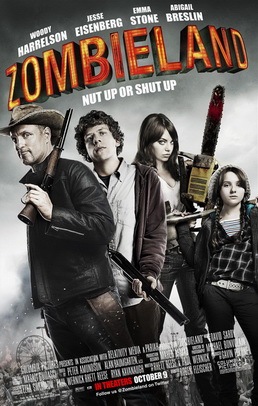
After a zombie outbreak, a cautious young man known as Columbus travels towards his hometown hoping to find his parents. He meets Tallahassee, an aggressive survivor with a fondness for Twinkies, then sisters Wichita and Little Rock, who steal the men's supplies before eventually agreeing to travel together. The sisters hope Pacific Playland, a Los Angeles amusement park, is free of zombies. At Bill Murray's home, they meet the actor disguised as a zombie; a prank leads Columbus to shoot him accidentally. Columbus also learns that the loss Tallahassee described as a dead puppy was actually his son. Wichita takes Little Rock to the park, where switching on the attractions draws a horde. Columbus and Tallahassee follow and rescue them. Having survived together, the four decide to remain a group. Their destination has failed as a sanctuary, but their journey has created another possibility of home.
Columbus treats fear as a practical resource. His rules are attempts to make an unpredictable world behave like a problem with clear steps, and the film gives those steps a playful visual presence. Instructions become part of the image rather than remaining private thoughts. This device gives the action a second rhythm: something frightening can also be an occasion to see whether a rule works. Jesse Eisenberg makes the caution socially awkward as well as useful. The character's difficulty reaching other people survives the collapse of ordinary society, making the apocalypse an exaggerated version of a familiar problem. Staying alive does not automatically teach him how to have company.
Tallahassee approaches the same problem through force, appetite and a deliberate refusal to seem vulnerable. Woody Harrelson gives his confidence a comic physicality, making a room feel occupied before the character has explained himself. Beside Columbus, that confidence produces an immediately legible contrast: one man needs procedures, while the other wants to believe he can overpower whatever happens. The film allows both approaches to have uses and limitations. A survival partnership requires more than selecting the person with the better strategy. It requires tolerating another person's habits, including the ones that seem foolish. Their friction gives the road trip momentum even in stretches when the immediate threat is human conversation.
The sisters complicate that partnership because their caution is social rather than procedural. Wichita and Little Rock have learned to look at another survivor as a potential danger or opportunity, making charm something the men cannot simply accept at face value. Emma Stone gives Wichita's guardedness an alert, testing quality, while Abigail Breslin makes Little Rock's youth part of the group's uneven responsibilities. The characters do not share a ready-made agreement about what trust should mean. Each has reasons to keep control of the situation. This gives the eventual group a texture that would be missing if all four were instantly grateful to meet, and keeps companionship close to the risk of being taken advantage of.
The abandoned American landscape offers a strange abundance. Buildings, vehicles and consumer goods remain, but the social arrangements that once gave them value are gone. Fleischer uses that mismatch for comedy: ordinary desires persist in places where ordinary life has become impossible. The characters are still interested in snacks, entertainment and private comforts, which makes them recognizably human inside the exaggerated horror. An empty shop can be an opportunity and an unsettling reminder of who is absent. The film's road-trip form makes these spaces temporary meeting places rather than a comprehensive account of rebuilding civilization. Its interest lies in what a small group can make of the ruins as it moves through them.
The mixture of comedy and horror depends on keeping physical danger visible without making it the only possible response. The zombies create deadlines and obstacles, but the survivors bring embarrassment, vanity and conflicting expectations into those encounters. Humour can arise from preparation as readily as from panic. The stylized rules help connect those tones, presenting a frightening situation through the language of a nervous person's attempt to manage it. The film also allows quieter feelings to interrupt the jokes. A character's bravado may be a defence rather than an adequate explanation of who he is, leaving the audience room to reconsider an impression without abandoning the playful pace.
Calling people by place names creates another useful tension. The names promise distance, as though identity can be reduced to a destination and attachment kept under control. Yet the trip continually makes those people more particular through their reactions, needs and disagreements. The film's version of family is therefore something assembled through shared attention rather than inherited from the vanished world. Its modest emotional scale suits the larger absurdity: the characters cannot restore society, but they can decide how to treat one another. Zombieland makes that decision a comic adventure filled with suspicion and inconvenient company, then shows why company might be worth the inconvenience. Survival becomes less lonely without becoming less uncertain.