
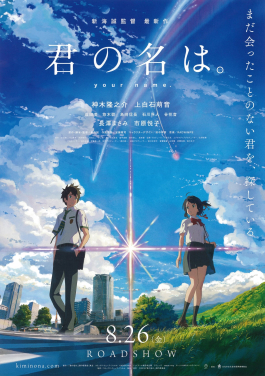
Behind the film
- Year
- 2016
- Director
- Makoto Shinkai
- Writers
- Makoto Shinkai
- Runtime
- 1h 47m
- Genres
- Coming-of-age, Time-travel, Romance, Fantasy
- Production
- CoMix Wave Films
- Country
- Japan
About the film
Contains story spoilers.
Makoto Shinkai’s animated feature begins with two teenagers leading lives that seem to belong to different rhythms. Mitsuha Miyamizu lives in Itomori, a fictional town surrounded by mountains and shaped by its shrine traditions. She is tired of the small-town routine and imagines a next life as a boy in Tokyo. Taki Tachibana is already a Tokyo high-school student, balancing school, a part-time restaurant job and the city’s crowded pace. They have never met, but each begins to dream that they have become the other, and the dreams leave traces that are too specific to dismiss.
The body switches arrive irregularly. When Mitsuha wakes as Taki, she navigates his apartment and social life with a confidence that changes how his friends and co-workers see him. When Taki wakes as Mitsuha, he must manage her home, school and family obligations. Neither receives a reliable explanation, so they leave messages on phones and in notebooks to establish rules and record what happened. Their exchanges are funny and awkward, but the practical notes also become a form of care: each learns the other’s routines and tries not to disrupt a life they do not understand.
Mitsuha’s world includes her younger sister Yotsuha and grandmother Hitoha, who teaches the girls the Miyamizu shrine’s rituals. The family makes braided cords and performs a dance associated with its inherited practices. Taki, in Mitsuha’s body, accompanies them to a sacred place in a mountain crater, where the family leaves an offering. These scenes give the story’s fantasy a material vocabulary of repetition, craft and place. The ritual is not detached lore: later, it becomes one of the only routes Taki can follow when the easy messages between the teenagers stop arriving.
As the exchanges continue, Mitsuha arranges a date for Taki with his co-worker Miki Okudera, while Mitsuha’s interventions reshape how Taki behaves around his friends. The pair’s growing familiarity produces affection, even though they can communicate only through borrowed days and fading recollections. When the switches abruptly end, Taki tries to find Mitsuha using the sketches he has made from his memories of Itomori. The search is difficult because he remembers the landscape more clearly than the name of the place or the person he is trying to reach.
The film’s central shift comes when Taki discovers that the two have not been switching in the same present. Mitsuha’s days were three years earlier, and the comet Tiamat fragmented above Itomori, destroying much of the town and killing its residents on the night Taki remembers as a celebrated astronomical event. His inability to contact her is not a broken phone connection: the gap separates their timelines, and Mitsuha belongs to the past that Taki now occupies. That revelation turns the romance into a rescue story with an impossible deadline already passed.
Taki returns to the crater shrine and drinks the offering Mitsuha left there, hoping to reach her once more. The story reconnects them during the brief twilight called kataware-doki, when day and night meet. In their original bodies, they recognize each other and attempt to leave names behind before the connection fades. Taki writes a message on Mitsuha’s hand but not his name; the twilight ends before Mitsuha can write her name, and their memories of each other begin slipping away. The message of affection on her palm remains, even as she struggles to recall who wrote it. The thread between them survives less as information than as a persistent feeling of absence.
Mitsuha then carries the urgent knowledge back to the town. With her friends Tessie and Sayaka, she tries to move the residents toward safety, while also confronting her father, Toshiki, the town’s mayor. The evacuation effort meets resistance and confusion, but Mitsuha persists until the community is moved away from the impact area. The film then jumps forward: the surviving residents have lives beyond the catastrophe, and Taki and Mitsuha have grown up in Tokyo without a shared account of what happened. They repeatedly pass near one another, sensing a missing connection they cannot name.
Shinkai builds the contrast between Tokyo’s transit, signs and tightly arranged streets and Itomori’s lake, slopes and local routines through exceptionally detailed backgrounds. The changing sky is not decoration alone; the comet’s beauty and danger occupy the same image, and the sky connects distant lives while making their timing fragile. Music by RADWIMPS is integrated into the film’s shifts between momentum, quiet observation and emotional release. The final encounter does not restore every lost memory or explain the supernatural mechanism. It gives the characters another chance to ask who the other person is, and lets the title’s question remain at the heart of the reunion. The film also gives the red braided cord a recurring physical presence, linking Mitsuha’s family craft to Taki’s life in Tokyo. It works as a keepsake rather than a simple explanation of the mystery: the cord can be passed between people even when names and dates slip from memory. In the same way, the changing line between the two timelines is made visible through familiar locations revisited under a different sky. The film lets the audience notice the difference before Taki fully understands it.