
Behind the film
- Year
- 1938
- Director
- Frank Capra
- Writers
- Robert Riskin
- Runtime
- 2h 6m
- Genres
- Romantic comedy
- Production
- Columbia Pictures
- Country
- United States
- Cast
- Jean Arthur, Lionel Barrymore, James Stewart, Edward Arnold, Mischa Auer, Ann Miller, Spring Byington, Donald Meek
About the film
Contains story spoilers.
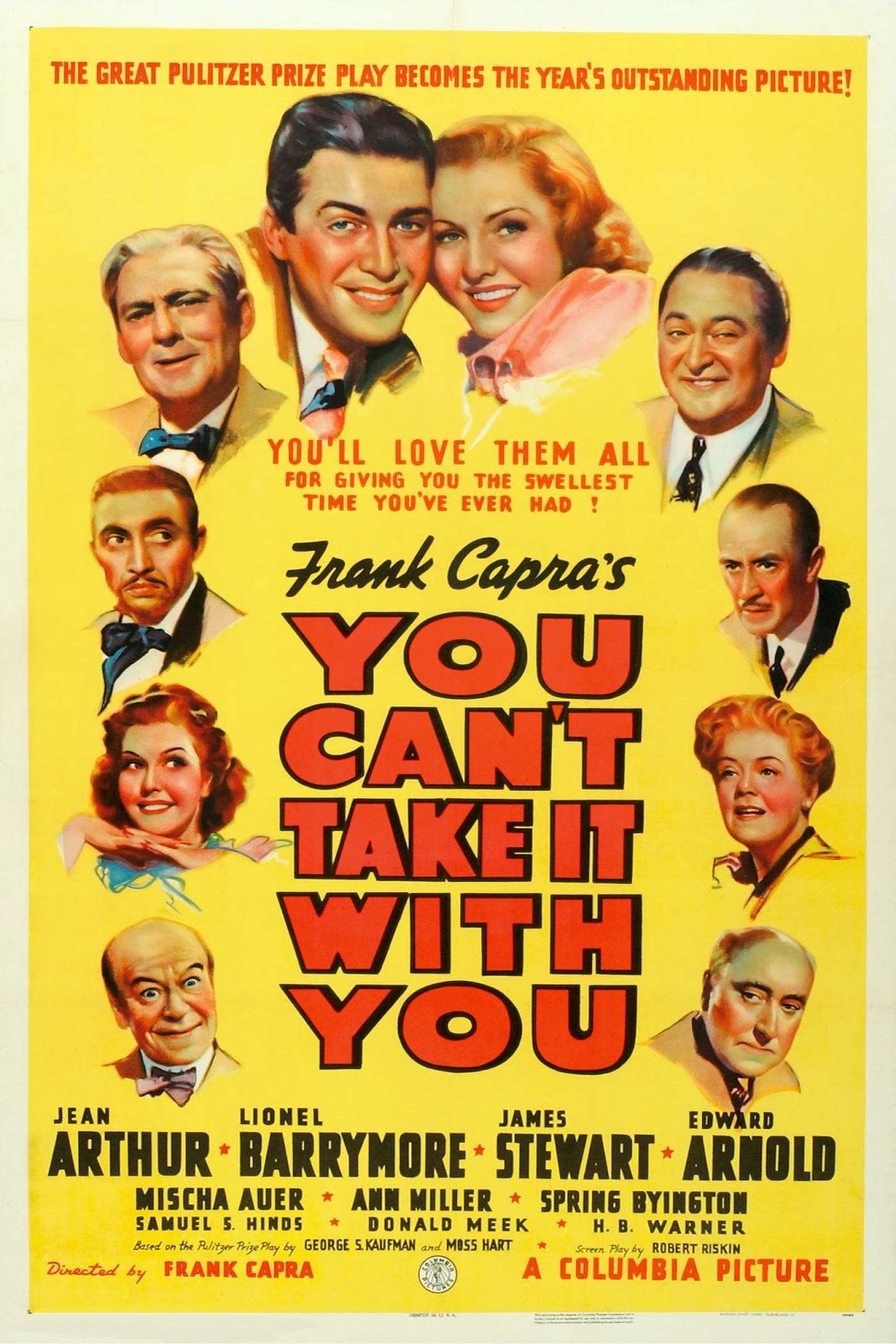
Frank Capra’s You Can’t Take It with You sets a young romance inside a conflict over one New York house. Alice Sycamore (Jean Arthur) works as stenographer to Tony Kirby (James Stewart), the son of banker Anthony P. Kirby (Edward Arnold). Tony and Alice want to marry, but their families occupy opposite ends of the city’s social and economic life. The Kirbys measure success through business, status and disciplined appearances; the Sycamores have built a crowded home around whatever each person feels moved to do.
At the centre of that home is Grandpa Martin Vanderhof (Lionel Barrymore), who left the world of business years earlier and now refuses to make money his reason for living. His daughter Penny (Spring Byington) writes plays, often trying out scenes on the household. Her husband Paul (Samuel S. Hinds) makes fireworks in the basement. Their daughter Essie (Ann Miller) practices ballet, while Essie’s husband Ed (Dub Taylor) makes and delivers candy. The family’s pastimes spill into daily life: a xylophone gets played, a dance gets rehearsed, and a new idea can take over a room before anyone has finished the last one.
Alice is the household member who appears most at home in conventional work. She is Tony’s secretary at Kirby and Company, and she understands the risk of bringing the two families together. Tony proposes, but his mother’s social hauteur makes Alice doubt she can enter the Kirby family without being judged. Tony, meanwhile, has not told his parents that Alice is related to the person standing between his father and a major business deal. Their private relationship therefore sits on top of a conflict that neither lover can solve simply by agreeing to marry.
Anthony Kirby is buying up the neighbourhood around a competing factory so that his firm can secure a munitions monopoly. Vanderhof’s home is the remaining holdout. Kirby’s plan treats the house as one more obstacle to acquire, while Grandpa values its memories and the independence it gives his family. The film makes the real-estate campaign tangible through its contrast between the orderly commercial world of the Kirby offices and the Sycamores’ bustling rooms. Tony is a vice-president in his father’s company, but his affection for Alice makes him less willing to treat the family’s home as a disposable parcel.
Alice plans a dinner at which the Kirbys can meet the Sycamores properly, hoping her relatives will keep their exuberance in check. Tony worries they will put on an unnatural performance, so he brings his parents to the house a night early. That choice exposes them to the household in full motion: Penny is working on a play, Paul’s fireworks occupy the cellar, Essie is dancing, and Ed’s candy business has its own unexpected connection to the family’s activities. Mrs. Kirby’s discomfort and the family’s unfiltered habits make the dinner collapse before it can become the carefully managed introduction Alice wanted.
The evening grows more chaotic when police arrive over flyers Ed has placed in Essie’s candy boxes. The flyers advertise Paul’s fireworks, but officials mistake them for Communist propaganda. Then fireworks go off in the cellar, and both families are swept into the same arrest. In jail, Kirby insults the other prisoners until Grandpa tells him that wealth has left him with no friends. Grandpa later offers Kirby a harmonica as an apology, but the brief exchange has already unsettled the banker. At the hearing, Kirby’s wife prevents him from explaining why they were at the house; Grandpa shields them by claiming they came to buy it. Alice then tells the judge the truth and breaks off her engagement with Tony, while the reporters’ arrival turns the courtroom into a public commotion.
Alice disappears after the hearing and writes that she will not return. To reunite his scattered family, Grandpa agrees to sell the house, allowing Kirby’s acquisition plan to move forward. The timing forces the business victory to collide with a personal one: just before Kirby’s board meeting, the competitor he has pushed aside visits him, and Tony says he is leaving the firm and home. The competitor dies of heart failure soon afterwards. Kirby, shaken and without the triumph he expected, turns away from the meeting and seeks Grandpa’s advice about winning his son back.
At the Sycamore house, packing has begun, and Alice is distraught that Grandpa has sold it. Kirby arrives too, and Grandpa answers the family crisis with music rather than another argument: he and Kirby play a harmonica duet of “Polly-Wolly-Doodle.” The tune draws the household back into singing and dancing, and Tony and Alice reappear to find Grandpa and Tony’s father at ease together. Kirby gives the couple his approval, and the film ends with the house bought back and the family gathered at dinner. The resolution brings the romance and the property dispute together, with Kirby changing through contact with the people he had treated as obstacles.