
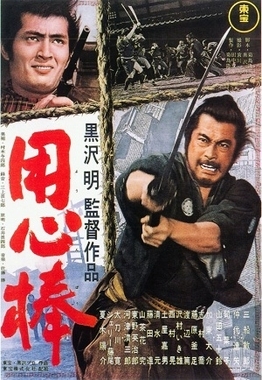
Behind the film
- Year
- 1961
- Director
- Akira Kurosawa
- Writers
- Akira Kurosawa, Ryuzo Kikushima
- Runtime
- 1h 50m
- Genres
- Drama
- Production
- Toho
- Country
- Japan
- Cast
- Toshirō Mifune, Tatsuya Nakadai, Yōko Tsukasa, Isuzu Yamada, Takashi Shimura, Daisuke Katō, Eijirō Tōno, Kamatari Fujiwara
About the film
Contains story spoilers.
A wandering rōnin enters a town controlled by two rival criminal factions and lets each believe he can be hired as a bodyguard. He uses their rivalry to weaken both, but changes course when he learns a farmer’s wife is being held as property. After helping her escape, Sanjuro is captured and badly beaten; the tavern keeper helps him flee. He returns to confront the gangs and frees the town from their leaders, sparing a frightened young man and sending him home. The violence does not restore an untouched community: the town has been damaged, and its people still face the consequences of the conflict. The film ends with Sanjuro leaving, having intervened without turning himself into a permanent ruler.
Yojimbo’s central pleasure is the way its hero reads a room. Sanjuro arrives with almost no social obligations and quickly understands that the town’s public order is a performance maintained by people who profit from disorder. Toshiro Mifune plays him with a rough, watchful physicality; he seems to register exits, threats and weaknesses before deciding whether to speak. That intelligence makes him entertaining, but the film does not confuse cleverness with moral purity. His strategy uses the factions’ own habits against them, and its costs remain visible even when a scene has a dry comic edge.
The town itself feels like a pressure chamber. Streets, doorways and the tavern create a small map on which every movement can be noticed and interpreted. Kurosawa’s widescreen compositions often make the characters appear exposed within that space, with open ground offering little protection. The setting is not presented as a complete account of a historical period; it is a highly designed dramatic environment where corrupt power can be seen clearly. That stylisation matters. The film uses the conventions of a period story to examine a social world rather than to claim that every village or conflict followed this pattern.
The rival leaders are not simply two interchangeable villains. Their competition gives each one a reason to recruit the outsider, but the film also shows how personal vanity and political influence cooperate. The gang bosses depend on networks of followers, merchants and local authority, so violence is embedded in a system of relationships. Their apparent independence is therefore fragile: each has to keep proving dominance to people who may switch allegiance. Sanjuro’s presence exposes that insecurity, making the gangs’ power look theatrical and unstable rather than natural.
Tatsuya Nakadai’s Unosuke changes the balance because his gun represents a different kind of threat from the sword. It is not only a more efficient weapon; it alters the distance at which violence can be imposed. The contrast makes technology part of the film’s visual argument. Sanjuro’s physical skill depends on proximity, timing and nerve, while the firearm makes intimidation easier to project across space. Kurosawa uses the difference to sharpen suspense and to show how new tools can tilt an already unjust contest. The weapon does not make its owner morally superior; it makes the threat harder to answer.
The film’s humour is dry and economical. Sanjuro’s invented name, his plain speech and his visible impatience puncture the grand self-image of the people around him. That comic quality does not turn the story into a light romp. It gives the audience a way to notice the absurdity of a town whose leaders keep producing fresh reasons for violence while claiming to defend order. The jokes expose vanity, but they do not erase cruelty. The tone can pivot from a sardonic exchange to a troubling consequence without signalling that the danger has become harmless.
The story’s moral centre emerges when Sanjuro’s calculation is interrupted by compassion. He may initially treat the factions as pieces in a game, but the film asks what he does when a person is being treated as a possession. That shift separates tactical cleverness from ethical judgment. The rōnin is not transformed into a conventional civic hero; he remains an outsider who understands that leaving a wrong untouched would make his own freedom feel hollow. His choice matters precisely because he has no formal duty to the town and no guarantee of gratitude.
Kurosawa’s staging gives action a clear geography. Bodies move through doors, across open streets and around the edges of a frame, so a fight feels like a consequence of positioning rather than a blur of editing. The camera can hold a wide view long enough for a viewer to anticipate danger, then shift into a closer rhythm when the balance changes. This visual clarity supports the film’s theme of observation: Sanjuro’s advantage comes from seeing how a situation is arranged. The viewer is invited to read space with him, noticing how a pause or a turn can change who controls the moment. As a stylised jidaigeki, Yojimbo uses period costume and social convention while keeping its attention on recognisable mechanisms of power: protection sold as loyalty, authority traded for money, and communities caught between leaders who benefit from fear. Sanjuro’s departure prevents the story from becoming a fantasy in which one capable man can permanently repair a damaged town. He can interrupt the immediate cycle and give individuals room to return to their own lives, but the film does not promise a simple cure for the structures that produced the violence. Its ending keeps both his accomplishment and its limits in view.