
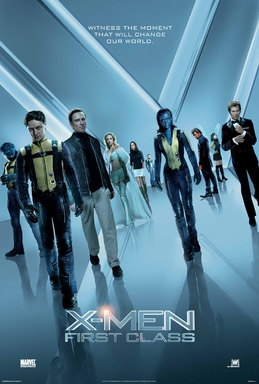
Behind the film
- Year
- 2011
- Director
- Matthew Vaughn
- Writers
- Ashley Edward Miller, Zack Stentz, Jane Goldman, Matthew Vaughn
- Runtime
- 2h 11m
- Genres
- Action, Fantasy, Teen, Superhero
- Production
- 20th Century Studios, Marvel Entertainment, RatPac-Dune Entertainment
- Country
- United States, United Kingdom
- Cast
- James McAvoy, Michael Fassbender, Jennifer Lawrence, Rose Byrne, January Jones, Nicholas Hoult, Kevin Bacon, Lucas Till
About the film
Contains story spoilers.
X-Men: First Class places the beginning of its central alliance in a world already organised around suspicion. The Cold War gives Charles Xavier and Erik Lehnsherr a crisis in which their powers can become urgently useful, but usefulness does not guarantee acceptance. Matthew Vaughn's film approaches the familiar future adversaries as young men discovering what they can do together. Charles can reach into minds; Erik can act on metal. Those abilities make cooperation possible in dramatic ways, yet their disagreement comes from experiences that neither power can erase. One sees understanding as a route to coexistence, while the other has strong reasons to distrust the people who would decide whether coexistence is permitted.
Erik seeks the man who killed his mother, now operating as Sebastian Shaw. CIA officer Moira MacTaggert brings Charles into an investigation of Shaw's mutant allies, and Charles rescues Erik during an attempted confrontation. They recruit mutants and train them at Charles's mansion. Shaw plans to provoke nuclear war around the Cuban missile crisis, believing mutants can inherit the aftermath. At the blockade, Erik kills Shaw despite Charles's opposition. American and Soviet forces then fire on the mutants. Erik redirects their weapons until a deflected bullet injures Charles, leaving him unable to walk. Their alliance breaks: Charles opens a school, while Erik becomes Magneto and takes several mutants, including Raven, with him.
James McAvoy's Charles begins from a position of confidence in his place within the world. His academic interest in mutation allows him to describe what makes other people unusual, and his telepathy makes intimacy seem readily available. Yet knowing what someone thinks is not the same as sharing the conditions that shaped that thought. Michael Fassbender's Erik carries a different relationship to institutions and belonging. He has experienced persecution at its most destructive, and his search for Shaw gives that history a particular target. Their friendship develops because Charles can recognise more in Erik than anger. Its limit emerges when recognition is expected to produce agreement about what safety should look like for people who remain vulnerable to others' fear.
The recruitment and training scenes let the film move beyond that pair without losing their argument. A power may be valuable before its owner knows how to use it reliably, and a group can provide the conditions for that learning. The mansion becomes a place where an extraordinary trait does not have to remain a private problem. It is also a space where definitions are being negotiated. Is the group a weapon for a government, a temporary alliance against Shaw, or the beginning of a community with responsibilities to its own members? Those purposes overlap during the emergency but need not remain compatible afterwards. The young recruits' discoveries give the question physical form through practice, failure and the different demands of their abilities.
Raven and Hank make visibility part of that negotiation. Charles can move through ordinary society without his mutation being announced by his appearance; they cannot depend on the same freedom. Jennifer Lawrence's Raven can disguise herself, but being able to hide does not answer whether she should have to. Nicholas Hoult's Hank tries to manage appearance through science, treating the visible part of his mutation differently from the abilities he values. Their connection draws attention to the distinction between acceptance and a solution that makes difference less noticeable to others. The film does not leave that distinction as a side issue. Raven's eventual choice of company depends partly on whose understanding of mutant identity permits her to feel that her natural form belongs.
Shaw offers a particularly dangerous answer to the question of belonging. His recognition of mutant power leads to supremacy, making human lives expendable in a plan for a different world. Kevin Bacon's character can promise freedom while reproducing the logic of domination. Erik's hatred of him therefore creates an unstable boundary: defeating the man who abused him does not automatically mean rejecting every part of that man's ideology. The confrontation forces Charles to distinguish between supporting his friend and consenting to the act his friend has chosen. It also makes the eventual human attack more than another action obstacle. A moment intended to settle the crisis supplies Erik with further evidence for the distrust Charles has hoped to soften.
The screenplay by Ashley Edward Miller, Zack Stentz, Jane Goldman and Vaughn uses a period espionage framework around its superhero origin. Secret meetings, covert facilities and competing national powers give the mutants a world in which hidden identities already matter. Its version of the Cuban missile crisis is an alternate-history fantasy, not an explanation of the real event. The final separation leaves that distinction between personal knowledge and political belief unresolved. Charles has a school to build; Erik has a movement to pursue. Their shared experiences have created affection without producing a common answer. That is the film's lasting origin: not only how a team acquired its members, but how two people who understood each other became committed to opposing futures.