
Behind the film
- Year
- 2014
- Director
- Bryan Singer
- Writers
- Simon Kinberg
- Runtime
- 2h 11m
- Genres
- Action, Superhero, Dystopian, Thriller
- Production
- Marvel Entertainment, RatPac-Dune Entertainment, Bad Hat Harry Productions
- Country
- United States, United Kingdom
- Cast
- Hugh Jackman, James McAvoy, Michael Fassbender, Jennifer Lawrence, Patrick Stewart, Ian McKellen, Peter Dinklage, Nicholas Hoult
About the film
Contains story spoilers.
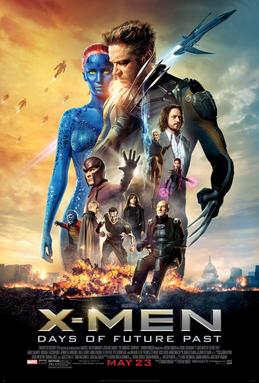
X-Men: Days of Future Past begins in a world where resistance has almost run out of places to hide. Sentinels hunt mutants and the humans who help them, adapting to powers that once gave the X-Men an advantage. Kitty Pryde can send a companion’s consciousness a short distance into the past, allowing a warning before an attack arrives. The surviving Xavier and Magneto propose a much longer journey to prevent the catastrophe’s origin. Logan’s healing ability makes him the person most likely to withstand it. He must reach 1973, when Mystique’s intended assassination of weapons designer Bolivar Trask set events moving towards the machines surrounding the survivors.
The mission involves more than stopping a murder. In the original history, Mystique killed Trask and was captured; experiments using her ability to change form enabled the later Sentinels to adapt. Preventing that sequence requires reaching someone whose grief and anger have become a purpose. Logan wakes in his younger body and finds Xavier’s school depleted. Charles has withdrawn after losing students to the Vietnam War and after Raven left with Magneto. A serum allows him to walk but suppresses his telepathy. James McAvoy plays him as a man protecting himself from further disappointment, making Logan’s account of a future catastrophe difficult to translate into a reason to act.
Hank McCoy helps Logan approach Charles, while the group also needs Magneto, imprisoned beneath the Pentagon over the Kennedy assassination. They recruit the extraordinarily fast Peter Maximoff, whose abilities make the escape possible. The kitchen sequence slows the surrounding action almost to stillness, letting Quicksilver casually reposition threats before everyone else can react. His confidence provides a temporary release from the mission’s anxiety, but freeing Magneto introduces another danger. Michael Fassbender’s Erik brings his own explanation of what mutants must do to survive. He can help reach Raven without agreeing that her freedom or Xavier’s preference for persuasion should determine the outcome.
In Paris, Mystique prepares to kill Trask after discovering evidence of experiments on mutants. The intervention prevents the assassination, but Magneto attempts to kill her himself because he believes her survival could preserve the future threat. Hank fights him, allowing Raven to escape while their confrontation exposes mutants to the public. The effort to avert a catastrophe has supplied Trask with a new argument for his weapons. Magneto later works steel into the Sentinel prototypes so he can control them with his magnetic power. Those machines and the adaptive killers in the future remain distinct: his manipulation of the prototypes is a separate plan from the experiments conducted on Mystique in the original timeline.
Charles has to relinquish the serum and confront what recovering his powers will demand. Reading Logan’s mind connects him with the older Xavier, whose experience gives hope a weight his younger self cannot yet find on his own. The exchange joins Patrick Stewart and McAvoy as two stages of the same person, rather than making one simply the answer to the other’s failure. Charles then uses Cerebro to locate Raven. His approach changes from trying to direct her movements to asking her to consider what the decision will mean. The film places that effort beside Magneto’s increasingly public demonstration of power, with both men claiming to act for mutant survival.
The Washington unveiling of the Sentinels becomes a confrontation before the president, officials and cameras. Magneto brings a stadium around the White House and turns the machines against the people presenting them. Logan is thrown into the river, leaving the final intervention to others. Mystique shoots Magneto and saves the humans he threatens, then faces her opportunity to kill Trask. Xavier urges her to choose a different outcome, but the choice remains hers. Jennifer Lawrence’s Raven is therefore more than the object of the men’s argument. Her refusal to murder Trask changes the public meaning of the incident, allowing an act of protection to interrupt the evidence of mutant danger.
In the future, the older team fights to hold the Sentinels off while Kitty keeps Logan connected to the past. The editing brings that defence and Raven’s decision together, making the dwindling time visible through bodies and broken shelter rather than a simple countdown. Once the past changes, that ruined future gives way to a restored school. Logan wakes among people he had believed lost, with memories of events the others have not experienced. The conclusion offers a changed history without detailing every intervening year. It leaves him needing to learn what happened, while a later image of Mystique in another identity keeps the altered past from looking entirely settled.
Bryan Singer directed Simon Kinberg’s screenplay, combining the earlier films’ cast with the younger versions introduced in First Class. Hugh Jackman’s Logan becomes a messenger who cannot solve the mission through endurance or fighting alone; the people he needs must decide to trust one another. Peter Dinklage’s Trask makes the threat institutional, presenting persecution through the language of defence and technological progress. The separate periods also give familiar powers different surroundings, from Quicksilver’s playful manipulation of a kitchen to the exhausted survivors’ desperate coordination. The decisive action finally belongs to someone still free to choose what she does next. That makes the film’s return to the past a contest over possibility, as well as a way to reunite its characters.