
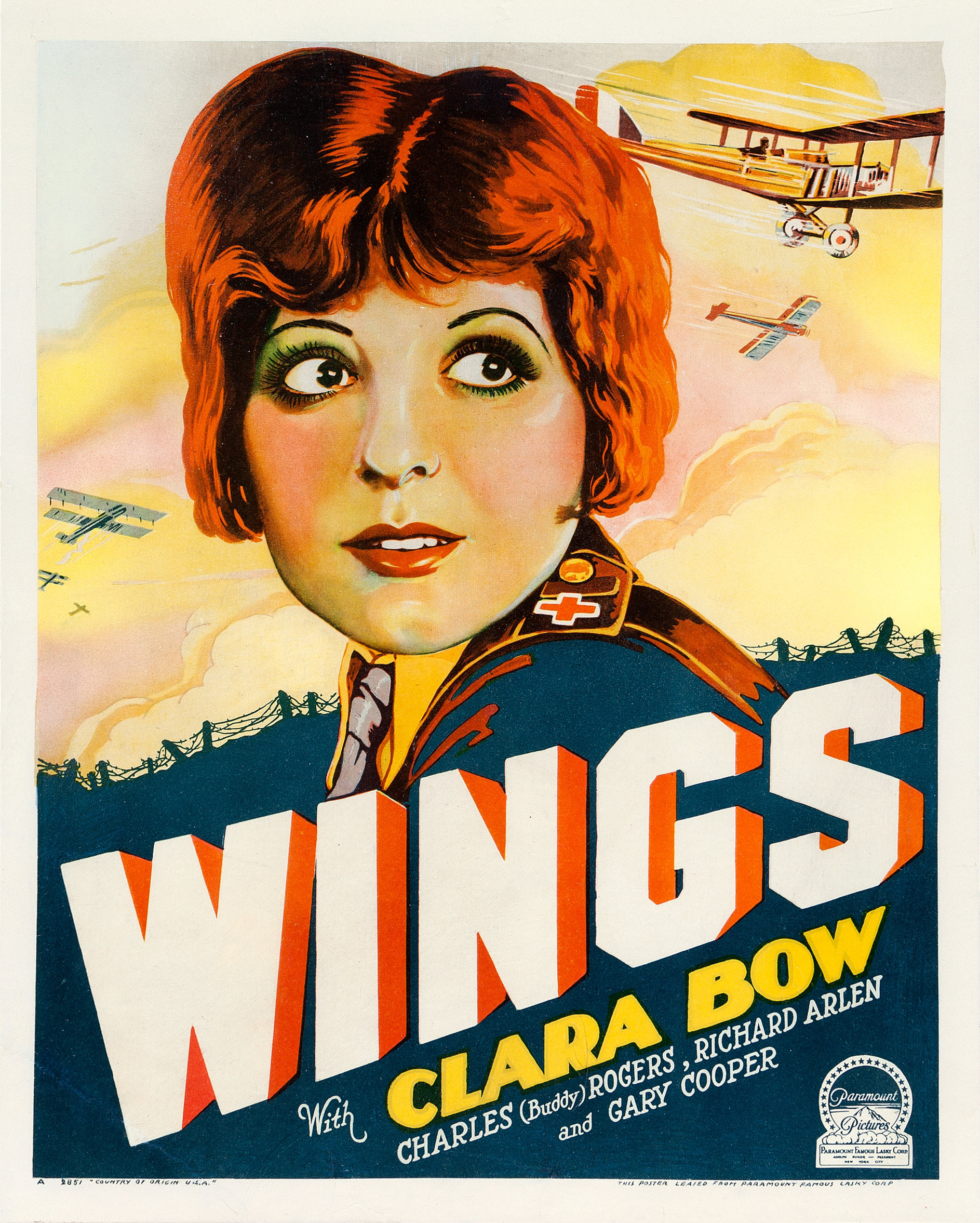
Behind the film
- Year
- 1927
- Director
- William A. Wellman
- Writers
- Hope Loring, Louis D. Lighton
- Genres
- War, Romance, Drama, Silent
- Production
- Paramount Pictures
- Country
- United States
- Cast
- Clara Bow, Charles "Buddy" Rogers, Richard Arlen, Jobyna Ralston, El Brendel, Richard Tucker, Gary Cooper, Henry B. Walthall
About the film
Contains story spoilers.
Before Jack Powell has an aeroplane, he has a car and an imagination full of flight. Wings begins with ambitions that are still small enough to fit inside a hometown: getting a machine to work, taking the right girl for a ride, being noticed. Charles 'Buddy' Rogers plays Jack with an eagerness that makes his mistakes easy to understand even when they hurt somebody else. Mary Preston, played by Clara Bow, helps him and loves him, but he looks towards Sylvia Lewis. Sylvia's affection belongs to David Armstrong, played by Richard Arlen. The misunderstanding is not merely an excuse to bring two rivals together. It establishes the film's recurring difficulty: people act decisively on what they think they see, while the truth can remain immediately beside them.
America's entry into the First World War carries the young men away from that familiar world. Jack and David enlist, go through training and turn antagonism into friendship. Gary Cooper's brief appearance as another cadet makes death arrive before combat has even begun: the man they have just met dies in a flying accident. William A. Wellman's film gives the training ground its own vulnerability. Learning to fly does not provide a protected interval before danger starts. The two friends can develop courage and technique, but neither skill nor enthusiasm supplies a guarantee of survival. Jack's painted shooting-star emblem takes a piece of his earlier life into the air, attaching an individual identity to a machine that other people may see only as a target.
The aerial scenes repeatedly shift the scale of the story. A face in a cockpit can occupy the screen, then become a tiny moving point inside a formation or a sky filled with aircraft. The change matters because the romances and rivalries remain intensely personal while the battlefield cannot accommodate that intimacy. A plane has to be recognised quickly from a distance. An attack can separate a pilot from his companions in seconds. The film's physical movement asks the audience to follow direction, pursuit and changing altitude rather than simply wait for an explosion. Its danger extends downwards as well: troops and villages exist beneath the combat, making flight part of a wider war rather than an isolated sporting contest between exceptional men.
Mary also reaches France, driving in the war effort. Her presence prevents the hometown romance from remaining safely behind the fighting. She has work, initiative and an exposure to danger of her own, although Jack is still slow to understand her. A Paris leave sequence brings a different kind of confusion. He is too drunk to recognise her properly; her attempt to get him back to his room results in military police discovering her changing clothes and assuming misconduct. She is sent home. The episode makes official judgement depend on a misleading appearance, just as Jack's romantic confidence has depended on one. Bow's Mary has considerably more understanding of the situation than the people who decide what she must have been doing.
The romantic misunderstanding between the men survives their friendship. David knows Sylvia loves him, while Jack still treats her photograph as evidence of her affection for himself. Resolving this would require David to hurt a man he now cares about. That reluctance creates a more generous motive than jealousy, but kindness does not make the deception harmless. Personal belongings become especially important in a world where separation can be permanent. A picture or a childhood mascot carries a history that a uniform cannot show. These objects also expose how incomplete one person's knowledge of another can remain. The men may trust each other with their lives while still failing to say something that was difficult even before the war.
The final battle makes misrecognition fatal. David survives being shot down and steals a German aircraft to reach friendly lines. Jack, believing his friend dead, attacks the plane in an effort to avenge him. He lands after bringing it down and discovers that he has mortally wounded David. The encounter reduces the great movement of the air battle to two men close enough, at last, to recognise each other. David forgives him. Revenge has achieved the opposite of its intended purpose, and the aircraft's markings have concealed the person Jack most wanted to defend. The film leaves Jack with responsibility that cannot be repaired by winning another fight. His grief belongs inside the victory, rather than being erased by it.
At home, celebration presents Jack as a hero. His visit to David's parents requires another identity: the surviving friend who must explain what happened and return the possessions of someone who will not come back. Their forgiveness does not undo the loss. It allows him to live with it. Mary and Jack's eventual reunion offers companionship after the film has exposed the cost of his earlier blindness. The ending can therefore hold romance and mourning together without making either an answer to the other. The small-town world continues, but its familiar places now contain absences. A star in the sky recalls Jack's original enthusiasm for movement and possibility, carrying a quieter meaning after the combat has finished.
As a silent film, Wings relies on the timing of gestures, glances and changes in physical distance to make these relationships legible. Written titles supply information, while faces and movement often reveal the feeling that a character cannot state. Jack's exuberance, David's restraint and Mary's practical determination give the triangle distinct emotional rhythms. The contrast between domestic closeness and aerial distance then becomes part of the film's storytelling machinery. It can invite exhilaration at what aircraft do and still show how war turns recognition into a matter of life and death. The first Best Picture winner is also a story about returning: coming home with public honour, private knowledge and a friend whose absence will remain after the parade has passed.