
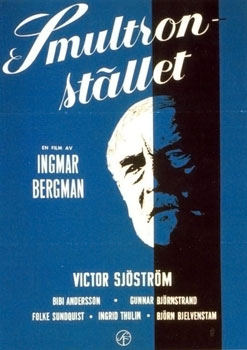
Behind the film
- Year
- 1957
- Director
- Ingmar Bergman
- Writers
- Ingmar Bergman
- Runtime
- 1h 31m
- Genres
- Flashback, Drama
- Production
- SF Studios
- Country
- Sweden
- Cast
- Victor Sjöström, Bibi Andersson, Ingrid Thulin, Gunnar Björnstrand, Folke Sundquist, Björn Bjelfvenstam, Naima Wifstrand, Gunnel Broström
About the film
Contains story spoilers.
Professor Isak Borg is an eminent physician preparing to travel from Stockholm to Lund, where he will receive an honorary degree fifty years after earning his doctorate. The morning before the ceremony begins with a dream: he wanders through an empty street, finds a clock without hands, sees a coffin overturn, and encounters the dead man inside as himself. The strange images establish the film’s inward rhythm. This is a road trip across Sweden, but also a trip through the memories and judgments that Isak has kept at a distance.
Isak’s pregnant daughter-in-law Marianne rides with him. She is considering leaving his son Evald, who does not want the baby, and she speaks to Isak with a frankness that his formal household rarely permits. Their conversation reveals that the older man’s composure can feel like indifference to the people around him. Rather than fly, they drive, and the open road creates a space where ordinary stops can trigger recollection. The award ceremony promises public recognition, but the journey keeps redirecting attention toward private relationships that honor cannot repair.
The first passengers they pick up are three young hitchhikers: Sara and the two men who both love her, Viktor and Anders. Bibi Andersson plays the young Sara as well as the cousin from Isak’s memory, linking present encounters to the past without turning them into simple flashbacks. The travelers argue about faith and science, while Sara’s liveliness recalls Isak’s youthful romance with his cousin. In a reverie at the family’s summer house, he watches the young Sara pick wild strawberries and sees her choose his brother Sigfrid instead. The memory exposes the difference between remembering a moment and having taken part in it.
A near collision brings another couple into the car: Sten and Berit Alman. Their argument quickly becomes cruel, and Marianne finally stops and tells them to leave. They are strangers, yet their contempt recalls Isak’s own unhappy marriage to Karin. A later dream transforms the Almans into examiners who test the professor and accuse him of guilt. The dream does not function as a verdict on one specific offense; it turns his habit of emotional distance into a question about whether professional competence is enough when a person has failed to be generous.
The journey also includes a stop at Isak’s childhood home and a visit to his elderly mother, who remains emotionally remote even in old age. Objects and family stories make his childhood seem close, but his memories are not idealized: he watches his younger self, his cousin, and his relatives as if unable to enter their lives. The film connects this distance to the present through Evald, whose own guardedness resembles his father’s. Marianne understands that the family’s emotional reserve is repeating itself, and Isak begins to hear her criticism as more than a complaint about his manners.
At the ceremony in Lund, Isak receives the honorary degree, but the formal recognition does not solve the tensions that accompanied him. He says farewell to the young travelers, and Sara’s playful affection gives him a moment of uncomplicated warmth. That night he goes to bed at his son’s home, where he dreams of being guided toward his parents beside a lake. The image of reunion is not a literal return to childhood; it suggests that his memories can now carry tenderness as well as regret. His expression carries a rare sense of peace.
Ingmar Bergman’s film keeps its psychological movement grounded in everyday road details: a roadside collision, a stop for petrol, a family visit, and an official ceremony. Dreams bend this realism rather than replace it. The clock without hands, the silent street and the examiner’s test are stark images, while the recurring roadside conversations remain natural and often awkward. Victor Sjöström’s restrained performance is central; he lets Isak’s pride show in clipped responses and then makes the smallest softening feel earned. The black-and-white photography gives present and remembered spaces a shared visual world.
Bibi Andersson's two Saras give memory a face that can reappear without becoming the same person. The young traveler can joke with Isak in the present, while the remembered cousin belongs to a scene he cannot now alter. Ingrid Thulin's Marianne makes that distinction practical: she is here, speaking to him, and he still has a chance to respond differently. Gunnar Bjornstrand's Evald provides another perspective on the family's reserve, making it possible to see a habit passed between generations rather than located only in one old man's personality. The car brings these differences into a shared space where avoiding a conversation is harder than it would be at home. In contrast, Isak's dreams allow rooms and people to appear according to the logic of his anxiety. A professional examination can become an accusation, and an ordinary clock can lose the hands that make it useful. Bergman moves between those registers without assigning every image a single meaning. The journey's tenderness develops through the friction between what Isak remembers, what he fears and what somebody beside him is actually saying.