
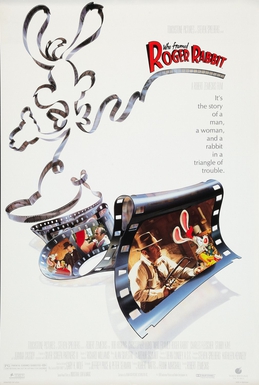
Behind the film
- Year
- 1988
- Director
- Robert Zemeckis
- Writers
- Jeffrey Price, Peter S. Seaman
- Genres
- Neo-noir, Buddy, Crossover fiction, Fantasy
- Production
- Amblin Entertainment, Touchstone Pictures, Walt Disney Animation Studios
- Country
- United States
- Cast
- Bob Hoskins, Charles Fleischer, Christopher Lloyd, Joanna Cassidy, Kathleen Turner, Stubby Kaye, Alan Tilvern, Richard LeParmentier
About the film
Contains story spoilers.
Who Framed Roger Rabbit introduces its world through work. Roger is performing in a cartoon short, and what initially looks like an ordinary animated scene becomes part of a film set occupied by human crew members. The distinction establishes the central fantasy of Robert Zemeckis’s 1988 film: cartoons are actors with lives beyond the productions in which they appear. They share a 1947 Los Angeles with people who hire, exploit, admire and resent them. Bob Hoskins’s private detective Eddie Valiant approaches that world with particular bitterness, because the death of his brother has left him hostile to the animated community and detached from the life they once shared.
Eddie’s assignment concerns Roger’s wife Jessica, whose apparent relationship with businessman Marvin Acme could explain the rabbit’s distracted performances. The photographs Eddie takes give the studio a way to pressure Roger, but the apparently simple job becomes a murder case when Acme is killed. Roger’s jealousy supplies an obvious motive, and his frantic manner does little to make him look innocent. He seeks out the detective anyway, forcing Eddie to spend time with the sort of character he has tried to avoid. Their partnership depends on a mismatch between temperaments: Eddie wants explanations and quiet, while Roger expresses feeling through a body and voice that cannot easily remain contained.
Toontown gives the fantasy a geography as well as a visual style. It is a place where animated characters can live according to the exaggerated possibilities of their bodies, yet its future depends on arrangements within the human city. Acme’s missing will becomes crucial because it is supposed to secure that future for the residents. Judge Doom represents an authority that can treat the cartoons’ vulnerabilities as opportunities for control. Christopher Lloyd plays him with an unsettling severity, especially beside the elastic comedy around him. The substance known as dip makes his threat real within the film’s rules: characters who can survive extraordinary physical mishaps are not invulnerable to everything.
Jessica’s appearance encourages Eddie, and the audience, to read her through a familiar mystery-film role. Her glamorous stage presence and the compromising photographs suggest a seductive figure with hidden motives. As the investigation develops, her concern for Roger complicates that assumption. Joanna Cassidy’s Dolores provides a different connection, maintaining an ordinary relationship with Eddie while recognising how grief has altered him. Both women help move the case beyond the initial story of a foolish husband and untrustworthy wife. The men controlling the studio, the evidence and the city have more to conceal than the couple whose private life has been put on display.
The live-action and animated worlds constantly meet through physical business. Roger can turn concealment into a spectacle, and his ability to slip a restraint when the moment becomes funny frustrates Eddie’s expectation that a practical problem should have a practical solution. A visit to Toontown reverses the detective’s usual advantage by placing his human body inside an environment governed by cartoon exaggeration. Encounters involving familiar animated stars reinforce the idea of a larger performance community rather than one rabbit existing in isolation. The visual integration gives those exchanges weight: characters can touch objects, cast shadows and disturb a room, making their presence more than an image placed beside an actor.
The investigation ultimately reveals a plan to remove Toontown and replace it with a freeway, while dismantling the transport system that would compete with it. The conspiracy links murder and forged appearances to property and control of the city’s future. Doom’s own identity overturns the distinction he has encouraged others to accept, and his responsibility for Teddy Valiant’s death brings Eddie’s old loss directly into the present case. The detective’s return to humour becomes useful in the final confrontation, allowing him to engage the cartoons on terms he had rejected. Defeating the immediate threat therefore requires more than proving Roger did not commit the murder; it also requires Eddie to stop treating grief as a reason to exclude an entire community.
The discovery of Acme’s will resolves the property question through something suited to the world the film has created. The document’s apparently blank surface has concealed its writing, allowing a visual joke and a genuine legal consequence to occupy the same object. Roger and Jessica can return to one another, while Eddie’s renewed connection with Dolores accompanies his willingness to enter Toontown again. The ending does not bring his brother back. It changes the way he can continue living with the loss, restoring the capacity for amusement and companionship that his anger had narrowed. The case closes through evidence, but the detective’s emotional recovery depends on the people he has learned to see differently.
Jeffrey Price and Peter S. Seaman’s screenplay adapts Gary K. Wolf’s premise into a film combining detective mystery, broad comedy and elaborate animation. Richard Williams’s animation direction and the performers’ interaction with unseen partners help create a world where impossible bodies still occupy shared space. Charles Fleischer’s Roger gives panic an energetic comic rhythm, while Kathleen Turner’s speaking voice for Jessica contrasts with the rabbit’s volatility. Hoskins supplies the tired solidity against which those movements can register. The film’s pleasure comes from that coexistence: a cynical investigator can work a recognisable case while discovering that the laws of comedy, the future of a neighbourhood and his own damaged sense of humour are all involved.