
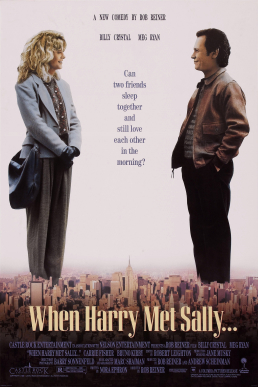
Behind the film
- Year
- 1989
- Director
- Rob Reiner
- Writers
- Nora Ephron
- Genres
- Romantic comedy, Christmas, Comedy
- Production
- Castle Rock Entertainment, Columbia Pictures
- Country
- United States
- Cast
- Billy Crystal, Meg Ryan, Carrie Fisher, Bruno Kirby, Franc Luz, Harley Jane Kozak, Lisa Jane Persky, Michelle Nicastro
About the film
Contains story spoilers.
Harry and Sally drive from Chicago to New York in 1977 and part after arguing about whether men and women can be friends. Later encounters eventually bring them together after both have lost relationships. They become close friends and introduce their friends Jess and Marie, who form a couple. When Sally learns her former boyfriend is marrying, Harry comforts her and they sleep together. His awkward departure makes the encounter painful, and their attempts to discuss it strain the friendship. Sally rejects the idea that she should be his consolation for loneliness. On New Year’s Eve, Harry recognises what their shared life has meant and runs to find her. He describes the particular things he loves about her, and they reconcile. A final account reveals they have married.
Nora Ephron’s screenplay makes compatibility something that accumulates rather than arrives fully formed. The first meeting supplies friction, but the story does not mistake a lively argument for complete knowledge of another person. Harry and Sally have to become people who can participate in the relationship they eventually recognise. Rob Reiner’s direction gives that gradual change room to feel ordinary, allowing conversation, routine and familiarity to bear the romantic weight. The time passing between meetings matters because it prevents their early opinions from becoming permanent definitions. A person who seemed impossible to like in one stage of life can become understandable in another without losing the habits that made the first meeting difficult.
Billy Crystal gives Harry a conversational confidence that is both attractive and evasive. An argument can let him remain in control of an uncomfortable subject by treating it as a general principle rather than a personal admission. If he sounds certain about how relationships work, he does not have to say as much about what frightens him within one. The humour often comes from the distance between that confidence and his emotional preparedness. He can explain a situation fluently while failing to respond generously to the person actually sharing it. The film makes his wit part of the connection, then asks whether wit alone can sustain what the connection has become.
Meg Ryan’s Sally has her own ways of arranging uncertainty. Precision can look like fussiness from the outside, but it can also be an effort to say what she wants clearly enough that somebody might listen. Her differences with Harry therefore involve more than temperament. They have different habits of making a request, defending an expectation and acknowledging disappointment. Ryan gives Sally enough assurance that vulnerability does not erase her judgment. She can be wounded without becoming merely the person waiting for Harry to improve. The romance requires him to recognise the meaning of her response, rather than treating her pain as another confusing feature of the theory he began with.
New York gives their relationship a world of repeated public rituals. Meals, walks, parties and conversations can be social occasions without being declarations, allowing companionship to grow in spaces neither character has to define as a romantic commitment. The city feels large enough to contain chance meetings and small enough, within their routines, for familiarity to become a kind of home. That balance suits the film’s interest in timing. Geography can put two people near each other while the moment remains wrong; later, the same ordinary activity can acquire meaning because their understanding has changed. The setting supports a romance made from shared habits as much as from exceptional gestures.
Carrie Fisher’s Marie and Bruno Kirby’s Jess make the central pair part of a larger conversation about coupling. Friends provide encouragement, unsolicited theories and another relationship against which Harry and Sally can measure their own. Their presence keeps romance from seeming like an isolated contest between two personalities. Becoming a couple also means joining an existing social world, with its expectations about what people should want and how quickly they should recognise it. The supporting performances give that world an easy conversational life. A friend’s certainty can be comforting when a person feels lost, but it can also make a private uncertainty seem like something that ought already to have been resolved.
The story’s recurring accounts from couples provide another scale of time. A relationship can look coherent when retold after years together, even if the people inside it experienced confusion as events unfolded. Ephron places that retrospective confidence alongside Harry and Sally’s unfinished present, creating a distinction between living a romance and knowing how to tell it. The audience is invited to see possibility without requiring the characters to possess that foresight. That arrangement helps explain why an apparently small misunderstanding can matter so much. Someone looking back might describe it as a temporary obstacle; the person encountering it does not yet know whether there will be a future from which to look back.
The eventual declaration depends on specificity. A theory about friendship cannot express what a particular shared life means, because the value of that life lies in habits, responses and details that a general rule would leave out. Harry’s change becomes convincing when he stops debating a category and addresses a person. The film does not establish a universal answer for every friendship between a man and a woman, and its characters’ assumptions belong to their own lives and period. It offers one relationship in which affection has become difficult to separate from familiarity. The ending recognises that being known can be romantic, provided knowledge is accompanied by the willingness to act with care.