
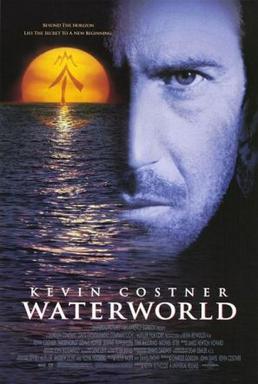
Behind the film
- Year
- 1995
- Director
- Kevin Reynolds
- Writers
- Peter Rader, David Twohy
- Runtime
- 2h 15m
- Genres
- Action, Science fiction, Post-apocalyptic, Dystopian
- Production
- Davis Entertainment
- Country
- United States
- Cast
- Kevin Costner, Jeanne Tripplehorn, Tina Majorino, Dennis Hopper, Michael Jeter
About the film
Contains story spoilers.
Waterworld makes the absence of land a practical condition of every relationship. People cannot move through its future without depending on something that floats, and the materials keeping them alive have to be preserved, traded or taken. That scarcity makes an apparently open landscape feel restrictive. The horizon offers room to travel without offering many places to arrive, so freedom and vulnerability remain closely connected, with the same openness that permits departure also making shelter difficult to find when conditions change. A solitary traveller can avoid some demands made by a community, but he cannot remove himself from the need for supplies or from other people's desire to obtain what he carries.
Kevin Reynolds directs the 1995 film, starring Kevin Costner as the Mariner, Jeanne Tripplehorn as Helen, Tina Majorino as Enola and Dennis Hopper as the Deacon. Peter Rader and David Twohy wrote the screenplay. The story's flooded future gives the adventure a world where living ground has become a possibility some people no longer believe in. That uncertainty separates survival from hope. A person can become capable of continuing on the sea without believing a different life exists, while somebody less adapted to the environment may still need the possibility of a destination to make continued survival meaningful.
At a floating settlement, the Mariner is imprisoned after his gills reveal his difference. A Smoker attack allows him to escape with Helen and Enola, whose tattoo is believed to point towards Dryland. The raiders pursue them and capture the girl. After his boat is destroyed, the Mariner recognises evidence supporting her connection to land and returns to rescue her from the Deacon's tanker. The tanker burns, the Deacon dies during the escape, and Gregor deciphers the tattoo. The group reaches a living island. Helen and Enola remain there, while the Mariner chooses to return to the sea.
The Mariner's adaptation makes his relationship to the world different from the relationship most people can have. What the settlement regards as alarming is also part of what allows him to live in conditions threatening everybody else. That difference complicates any simple account of the sea as a place people must escape. For Helen, another environment offers a future she wants for Enola; for him, the surrounding water is also the place in which his abilities make sense. Their shared journey can therefore move towards one destination without requiring that destination to answer the same need for everybody aboard.
Helen's care for Enola gives the supposed map a meaning beyond its usefulness. A route can be something to obtain, but the child carrying it also has a life that must be protected during the attempt to understand it. The raiders' pursuit makes that distinction particularly important. Their interest threatens to reduce her to access to a resource, while the developing companionship asks the Mariner to recognise somebody who cannot be adequately described through the advantage she might offer. The relationship changes his isolation by giving another person's future a place within his decisions.
The Deacon's power belongs to a different response to scarcity. Control over the raiders and their machinery allows him to make other people absorb the consequences of maintaining his position. The pursuit of a new destination promises an answer to limits he cannot indefinitely overcome through force. That makes the antagonism more than a contest between a sailor and a pirate leader. Both are operating within a world of diminishing possibilities, but their ways of responding distribute danger differently. The community built around taking from others cannot make its own appetite sustainable merely by discovering somewhere else to direct it.
The boats and floating structures give the action a geography defined by exposure. A vessel can be home, transport and the main means of survival simultaneously, so damaging it threatens more than the completion of a journey. The ocean's scale also makes companionship unusually immediate: people travelling together cannot easily separate after a disagreement without making that separation physically consequential. Reynolds's adventure uses those conditions to make trust a practical demand. Cooperation has to continue through uncertainty because the environment does not provide the ordinary alternatives of another road, a nearby house or somewhere safe to walk away.
The final departure allows discovery to remain real without becoming compulsory belonging. The Mariner has helped the others reach a place where their hopes can take a different form, yet his own relationship to the sea does not disappear when land becomes available. The ending therefore gives the rescue a value independent of possessing the destination himself. Waterworld completes the journey by letting people recognise different forms of home, preserving the importance of the bond formed at sea while allowing it to continue through separation. The ocean remains vast, but the man returning to it has acted for lives beyond the solitary one with which he began.