
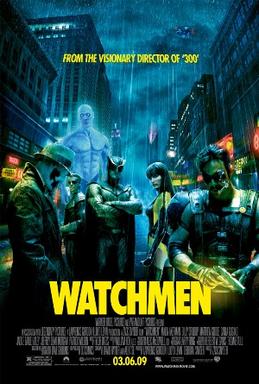
Behind the film
- Year
- 2009
- Director
- Zack Snyder
- Writers
- David Hayter, Alex Tse
- Genres
- Neo-noir, Dystopian, Vigilante, Superhero
- Production
- Legendary Pictures, DC Comics, Lawrence Gordon Productions
- Country
- United States
- Cast
- Billy Crudup, Patrick Wilson, Jackie Earle Haley, Malin Åkerman, Carla Gugino, Matthew Goode, Jeffrey Dean Morgan, Stephen McHattie
About the film
Contains story spoilers.
Watchmen opens in a world where superheroes have already changed history, and that change has not made the future safe. It is 1985, Richard Nixon is still president, and nuclear confrontation is approaching. Most costumed vigilantes have retired or been outlawed. The exception with truly extraordinary power is Doctor Manhattan, a former physicist whose transformation has made him an American strategic asset. Zack Snyder's adaptation of the graphic novel uses that alternative history to alter the usual superhero promise. Power has consequences for governments, wars and ordinary people's expectations, while the people in costume remain vulnerable to vanity, cruelty and fear. The murder of Edward Blake, the Comedian, begins a mystery inside this unsettled arrangement.
Rorschach sees the killing as evidence that somebody may be targeting former masked crime-fighters. Jackie Earle Haley gives the investigator a harsh physical and vocal presence, with his shifting inkblot mask concealing a face that the police will eventually expose. Rorschach's refusal to compromise can resemble moral certainty, but his violence makes that certainty frightening. Patrick Wilson's Dan Dreiberg, the former Nite Owl, approaches their past more hesitantly. His equipment remains available, while his confidence has faded. Matthew Goode's Adrian Veidt has converted the identity of Ozymandias into a corporate empire. These different lives show that retirement has not released the characters from their costumes. Each has found another way to carry the need for significance, order or action.
The Comedian's funeral brings memories rather than a clean account of an honoured colleague. Jeffrey Dean Morgan's Blake has participated in the brutality of this world's politics, and his contempt for heroic ideals does not excuse what he has done. Laurie Jupiter, played by Malin Åkerman, also inherits a costumed identity from her mother, Sally. Being the second Silk Spectre makes her life partly an answer to somebody else's ambitions. Her relationship with Doctor Manhattan places her beside astonishing power and an increasingly distant partner. Billy Crudup's Manhattan can manipulate matter without easily understanding what another person needs from him. The difference between his capabilities and his emotional availability makes intimacy another field where apparently overwhelming strength fails to solve the problem.
The investigation spreads as pressure on the former heroes increases. Manhattan withdraws to Mars after public accusations that people close to him have developed cancer. Rorschach is framed for murder and imprisoned. Dan and Laurie resume their costumed roles, finding an energy together that their civilian lives had not supplied, and break him out. The action gives their return a practical purpose without making the costumes morally neutral. Rorschach's brutality does not disappear because his suspicions may contain truth. The film keeps the excitement of spectacular rescue alongside discomfort about who is exercising force. Its investigators can identify a threat while still carrying serious problems of their own, making the question of whom to trust persist beyond any individual clue.
Manhattan's distance changes the scale of the story. On Mars, human crises can appear almost absurdly brief beside the structures he can create and the time he perceives differently. Laurie has to argue for a value that cannot simply be calculated from physical power. Her discovery that Blake is her father reveals an unlikely chain of human choices, including a history shaped by his attempted rape of Sally. The revelation does not make that assault acceptable or dissolve its horror into destiny. It unsettles an understanding of parentage and allows Manhattan to reconsider the improbability of a particular life. Against his expanding abstraction, Laurie insists on people as individuals with histories, not interchangeable inhabitants of a threatened planet.
Dan and Rorschach trace the conspiracy to Veidt's Antarctic base. His plan is already complete when they confront him: destructive energy attacks have devastated cities, and the world believes Doctor Manhattan is responsible. Veidt intends the shared threat to end the conflict between nations. The film's catastrophe is therefore engineered through the apparent signature of a being those nations already fear. It is not the giant-creature attack used in the original comic's ending. The timing denies the confrontation its conventional promise. Identifying the mastermind does not mean there is still a bomb to disarm. Veidt has chosen to commit mass murder first and seek moral agreement afterwards, leaving the survivors to decide what exposing him might now cause.
The others accept concealment to preserve the resulting peace; Rorschach refuses. Manhattan kills him rather than let him reveal the truth. Dan's anger at Veidt prevents the silence from becoming an uncomplicated endorsement, and Manhattan leaves humanity behind. The conflict remains between an atrocity presented as necessary and a principle maintained at the price of another life. Neither the scale of Veidt's intelligence nor Manhattan's power can make the dead cease to matter. Rorschach has also left his journal with a newspaper, creating a possible route by which the secret could escape. The final approach to that document keeps the settlement precarious. A supposedly perfected plan still depends on what a person in an ordinary newsroom decides to pick up.
The film tells this history through accumulated images as much as investigative dialogue. Its opening montage places costumed figures inside recognisable cultural and political scenes, making the alternative timeline legible before the main inquiry explains it. Flashbacks then interrupt the forward movement, revealing relationships that the survivors have edited or misunderstood. Slow motion and heightened violence give heroic poses weight while exposing the damage those poses can conceal. The blue distance of Manhattan, the enclosing mask of Rorschach and Dan's elaborate flying machine offer different pictures of separation from ordinary life. Each can look like protection and become isolation. By the end, the murder mystery has opened onto a broader uncertainty: the people who claim to protect humanity disagree profoundly about what protection allows them to do.