
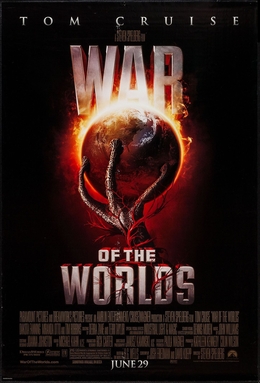
Behind the film
- Year
- 2005
- Director
- Steven Spielberg
- Writers
- Josh Friedman, David Koepp
- Genres
- Action, Science fiction, Thriller, Alien invasion
- Production
- Paramount Pictures, DreamWorks, Amblin Entertainment
- Country
- United States
- Cast
- Tom Cruise, Dakota Fanning, Justin Chatwin, Miranda Otto, Tim Robbins, Rick Gonzalez, Lenny Venito, Lisa Ann Walter
About the film
Contains story spoilers.
Steven Spielberg’s War of the Worlds brings an interplanetary invasion down to a single family’s scale. Ray Ferrier is a New Jersey dockworker, divorced from Mary Ann and estranged from his children, Rachel and Robbie. He has weekend custody, but the children arrive at his cluttered home with a guardedness that makes clear he is not the parent who usually handles their routines. Their visit begins as an awkward domestic negotiation: Ray tries to act in charge, Robbie pushes back, and young Rachel watches both of them. The film’s science-fiction premise interrupts before anyone has repaired that relationship, forcing Ray to become responsible in circumstances where his usual shortcuts fail.
A series of strange lightning storms strikes the neighborhood, and Ray notices that the ground itself seems disturbed. A colossal tripod rises from beneath the streets and destroys people and buildings with a heat ray. The machines move through familiar suburban roads as if the town were only an obstacle. Ray gets the children into a car and drives away through a collapsing city, but escape is not a clean line from danger to safety. Roads clog, crowds become unpredictable, and the family has no reliable information about what is happening beyond the immediate attack. The movie uses street-level views, radio fragments and sudden eruptions to keep the invasion frighteningly larger than the characters’ understanding.
Ray heads toward Boston, where Mary Ann and her parents may provide shelter. The trip makes his children’s differing needs visible. Rachel is young and terrified, clinging to routines and asking for explanations Ray cannot give. Robbie is older and increasingly drawn toward the military response, angry at his father’s attempts to order him around. When the family reaches a ferry crossing, crowds surge toward the boats and the tripods attack the shoreline. All three survive the ferry attack. Later they encounter a military counter-offensive, and Robbie insists on joining the fighting, disappearing from Ray’s sight. Ray chooses to continue with Rachel, carrying guilt over leaving his son behind and uncertainty about whether he can protect either child.
Ray and Rachel take shelter in a cellar with Harlan Ogilvy, a former ambulance driver whose determination to fight conflicts with Ray’s need to keep his daughter hidden. Their refuge is interrupted by a mechanical probe and then by aliens exploring the rooms around them. The invasion has entered a scale where remaining quiet matters more than running quickly. Ordinary furnishings provide cover, but every movement can reveal the people trying to hide. Above ground, red vegetation spreads across the landscape, and the machines harvest humans to sustain it. This discovery makes Harlan increasingly unstable. Ray fears that his shouting will expose Rachel and kills him out of her sight. The act is left largely outside the camera’s view, keeping attention on the father’s decision and the child he is trying to protect.
The cellar changes the film’s rhythm after the crowded road journey. Ray can no longer rely on a vehicle, a destination or the movement of other refugees to supply the next step; he has to wait close to a frightened child while a much stronger enemy searches. When another probe discovers them sleeping, Rachel flees outside and is captured by a tripod. Ray takes grenades from an abandoned military vehicle and deliberately lets himself be taken too. Other prisoners pull him away from the mechanism carrying captives into the machine, allowing the explosives to destroy it from within. Their escape depends on people helping one another under immediate pressure. It removes a single threat rather than offering a strategy that could defeat the invasion everywhere.
Ray and Rachel eventually reach Boston, where alien tripods have begun to fail. Birds settling on one machine reveal that its protective shield has stopped working, and Ray alerts soldiers who bring it down. The invasion ultimately fails because the aliens succumb to Earth’s microorganisms, to which they have no immunity. The film’s explanation echoes the structure of H. G. Wells’s original novel, though this adaptation updates the setting and centers a contemporary American family. Ray finds Mary Ann’s parents’ home and discovers that Robbie has survived and reunited with them. The reunion is abrupt and emotionally complicated; relief comes before the family can resolve how Robbie escaped the fighting or how Ray’s earlier choices will affect their trust.
Spielberg’s staging emphasizes the gap between immense catastrophe and what any one person can see. The camera stays near Ray and the children as smoke, dust and debris fill the frame, so the scale of the attack is experienced in fragments rather than from a secure overview. The sound design makes the tripods’ horn-like calls feel both mechanical and almost biological, while the ordinary rhythm of a custody weekend gives the opening an intimate baseline. By the end, Ray has not become a heroic strategist; he has been pushed into the role of parent he had neglected. His journey ends with the family physically reunited, but the film leaves the emotional repair ahead of them.