
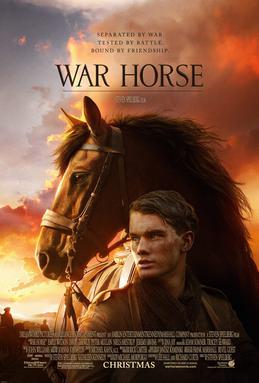
Behind the film
- Year
- 2011
- Director
- Steven Spielberg
- Writers
- Lee Hall, Richard Curtis
- Runtime
- 2h 26m
- Genres
- War, Drama
- Production
- DreamWorks, Amblin Entertainment, Reliance Entertainment
- Country
- United States
- Cast
- Jeremy Irvine, Emily Watson, Peter Mullan, David Thewlis, Tom Hiddleston, Benedict Cumberbatch, Niels Arestrup, David Kross
About the film
Contains story spoilers.
Steven Spielberg’s War Horse follows Joey, a bay horse whose life begins in rural Devon and is repeatedly redirected by the First World War. Albert Narracott forms a close bond with the horse after his father buys him at auction, and trains him to plough a field that the family needs for its livelihood. When the harvest fails, Joey is sold to the army. He passes from British cavalry to German soldiers, then to a French girl and her grandfather, before becoming trapped in barbed wire between the lines. Albert, now serving at the front, is temporarily blinded by gas. British and German soldiers venture into the open together to free Joey. At war’s end, the horse is auctioned; the grandfather recognizes Albert’s attachment and returns him to the young soldier, who carries Joey and a cavalry pennant home.
The horse’s passage from one household to another gives the film a chain of human viewpoints without pretending that Joey speaks for himself. Each person reads him through a different need: as a farm animal, cavalry mount, workhorse or beloved companion. The changing owners are not all granted equal time, and that unevenness is part of the design. The film keeps returning to the fact that an animal’s fate can be decided by people with very different degrees of power. Joey’s continuity offers a simple line through a complicated war, but the meaning of that continuity changes as the surroundings change. His survival does not make the conflict coherent; it makes the human institutions around him easier to compare.
Jeremy Irvine’s Albert is written as a young man whose confidence is rooted in patience with the horse. Their bond is communicated through routines of training, work and touch, so Albert’s affection has a practical dimension. He does not merely want Joey near him; he has learned how to read the animal’s behavior and earn a response. That mutual attention forms a contrast with the abrupt orders and transfers demanded by military life. Emily Watson and Peter Mullan play Albert’s parents as people managing land, debt and pride, not as simple obstacles to a boy’s dream. Their farm is a working place with consequences attached to every choice. Joey’s sale is therefore painful because it grows from economic pressure as well as family disagreement.
The production makes the horse’s physical presence central. Fourteen horses played Joey, requiring the production to sustain the impression of one animal moving through different conditions. Spielberg builds the action around readable bodies and distances: a rider’s balance, a horse’s hesitation, mud and wire across open ground. Those details matter because the story’s emotional scale depends on believable contact between people and animal. Effects are part of the film’s visual construction, but the filmed performance retains weight and texture. The camera’s attention to Joey’s face and gait gives the audience a stable point of recognition even as costumes, accents and uniforms change around him.
The landscapes provide a second continuity. Devon’s fields, the ordered spaces of cavalry, occupied farmland and the scarred front are not interchangeable backdrops. They show how the same animal’s movement is first associated with work, then with ceremony and finally with survival. The film’s broad compositions can make people appear small against fields or battle terrain, but it does not turn that scale into a map of military strategy. It stays with immediate hazards rather than explaining the war through policy. The result is deliberately personal: the conflict is encountered through what can happen to bodies, animals and homes. Its historical setting is specific, while its central dramatic device—a horse carried through human systems—remains a fictional construction.
The score and editing help make the story episodic without leaving it emotionally scattered. Changes of location and owner mark new chapters, but the film uses recurring visual cues—the bay coat, the distinctive pennant and Albert’s recognizable attention—to keep Joey’s journey legible. Music often enlarges the feeling of an image, yet the most effective pauses allow the sound of a horse moving through a space to carry the moment. Battle sequences are staged as dangerous environments rather than clean contests, with confusion interrupting the idea of a heroic charge. The movie’s sentiment is direct, but it is tied to visible labor and vulnerability. It wants the audience to feel attachment while still noticing the machinery that repeatedly puts the animal at risk.
The horse-centered story puts a limit on the sorts of answers a war film can offer. Joey cannot choose a cause or explain an allegiance, so his needs expose the consequences of human choices without endorsing their justifications. That perspective makes care unusually concrete: someone must notice exhaustion, make room for a vulnerable body or accept a responsibility that brings no strategic advantage. It is a modest ethical scale inside a vast conflict. Attachment does not repair the world, and compassion does not need to accomplish that impossible task to matter. The film's emotional promise rests on acts that remain available when larger explanations fail. A person can offer attention and protection even while belonging to an institution organized around destruction.