
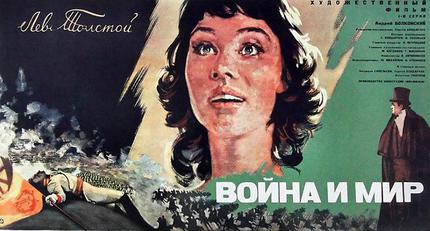
Behind the film
- Year
- 1965
- Director
- Sergei Bondarchuk
- Writers
- Sergei Bondarchuk, Vasily Solovyov
- Genres
- War, Drama, Epic, Historical
- Production
- Mosfilm
- Country
- Soviet Union
- Cast
- Sergei Bondarchuk, Ludmila Savelyeva, Vyacheslav Tikhonov, Boris Zakhava, Anatoly Ktorov, Antonina Shuranova, Oleg Tabakov, Kira Golovko
About the film
Contains story spoilers.
War and Peace asks how a life can remain personal when history grows large enough to swallow every ordinary plan. Sergei Bondarchuk's adaptation of Leo Tolstoy's novel is a four-part film, not a television series and not the earlier Hollywood adaptation. Its length gives it room to hold domestic hopes beside military upheaval without pretending that one belongs to a separate world. People can be concerned with a conversation, a marriage or their place in society while armies are changing the conditions under which those concerns will matter. The private life does not stop when public history begins.
Bondarchuk directs and plays Pierre, with Ludmila Savelyeva as Natasha and Vyacheslav Tikhonov as Andrei. The screenplay is credited to Bondarchuk and Vasily Solovyov, adapting Tolstoy rather than treating the novelist as a screenwriter. The film's scale is evident in its movement between social gatherings and massed conflict, but size alone would not explain why those movements belong together. The same people who seek meaning through personal decisions must live with forces no decision can master. Its breadth allows their changing perspectives to become part of the account of war, rather than using them only to decorate a sequence of historical events.
Across the four parts, Pierre inherits wealth and makes an unhappy marriage, while Andrei's search for purpose leads through military service and family loss. Natasha and Andrei's engagement breaks after her involvement with Anatole. The French invasion and Borodino bring the characters into a wider catastrophe. Andrei, wounded, later reconciles with Natasha before dying. Pierre survives captivity and is freed by partisans; he and Natasha eventually reunite. Those events span years of altered expectations. Their importance lies partly in how much the characters must revise the lives they once thought were waiting for them.
Pierre offers a particularly revealing way into that problem because an inheritance can change a person's circumstances without supplying a coherent identity. Money gives him position and options, but options do not answer what an option is worth choosing for. Reading his journey through that distinction keeps privilege from becoming an easy explanation for happiness. A life can be materially expanded while remaining inwardly unsettled. Within the larger narrative, his searching makes the question of purpose something repeatedly tested rather than a conviction stated once and then carried unchanged through the rest of the story.
Andrei's hopes point toward another possible answer: meaning through distinction, discipline or a public achievement. That desire is recognisable even outside the particular social world of the film. Someone dissatisfied with daily life may imagine that a sufficiently important undertaking will settle the dissatisfaction. War complicates the promise by placing an individual's aspiration among the needs and suffering of many others. The distance between the heroic picture of oneself and the vulnerable person who actually experiences an event becomes hard to avoid. Loss can alter the meaning of ambition more decisively than success could ever confirm it.
Natasha's place in the story brings time and feeling into close contact. Youth can make an emotional possibility seem immediate and total, while social arrangements insist that the same possibility wait, negotiate and answer to other people. That mismatch does not excuse every choice, but it makes the consequences more understandable than a simple division into sensible and foolish characters would allow. The longer narrative gives affection a history. Love can arrive in one form, be damaged, acquire remorse and return with a different understanding of what the other person has endured. Reconciliation becomes something distinct from returning to an untouched beginning.
The public scale prevents those transformations from appearing solely self-generated. A landscape of conflict changes what is possible, who can meet, what can be kept and whether someone survives long enough to reconsider. At the same time, the intimate scale stops history from becoming a diagram with people standing in for labels. A battle matters differently when the narrative has made room for somebody's expectations before it. This relationship between scales is central to the film's idea of an epic: many lives occupy the same upheaval, but they do not occupy it with identical knowledge, identical power or identical losses. Following that difference helps keep the crowded narrative legible: an event shared by thousands may become a different turning point for each individual.
The ending's continuation of life should therefore be distinguished from a claim that suffering has been made worthwhile. Survival permits new attachments; it does not refund what has disappeared. That balance gives War and Peace a broader horizon than either a romance resolved by a couple or a war story resolved by an outcome. Its characters are left to inhabit the world that events have changed. The film's lasting question is how people learn to live without the certainty that their earlier plans implied. Across its enormous canvas, the answer emerges through relationships and revisions rather than a single triumphant statement about history.