
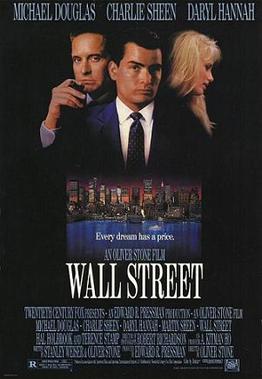
Behind the film
- Year
- 1987
- Director
- Oliver Stone
- Writers
- Oliver Stone, Stanley Weiser
- Genres
- Drama, Crime
- Production
- 20th Century Studios
- Country
- United States
- Cast
- Charlie Sheen, Michael Douglas, Daryl Hannah, Martin Sheen, Hal Holbrook, Terence Stamp, Sean Young, James Spader
About the film
Contains story spoilers.
In 1985, junior broker Bud Fox finally meets investor Gordon Gekko, winning his interest with inside information about Bluestar Airlines from his father Carl, a union representative. Bud prospers through further illicit dealings, while Gekko supplies access to wealth and a relationship with Darien. Bud proposes a Bluestar takeover he believes will strengthen the airline, then learns Gekko plans liquidation. Carl suffers a heart attack. Bud turns to rival investor Sir Larry Wildman, using union cooperation and a stock manoeuvre to defeat Gekko and protect the company. The SEC arrests Bud for his own offences. Wearing a wire, he confronts Gekko and records incriminating admissions. His parents accompany him to court: helping expose his mentor does not erase his responsibility for choosing the same methods.
Oliver Stone's film makes temptation feel like an invitation to become visible. Charlie Sheen's Bud is not content with doing well enough at an ordinary job; he wants someone powerful to recognise something exceptional in him. That appetite makes Gekko's attention valuable before its financial rewards have fully arrived. The possibility of admission to another world changes how Bud judges his existing one. Patience starts to resemble failure, and people who have spent years building a life can seem like warnings about settling. His ambition therefore has an emotional weakness at its centre. He can be persuaded that speed and access demonstrate worth, especially when the person offering them appears to possess everything he has been taught to desire.
Michael Douglas's Gekko understands that weakness as a form of leverage. He has the authority of someone who does not seem to need permission, and his speech turns aggression into a coherent-sounding account of how the world works. The force of the character comes partly from that ability to make self-interest appear clarifying. He does not ask Bud to believe himself a villain; he offers him a language in which hesitation looks naive and extraction looks intelligent. Their relationship is consequently more than a transaction between a wealthy client and an eager broker. Gekko teaches Bud how to narrate his choices to himself. Once wrongdoing can be called realism or initiative, a compromised act becomes easier to repeat without confronting its meaning.
Carl provides a competing account of value. Martin Sheen's character understands work through the people whose livelihoods depend on it, a perspective that can sound unglamorous beside Gekko's certainty. The father and son are not simply separated by income. They disagree about what deserves admiration and how achievement should be measured. Bud wants to escape a future that appears limited, while Carl sees dignity in a life sustained through effort and obligations. The film gives that disagreement its force by keeping affection inside it. A parent can love a child without admiring the child's direction, and a son can seek approval while treating the parent's standards as an obstacle. The conflict asks whose respect Bud is willing to lose to obtain someone else's.
The financial world turns information into a source of power, making knowledge seem detached from the circumstances in which it was acquired. A useful detail can travel across a desk and become an opportunity, while the trust that made it available disappears from the calculation. That is one of the story's important moral shifts. Bud begins to treat relationships as possible channels of advantage, so ordinary conversations take on a second purpose. The screenplay by Stone and Stanley Weiser makes this more unsettling than a simple attraction to cash. A person can retain the appearance of friendliness while quietly changing what another person means to him. The drama follows the resulting narrowing of attention, as questions about consequences are displaced by questions about what can be obtained.
Darien, played by Daryl Hannah, belongs to the desirable surface Bud is learning to inhabit. Her presence connects aspiration with taste, showing how a new life can announce itself through objects, rooms and associations. Those signs offer the reassurance that success has become concrete: it can be displayed and recognised by people who know the codes. Yet a carefully arranged environment does not settle the uncertainties inside the person occupying it. Bud can acquire the appearance of arrival while remaining dependent on someone else's favour. The film uses luxury as a language of status without granting it the ability to establish security. What seems like independence may simply be a more expensive condition of being judged, with different people deciding whether he belongs.
The corporate conflict gives the story a way to distinguish ownership from responsibility. From one perspective, a company can be represented as assets, numbers and opportunities to release value. From another, it is a working arrangement that supports people and relies on their accumulated skills. Neither scale of description is innocent when it begins excluding the other. The film's interest is in who gets to impose an interpretation and who absorbs its consequences. Its dialogue about greed can sound universal, but the surrounding drama keeps returning to particular attachments. A financial victory may be intelligible on its own terms while remaining destructive when measured against the lives beneath it. That tension explains why the struggle cannot be resolved solely by showing that Bud has become better at playing the game.
His eventual resistance also does not make him an uncomplicated hero. There is a difference between recognising a betrayal and acknowledging the earlier choices that helped make it possible. Wall Street allows personal loyalty to prompt a change while retaining the question of accountability. Bud has to consider the standards he accepted when their costs were easier to keep at a distance. The ending gives that recognition somewhere to go without pretending recognition itself is a complete payment. Its deeper conflict is about the kind of person ambition produces when admiration becomes scarce and power seems able to distribute it. The film leaves wealth visible, persuasive and dangerous, but asks Bud to see the people and obligations his pursuit had taught him to ignore.