
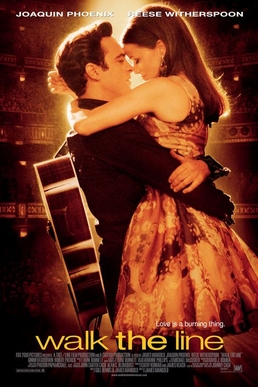
Behind the film
- Year
- 2005
- Director
- James Mangold
- Writers
- Gill Dennis, James Mangold
- Genres
- Biographical, Musical, Drama, Flashback
- Production
- 20th Century Studios
- Country
- United States, Germany
- Cast
- Joaquin Phoenix, Reese Witherspoon, Ginnifer Goodwin, Robert Patrick, Dallas Roberts, Larry Bagby, Dan John Miller, Shelby Lynne
About the film
Contains story spoilers.
Walk the Line uses musical performance to connect a public career with a private life that success cannot automatically repair. Its subject is Johnny Cash, but its dramatic focus is narrower than a complete account of everything he did. The story follows the formation of a voice, the damage surrounding it and the relationship through which a different future becomes possible. A song can reach an audience while its performer remains unable to communicate honestly at home. That gap gives the film its tension. Talent provides opportunity, yet the choices needed to sustain a life cannot be substituted for by recognition or applause.
James Mangold directs the 2005 film, starring Joaquin Phoenix as Johnny Cash and Reese Witherspoon as June Carter. Ginnifer Goodwin plays Vivian, while Robert Patrick plays Johnny's father. Gill Dennis and Mangold wrote the screenplay, drawing on Cash's autobiographical books. Those origins do not make every scene an independently established historical fact. This is a dramatised screen biography, arranging events and relationships into a particular emotional arc. Its useful boundary is the life as represented by the film: a selected story of ambition, addiction and courtship, with the music giving public expression to pressures the protagonist struggles to manage privately.
The film frames Johnny's earlier life through the approach to his Folsom Prison performance. Childhood loss and conflict with his father precede marriage, work and an opportunity at Sun Records. Touring brings success and a connection with June, alongside escalating addiction and the collapse of his marriage to Vivian. June resists the destruction accompanying his attachment to her, then helps him through withdrawal. The prison concert renews his connection to an audience. During a later stage performance, he proposes to June and she accepts. The ending joins their commitment to a hopeful family future without covering the entirety of their later lives.
The childhood material gives the adult story a pressure that achievement cannot simply release. Recognition can be pursued as if it might finally settle a judgment made long before a person could answer it. The film places that expectation beside the practical demands of becoming a performer. A voice must be found and heard, but being heard by strangers does not ensure that the person whose approval matters most will respond differently. That creates an emotional contradiction within success. The career can advance while an earlier wound retains its authority, leaving professional momentum and personal stability moving in different directions rather than supporting one another.
Vivian's position brings the costs of that momentum into the household. A dream pursued on the road depends on a life continuing elsewhere, and the person maintaining that life may experience ambition as absence rather than possibility. The film's family conflict makes those perspectives coexist. Understanding the protagonist's desire does not require dismissing what his pursuit demands of others. This is one reason the musical rise cannot carry the story on its own. Applause gives one kind of evidence that his work matters, while domestic disagreement reveals needs that the same work does not necessarily meet. Both are part of the life being built.
June's importance also involves limits rather than endless availability. Care can recognise somebody's worth while refusing to accommodate everything they do. That makes the relationship more complicated than the idea that a sufficiently loving person can rescue another through devotion alone. Trust requires behaviour that gives it somewhere to stand, and a shared future cannot honestly depend on one person carrying every responsibility. The story's hopeful movement gains meaning because support and resistance are allowed to exist together. Affection is not presented as proof that the damage never mattered; it becomes part of the difficult process of deciding what can change and what must be confronted.
Performance changes meaning across that process. A stage can be a place of ambition, instability, partnership or recognition, depending on the relationship between the performer and the people listening. Music allows feelings to take a form that direct conversation may fail to achieve, but the film does not make expression identical to resolution. Being able to sing about pain is different from accepting responsibility for its effects. That distinction keeps the songs connected to the drama without turning them into automatic explanations. Their emotional force comes partly from the distance between what can be communicated through a performance and what remains unfinished after it ends.
The Folsom setting gives the public career an audience whose presence matters to the protagonist's understanding of his work. The story returns to its opening situation with the intervening life now altering its significance. That structure makes the concert a point of connection rather than merely another milestone in a sequence of successes. The closing relationship offers a future the film has spent time making difficult to reach. It remains a chosen endpoint within a longer real life, not a claim that all later problems were solved. This is a musical biography organised around the search for a voice and the harder task of learning how to live alongside it.