
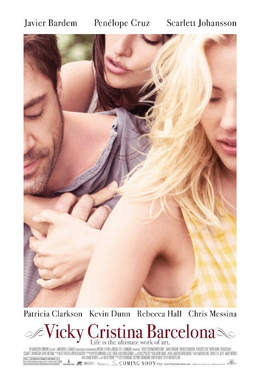
Behind the film
- Year
- 2008
- Director
- Woody Allen
- Writers
- Woody Allen
- Genres
- Drama, Lgbtq-related, Comedy drama, Romantic comedy
- Production
- Mediapro, Wild Bunch, The Weinstein Company
- Country
- United States, Spain
- Cast
- Rebecca Hall, Scarlett Johansson, Javier Bardem, Penélope Cruz, Patricia Clarkson, Chris Messina, Kevin Dunn, Pablo Schreiber
About the film
Contains story spoilers.
Vicky and Cristina spend a summer with relatives Judy and Mark in Barcelona. Artist Juan Antonio invites them to Oviedo. Cristina falls ill, leaving engaged Vicky to grow close to him and begin a secret affair. Back in Barcelona, Cristina becomes his partner. His former wife María Elena joins their household after a crisis, and the three form a relationship. Vicky marries Doug but remains drawn to Juan Antonio; Judy encourages her to reconsider. Cristina becomes restless and leaves, destabilising the artists' reunion. Vicky visits Juan Antonio again, but María Elena interrupts with a gun and wounds her hand. Vicky rejects that life. She and Cristina return to America, one resuming her marriage and the other still uncertain what she wants. Their experience has complicated desire without resolving it.
The friendship begins with a contrast that sounds comfortably clear. Rebecca Hall's Vicky has plans and standards she can describe; Scarlett Johansson's Cristina is more willing to entertain unfamiliar possibilities. Woody Allen's screenplay gradually makes both positions less secure. Being able to state what one wants does not guarantee that an unexpected feeling will fit the statement, while openness does not guarantee discovery of something lasting. Their different temperaments are useful because neither can simply absorb the other's experience. The holiday gives them a shared setting but not a shared answer. As their responses diverge, friendship becomes a way of recognising that another person's freedom or certainty may conceal difficulties rather than supply a model ready to be borrowed.
Vicky's restraint carries more than fear of adventure. She has organised an idea of adulthood around commitment and intelligible choices, so attraction creates a problem for her understanding of herself. Hall plays that disturbance through the effort to remain composed. A person may defend a sensible position while privately recognising that the position no longer explains everything. The resulting discomfort does not mean her established values were fraudulent; it means values and feelings can come into conflict without either becoming unreal. The film follows that conflict with room for embarrassment and self-deception. Vicky wants experience to confirm the kind of person she believes herself to be, making the possibility of another life emotionally powerful even when its practical terms remain unclear.
Cristina has a different relationship with uncertainty. She can describe dissatisfaction more readily than a destination, which gives her willingness to experiment an appealing freedom and a built-in instability. Johansson's character is not satisfied merely because an arrangement is unconventional. Its novelty may answer one question while leaving another untouched. That makes her place in the story more interesting than a simple embodiment of liberation. A person can resist prescribed roles and still struggle to distinguish curiosity, belonging and the need to move again. The film allows those impulses to coexist. Her openness has consequences for other people, so restlessness does not remain a private matter once a relationship has begun organising itself around her presence.
Javier Bardem's Juan Antonio offers an attractive story about living beyond ordinary inhibition. He can make a proposal sound like an opportunity to be more honest, more adventurous or less constrained. The persuasive force lies partly in how readily he names possibilities others have been taught to approach indirectly. Yet clarity about an immediate desire does not establish clarity about a whole relationship. His artistic world carries a promise of authenticity that the surrounding drama continually complicates. Expressiveness can reveal a feeling without making someone reliable, and emotional intensity can coexist with habits that frustrate stability. The film therefore treats his confidence as something the visitors must interpret, rather than granting the person most fluent in the language of freedom the authority to define freedom for everyone else.
Penélope Cruz's María Elena brings that complication into sharp focus. Her intensity does not allow the artist's private history to remain a picturesque explanation for his temperament. She is another person with desires, resentments and a sense of her own importance, giving the relationship a competing account of itself. Cruz makes their shared artistic identity feel inseparable from rivalry and dependence. Affection does not settle who has been recognised or whose contribution has been taken for granted. The character can be funny without the hurt beneath her behaviour disappearing into the joke. Her presence makes it difficult to regard passionate incompatibility as a purely attractive feature of an artistic life, because the consequences are being experienced by people rather than observed from a safe distance.
Barcelona and the surrounding travel spaces give the story a temporary looseness. A holiday separates people from the routines that normally make their choices feel inevitable, allowing a different version of the self to seem available. The city's beauty supports that possibility without proving the version sustainable. Woody Allen's direction keeps pleasures of place close to conversations about attachment, so the atmosphere becomes part of what the visitors are responding to. There is a difference between wanting a person and wanting the life that person appears to make imaginable. The film does not insist those desires can always be cleanly separated. It allows the appealing environment to complicate interpretation, making romance feel expanded by circumstances that cannot simply accompany everyone home.
Judy supplies a quieter form of dissatisfaction beside the younger women's uncertainty. Patricia Clarkson gives her a position from which someone else's possible choice can seem like a chance to revisit one's own. That is an important pressure inside advice: concern for another person may mingle with regret, projection and the desire to see a different outcome demonstrated. The film's adults do not divide neatly into those who have solved life and those who have yet to begin it. Commitment can continue without certainty, and experience can sharpen a longing without providing a reliable remedy. The ending retains those ambiguities. A summer can alter what someone understands about desire while leaving the next choice just as difficult to name.