
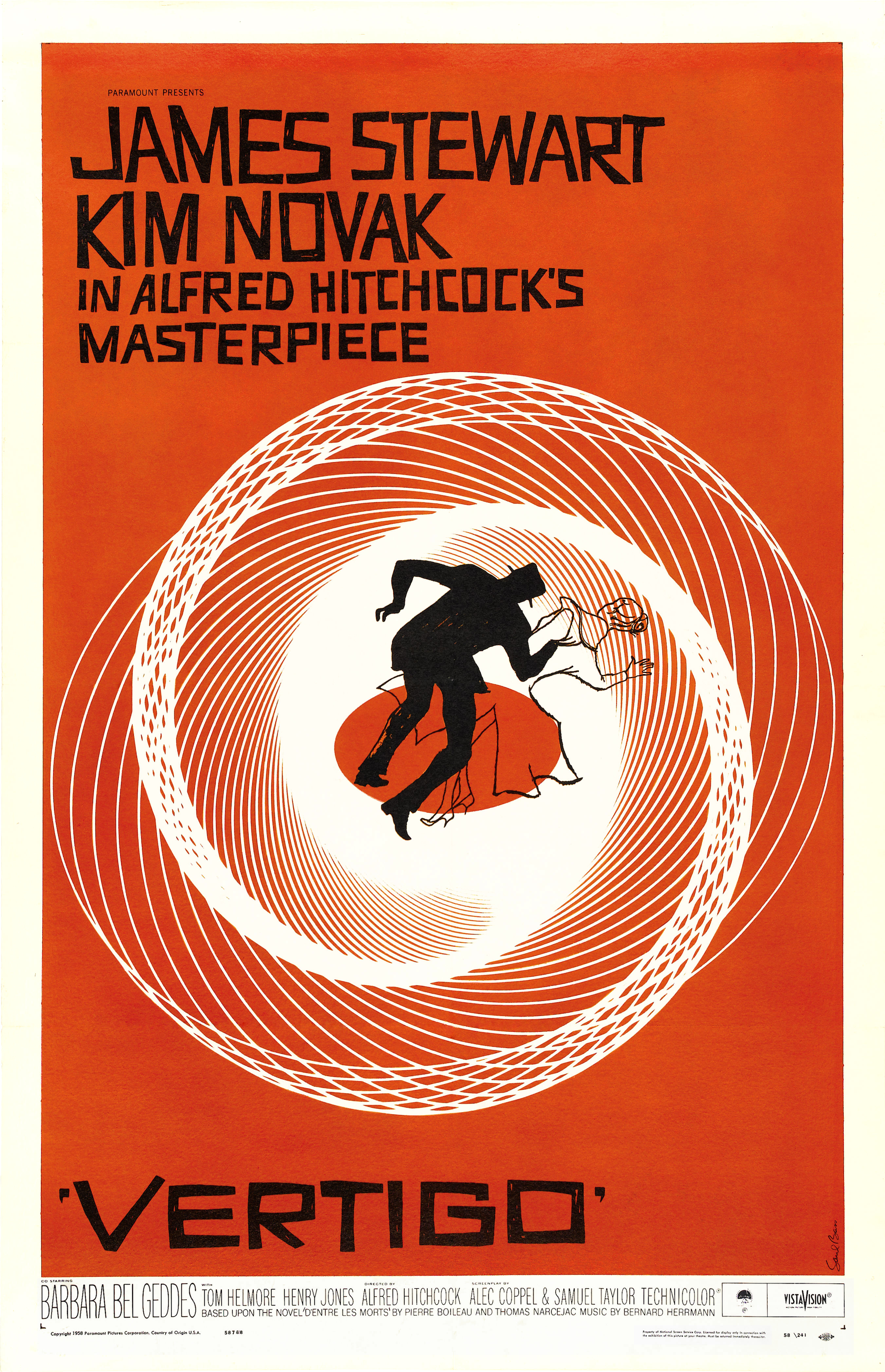
Behind the film
- Year
- 1958
- Director
- Alfred Hitchcock
- Writers
- Alec Coppel, Samuel A. Taylor
- Genres
- Mystery, Thriller, Drama, Romance
- Production
- Paramount Pictures
- Country
- United States
- Cast
- James Stewart, Kim Novak, Barbara Bel Geddes, Tom Helmore, Henry Jones, Raymond Bailey, Ellen Corby, Konstantin Shayne
About the film
Contains story spoilers.
Vertigo begins with a pursuit across San Francisco rooftops that ends in a death. Detective John Ferguson, known as Scottie, is left with a fear of heights and the dizziness that can accompany it, making police work impossible. His friend Midge knows him well and offers practical companionship, but he is restless without an occupation. An old acquaintance, Gavin Elster, supplies one: watch his wife Madeleine and discover where she goes during periods she apparently cannot explain. Elster presents the task as a concern for her wellbeing, suggesting a connection with a woman from the past. Scottie reluctantly accepts, then becomes fascinated by the person he has been asked to observe.
Following Madeleine turns the city into a route of repeated images. She buys flowers, visits a grave, and sits before a museum portrait of Carlotta Valdes, whose hairstyle and bouquet resemble her own. A hotel and an account of Carlotta’s unhappy life add to the impression that Madeleine is reliving someone else’s history. Scottie watches from a distance, often without speaking to her, so the apparent pattern reaches him through appearances before it can be tested through conversation. Alfred Hitchcock makes the act of following feel absorbing in itself. Doors, cars, and streets connect one sighting to the next, while each quiet stop deepens Scottie’s investment in the explanation Elster supplied.
Madeleine’s plunge into the bay changes the arrangement from surveillance to intimacy. Scottie rescues her and takes her to his home, giving them a reason to meet openly. Their later journeys move through the coast and a grove of enormous trees, where the scale of the surroundings makes one human lifetime seem very small. Scottie wants to help her escape the history she appears to be inhabiting, and their attachment grows around that wish. When they reach the mission at San Juan Bautista, she runs up its bell tower. His vertigo prevents him from following her to the top, and a body falls. He is left believing both that she is dead and that his own limitation stopped him saving her.
An inquest and a period of severe distress leave Scottie struggling to return to ordinary life. Midge cannot reach him simply through loyalty or sensible reassurance. Wandering the city, he encounters Judy Barton, whose features remind him of Madeleine despite different hair, clothes, and manner. The film then reveals information Scottie still lacks: Judy was the woman he followed, employed by Elster to impersonate his wife. At the tower, Elster used the real Madeleine’s body to stage the fall, counting on Scottie’s inability to climb. Judy begins a confession letter but destroys it. Her decision to stay gives the relationship a second beginning founded on a secret neither person can comfortably leave behind.
Scottie’s attention now becomes a project of reconstruction. He chooses clothes for Judy, asks her to change her hair, and pushes her toward the exact appearance he remembers. She wants his affection as herself, yet increasingly accepts the conditions he places on it. The green light in her hotel room gives the completed transformation an unreal quality, as though someone absent has returned through the image he has insisted on recreating. Their embrace offers Scottie the fulfilment he has pursued, but the audience knows what Judy has surrendered to make it possible. Her guilt and attachment keep her near him even as his demands make their apparent reunion more troubling.
Carlotta’s necklace breaks the illusion. Judy wears it while preparing to go out, and Scottie recognizes its connection to the portrait he studied during the earlier deception. He takes her back to the mission and forces the two stories together as they climb the tower. Repeating the ascent allows him to overcome the limitation Elster exploited, but recovering that ability does not repair the relationship. Judy admits her role and explains that Elster abandoned her after the murder. A nun’s sudden appearance frightens her, and she falls. Scottie reaches the place he could not reach before and is left standing above another death, with knowledge arriving too late to become protection.
James Stewart’s familiar warmth makes Scottie’s progression particularly uncomfortable. His concern can initially look like ordinary kindness, especially beside Elster’s calm confidence, but the same concentrated attention becomes a way of deciding how another person should look and behave. Kim Novak has to hold together the poised figure Scottie follows and the less protected woman he later meets. Once the deception is revealed, her pauses and concessions can be understood through a pressure he does not yet recognize. The revelation shifts the suspense from identifying a mysterious woman to watching what two people will do with unequal knowledge of the same relationship.
The film’s visual patterns make that pressure persistent. Spirals appear in its opening imagery and in the feeling of being pulled back through repeated places, while the famous change in perspective at height gives Scottie’s fear a physical form on screen. Bernard Herrmann’s music can carry scenes in which following, waiting, or looking takes the place of dialogue. San Francisco’s steep streets offer recognizable geography, but the repeated routes also become paths through a private memory. Midge’s workroom and straightforward conversation provide a possible ordinary life at the edge of that fixation. Scottie keeps choosing the image he cannot settle instead, until the effort to recover it has consumed the people who could have made it real.