
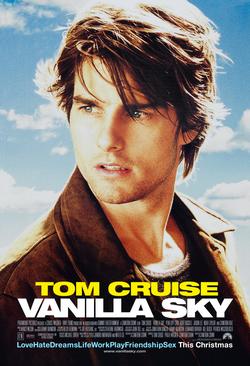
Behind the film
- Year
- 2001
- Director
- Cameron Crowe
- Writers
- Cameron Crowe
- Genres
- Science fiction, Psychological thriller, Drama, Romance
- Production
- Cruise/Wagner Productions, Paramount Pictures, Vinyl Films
- Country
- United States
- Cast
- Tom Cruise, Penélope Cruz, Cameron Diaz, Kurt Russell, Jason Lee, Noah Taylor, Timothy Spall, Tilda Swinton
About the film
Contains story spoilers.
Cameron Crowe's Vanilla Sky begins with a New York that has lost the people who usually give it scale and movement. David Aames appears alone in a city that should be crowded, establishing an absence before the film explains whose reality it belongs to. Released in 2001, the film follows a wealthy publisher whose familiar social world becomes increasingly difficult to recognize. Tom Cruise plays David as someone accustomed to treating his face, money and access as dependable advantages. An interview with court psychologist Curtis McCabe frames a series of recollections, but recollection does not guarantee accuracy. The story asks how a man can describe his own life when desire has begun to determine what he sees.
David meets Sofia through his friend Brian and becomes involved with her. His lover Julie deliberately crashes their car, killing herself and disfiguring him. After a failed nightclub reunion, he falls asleep outside. The apparent reconciliation with Sofia that follows includes repaired looks, then disturbing substitutions between Sofia and Julie. He suffocates the woman he perceives as Julie and finds himself imprisoned. An investigation into Life Extension reveals that he chose cryonic preservation and died from an overdose. His subsequent experience is a lucid dream beginning after the nightclub failure; its apparent recovery has turned into a nightmare through subconscious distortion. Tech Support explains that 150 years have passed and offers a repaired dream or waking into the future. David chooses waking, says goodbye to imagined versions of Brian and Sofia, and jumps from a rooftop. A voice asks him to open his eyes.
The injury changes the role of David's face before the dream offers its repair. Earlier ease depended on being able to move through rooms without wondering what people were seeing. The prosthetic mask makes that question unavoidable, placing an artificial surface between him and others while announcing the very damage it is meant to conceal. It also changes how the viewer reads Cruise's presence. A familiar expression can no longer perform all the work of establishing confidence or attraction, and the mask makes David's attempts at social composure visibly effortful. His problem is not confined to whether another person will desire him. He has lost an image through which he recognized his own place in a privileged world.
The dream's promise answers that loss with a life arranged around a repaired surface. What seems like an unexpected second chance becomes, in retrospect, a system built to supply what David could not obtain while awake. Its appeal depends on more than recovering his appearance: it offers a relationship in which the desired person returns and the rejected future can be replaced. The nightmare develops because a memory is not a neutral collection of images. Guilt, fear and competing attachments can enter the same constructed environment. Sofia and Julie's changing appearances make that intrusion intimate. A supposedly reassuring face becomes unstable, and recognition no longer guarantees that David has encountered the person or relationship he expected.
McCabe gives David's account a formal setting without placing the listener outside the mystery. Kurt Russell plays a man whose questions appear to offer the steadiness David has lost. The prison interviews make the story resemble an investigation into a crime, with a professional attempting to bring an unreliable statement into order. Once the dream is explained, that apparent framework also becomes part of what requires explanation. The doctor is not a viewpoint the film can simply use to certify every memory. The relationship between speaker and listener therefore mirrors David's larger difficulty: a person who seems capable of resolving confusion can belong to the same constructed experience that produced it. Even the scene in which a story is being examined cannot be taken as unquestioned ground.
Crowe's version adapts the 1997 Spanish film Abre los ojos, with Penélope Cruz returning as Sofia. Here the Manhattan setting places the damaged self-image within a world of inherited business power, parties and abundant choices. Rooms and faces can look polished while the account connecting them breaks apart. Music gives recollections another surface David can idealize, making an encounter feel suspended within the emotional world of a song. The film's shifts between a desirable social environment and abrupt visual contradictions suit a consciousness that wants to arrange experience into something bearable. The emptiness of the opening city carries that impulse to its limit. Possessing an environment and being able to inhabit it with other people are different things.
Life Extension changes the scale of the problem from a damaged recent past to an unfamiliar future. David has been trying to understand what happened to the people around him, but the explanation places waking life far beyond the period in which those relationships existed. The company can offer continuity as an experience, while actual continuity would involve returning to a world he does not know. Tech Support's presence also gives the dream a commercial shape. This is an environment somebody has purchased and a service whose malfunction can apparently be corrected, even though its emotional consequences have felt unlimited to the customer inside it. The story turns a promise of personal control into a question about what such control would exclude.
The rooftop choice makes David confront that exclusion directly. Remaining in a corrected dream would preserve access to a desired version of the past, but waking requires accepting that the future will not be arranged around those wishes. The imagined farewells make the decision an attachment he must release rather than a technical problem he merely solves. His leap ends the account without providing a tour of the future or confirming another romantic reunion. The opened eye is a smaller conclusion than the extraordinary height of the rooftop suggests: he has chosen to encounter something he cannot yet describe. Vanilla Sky leaves that new experience outside its frame, after spending its running time inside a life whose familiarity had become the source of its unreliability.