
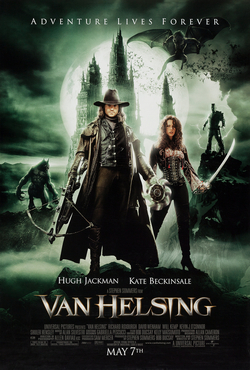
Behind the film
- Year
- 2004
- Director
- Stephen Sommers
- Writers
- Stephen Sommers
- Runtime
- 2h 12m
- Genres
- Action, Horror, Swashbuckler, Crossover fiction
- Production
- Universal Pictures
- Country
- United States, Czech Republic
- Cast
- Hugh Jackman, Kate Beckinsale, Richard Roxburgh, David Wenham, Shuler Hensley, Will Kemp, Kevin J. O'Connor, Elena Anaya
About the film
Contains story spoilers.
Van Helsing builds an adventure out of creatures that usually occupy their own stories, placing Dracula, Frankenstein's monster and werewolves inside one interconnected struggle. Stephen Sommers writes and directs this 2004 film, with Hugh Jackman as Gabriel Van Helsing, a hunter working for a religious order while unable to remember his own earlier life. The setting is a heightened nineteenth-century Europe of towers, laboratories, mist and elaborate machinery. Its supernatural rules belong to this film's invented world rather than providing a direct adaptation of a single novel. The connections between the monsters become the plot's machinery: what gives one creature life, what can destroy another and what happens when a human body acquires a power it cannot control.
The opening presents Victor Frankenstein's work as both a scientific act and something Dracula intends to appropriate. The creature's existence makes him valuable before he has any opportunity to choose a role for himself. A burning windmill seems to end the experiment, but the image of the monster carrying his creator gives their relationship an emotional weight beyond the apparatus that produced him. The following encounter between Van Helsing and Mr. Hyde introduces a different sort of problem. The hunter can accomplish a violent assignment and still be seen as dangerous by the surrounding public. Jackman's Van Helsing is physically confident but uncertain about the moral account of his own life. His missing memory means the job offers action without a complete explanation of the person performing it.
An assignment from the Vatican takes him to Transylvania to protect Anna and Velkan Valerious, whose family has struggled for generations against Dracula. Anna's remaining freedom is bound to an inherited promise: defeating the vampire would release her family from its spiritual burden. Kate Beckinsale plays her as a fighter already engaged in that conflict, so Van Helsing enters a situation with its own history and losses. Her brother's transformation into a werewolf makes the threat immediate and personal. David Wenham's friar Carl accompanies the hunter with inventions, specialist knowledge and far less enthusiasm for physical danger. His presence gives the mission a practical support system, with comic reactions emerging from the gap between preparation in a workshop and facing the creatures themselves.
Richard Roxburgh's Dracula rules through spectacle, command and manipulation. His brides make the village attack a display of movement through air and between buildings, turning a community's familiar spaces into exposed ground. Van Helsing's weapons can affect the confrontation, but the larger purpose of Dracula's experiments only gradually becomes clear. He wants to bring his otherwise lifeless offspring into existence using Frankenstein's technology. The story makes the machinery depend on a particular source of power, and the surviving creature becomes the essential part of that plan. Shuler Hensley's performance gives the monster speech, feeling and an urgent wish not to be used. His appearance marks him as frightening to other people, while his choices place him closer to the endangered humans than to the villain seeking to exploit him.
Anna's attachment to Velkan complicates the pursuit because the werewolf is both a threat and someone she hopes to save. An attempt to move the creature away from Dracula leads to an attack, Van Helsing's infection and Anna's capture. The exchange arranged at a masquerade places human society and predatory society in the same ornate setting, with the apparent gathering concealing a population of vampires. Across these sequences, the film treats grand architecture as something to traverse at speed: carriages, roofs, suspended structures and crowded rooms create obstacles as much as atmosphere. The danger shifts rapidly between individuals, preventing the hunter from keeping a safe position as the person who merely confronts monsters from outside.
Carl's discoveries connect Dracula's history to the Valerious family and reveal a route into the vampire's hidden fortress. Van Helsing also learns that a werewolf can kill Dracula, and that a cure exists for the transformation. The same bite that threatens to remove his humanity therefore becomes the means of completing the mission. Dracula recognises a deeper identity behind the hunter's missing past and offers knowledge of it, but Van Helsing refuses that bargain. His final battle takes place inside a larger effort to rescue the creature and obtain the cure. Anna and Carl have indispensable tasks of their own, so the outcome relies on timing and cooperation rather than simply on which opponent possesses greater strength. The power to defeat Dracula has arrived with a serious limit on how safely it can be used.
Dracula's death destroys his brood, but it does not allow an uncomplicated reunion. Anna administers the cure while Van Helsing is transformed and is killed by him in the process. Her death completes the family's release while leaving the hunter responsible for a loss he had been trying to prevent. The funeral by the sea changes the film's scale after its crowded battles. The creature departs, and Van Helsing sees Anna reunited with her family before continuing with Carl. That conclusion gives the spiritual promise a visible fulfilment without returning Anna to ordinary life. The hunter regains his human form, yet survival and success remain different things. The adventure closes with movement onward and a memory of the person whose purpose gave the mission its personal stakes.
Sommers uses the contrasting creatures to connect questions of identity with the action. Dracula wants a future for his offspring through the exploitation of another created being; the creature wants the chance to exist without becoming someone else's instrument; Van Helsing wants knowledge of himself while risking the loss of control over his body. Carl's awkwardness introduces a human scale beside the towering machinery, while Anna's family history keeps the conflict anchored to a specific obligation. The film's busy encounters ultimately depend on a comparatively clear distinction: having supernatural power does not determine how someone will use it, and being recognised as a monster does not settle whether that person deserves protection.