
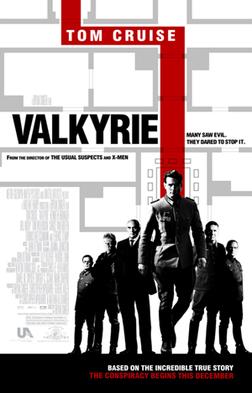
Behind the film
- Year
- 2008
- Director
- Bryan Singer
- Writers
- Christopher McQuarrie, Nathan Alexander
- Runtime
- 2h 0m theatrical cut
- Genres
- War, Drama, Biographical, Historical
- Production
- United Artists, Cruise/Wagner Productions
- Country
- Germany, United States
- Cast
- Tom Cruise, Kenneth Branagh, Bill Nighy, Tom Wilkinson, Carice van Houten, Terence Stamp, Thomas Kretschmann, Eddie Izzard
About the film
Contains story spoilers.
Colonel Claus von Stauffenberg joins German officers who seek to kill Hitler and end the war. They adapt Operation Valkyrie, an emergency reserve-army plan, into a way to arrest Nazi officials and take control in Berlin. An earlier attempt fails; on July 20, Stauffenberg leaves a bomb in Hitler's conference room and returns to the capital believing it worked. The coup begins, but Hitler survives, the news reaches Berlin, and officers withdraw their support. Troops arrest the conspirators at their headquarters. General Fromm hastily convenes a court martial, and Stauffenberg, Olbricht, Haeften, and Quirnheim are executed that night. The failure exposes the wider resistance to arrests and reprisal.
The known outcome means Valkyrie creates suspense from procedure rather than mystery. Its pressure comes from timing, authority, and the movement of information. A telephone call can start an operation or stop it; a report arriving minutes late can make yesterday’s order seem meaningless. The camera repeatedly places people at desks, doorways, and switchboards, where no one has the whole picture. The decisive battlefield is a bureaucratic network, and the contest is over which voice sounds legitimate when command itself is challenged.
The uncomfortable ingenuity of the conspiracy lies in its dependence on the same military culture that sustains the regime. These officers cannot simply declare a different Germany and expect obedience. They need the appearance of authorized command, the proper chain of responsibility and a plausible reason for soldiers to follow unfamiliar orders. That creates a thriller about the difference between legality and legitimacy. A document can be impeccably formatted and still conceal a revolutionary purpose; a familiar uniform can lend force to an appalling instruction. The film makes those contradictions concrete through the way people receive and question orders. Its tension includes the possibility that disciplined obedience might help resistance, while remaining the habit that made resistance necessary.
Stauffenberg’s injuries shape the mechanics of the plot. He has lost an eye and hand, with only a few fingers remaining on the other, and arming the bomb is a practical challenge. The detail makes his body part of the planning rather than a symbol outside it. Tom Cruise plays him with a stillness that fits a man conserving motion and attention. Kenneth Branagh’s Tresckow carries the exhaustion of earlier failure; Bill Nighy’s Olbricht understands the army’s machinery. The resistance feels like a coalition of people with different kinds of courage and doubt.
Information has a physical life here. It has to pass through rooms, travel along wires and reach somebody willing to trust the person speaking. The audience can compare different locations, but the characters must act inside the narrower world available to them. That difference gives the editing an important job: movement between headquarters and command posts becomes movement between incompatible versions of events. Waiting is active rather than empty. Someone who delays a decision can alter the meaning of a decision already taken elsewhere. The film invites us to follow these connections closely, because uncertainty is not merely an atmosphere around the action. It is a force that changes what action is possible.
Fromm embodies the danger of relying on an ally whose commitment is conditional. His concern with his own position exposes a weakness that equipment and careful planning cannot repair. The conspirators need people to accept personal risk before they have proof that anyone else will do the same. This makes their exchanges unusually tense: a cautious response can sound reasonable while leaving somebody else exposed. Tom Wilkinson gives that caution weight rather than treating it as an obvious villain's mannerism. Around him, assurances become things to be tested, and rank becomes a poor guide to conviction. The conspiracy's fragile social bonds matter as much as its technical arrangements, making the operation a study of trust under extreme pressure.
Bryan Singer keeps much of the film inside offices, corridors, and conference rooms. Maps and telephones replace the open battlefield, while uniforms make rank visible even when a character lacks control. Muted light and compressed compositions make these spaces orderly but unstable. The historical record supplies the outcome; the drama studies the interval in which people still have to choose. By following those choices, Valkyrie treats resistance as a moral act distinct from success, without turning the coup into a simple heroic fable.
There is a particular discomfort in watching competent people work towards an outcome we already know they cannot secure. Their attention to detail cannot guarantee success, and the film does not need to pretend otherwise to make their decisions matter. The offices and uniforms establish a world in which moral responsibility can disappear behind a job description. Resistance requires the officers to stop treating their assigned roles as an excuse. This is why the procedural emphasis has an ethical dimension: the same small acts that make a system function can become opportunities to oppose it. Valkyrie follows a specific conspiracy rather than offering a complete history of opposition to Nazism. Its narrower question is how people act when refusing obedience carries consequences they cannot control.