
Behind the film
- Year
- 2005
- Director
- James McTeigue
- Writers
- Lana Wachowski, Lilly Wachowski
- Runtime
- 2h 12m
- Genres
- Thriller, Dystopian, Action thriller, Political drama
- Production
- Vertigo, Virtual Studios, Silver Pictures
- Country
- United States, United Kingdom, Germany
- Cast
- Natalie Portman, Hugo Weaving, Stephen Rea, Stephen Fry, John Hurt
About the film
Contains story spoilers.
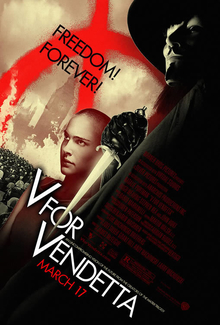
James McTeigue’s V for Vendetta takes place in a future Britain ruled by the Norsefire party, whose broadcasts, curfews and secret police present obedience as the price of safety. Evey Hammond works for the state television network, but her private life is cautious rather than openly rebellious. On Guy Fawkes Night she leaves home after curfew and is cornered by Fingermen, police who threaten her for violating the rules. A masked stranger intervenes with precise violence, introduces himself only as V, and brings Evey to a rooftop just as he sets off an explosion at the Old Bailey. The building’s destruction, timed to music, makes his politics a public performance: he wants the city to see that the government’s symbols can be broken.
V’s next move is to seize the state-controlled airwaves. He enters the British Television Network and delivers a message that calls the population to join him one year later, on November 5, while admitting that he is responsible for the attack. The regime quickly tries to control the account, presenting the destruction as a planned demolition and staging the news to make the authorities look capable. Evey’s presence at the station makes her a witness and an accomplice in the government’s eyes. V brings her to his hidden home, where she discovers that he lives among books, music and art that the state has banned. His refuge feels like a museum of individual expression, but his grand gestures and command of the space also make it clear that he expects Evey to follow his design.
V pursues the people tied to a government detention facility and its experiments. His victims include Lewis Prothero, the broadcaster whose familiar voice has become a vehicle for propaganda; Bishop Lilliman, who used his office to abuse the vulnerable; and Dr. Delia Surridge, who participated in the experiments but remembers their human cost. Inspector Eric Finch traces these deaths through records and interviews. At first he treats the pattern as a difficult police case, but each discovery exposes the regime’s own crimes: the state has concealed the origins of the virus that helped Norsefire seize power, and it has buried evidence of what happened to prisoners at Larkhill. The investigation turns into a contest between Finch’s professional duty and his ability to trust the government he serves.
Evey’s attempted return to ordinary life brings her to Gordon Deitrich, her employer and a television host whose comic routines ridicule the Chancellor. In private, Gordon shares the art and forbidden objects he has collected, and Evey sees how much of his public persona is a mask. After his broadcast mocks the regime, police raid his home and take him away. Evey tries to escape but is captured as well. She is interrogated and tortured for information about V, and a note from another prisoner, Valerie, becomes the source of strength that allows her to refuse the answers her captors want. When the cell door finally opens, Evey learns that her imprisonment was arranged by V as an ordeal intended to strip away fear. The revelation does not make his choice harmless; it leaves her to decide what to do with the freedom she claims to have found.
The film lets Evey’s ordeal and Finch’s investigation unfold alongside each other rather than treating V’s revolution as a simple victory. Finch reaches Larkhill and learns that V survived the state’s experiments, escaped the fire there, and rebuilt himself around revenge. The victims he targets are not interchangeable symbols: each represents a person who helped convert a secret crime into official policy. Yet V’s own methods remain severe, and the story does not resolve that tension by declaring him innocent. Gordon’s murder by the secret police confirms that the state will eliminate even a popular entertainer when he refuses to play along. Evey is meanwhile invited into V’s plan more deeply, but she is not simply absorbed into his identity; her growing independence changes what his final action can mean.
As November 5 approaches, V persuades the ambitious Creedy to arrange a meeting with High Chancellor Sutler, offering himself in exchange for Creedy’s rise to power. Creedy brings Sutler to the meeting and shoots him, then demands that V surrender. V refuses, and Creedy's men shoot him before he kills them and Creedy in the ensuing fight. Mortally wounded, V returns to Evey and the concealed underground train loaded with explosives. He leaves the decision to send it toward Parliament to her. Finch arrives before she acts, having followed the evidence far enough to understand the regime’s public story is false. Evey sends V’s body away and releases the train. Parliament explodes as the masked crowd approaches, making the destruction of the state’s seat of power part of the film’s final image rather than a threat left merely implied.
V for Vendetta’s masks are both an image of anonymity and a challenge to the idea that political action belongs only to exceptional individuals. The film builds its argument with contrasts: an official broadcast can disguise violence, while a comedy sketch can expose it; V speaks in theatrical flourishes, while Finch’s work depends on patient attention to small inconsistencies. Evey moves from a life shaped by caution into a choice she makes herself, though the film leaves room to question how much of that choice has been engineered by V. Its adaptation of Alan Moore and David Lloyd’s graphic novel is its own version, with its own political emphasis and ending. The final procession asks viewers to confront whether dismantling a corrupt order is enough, or whether a freer society also depends on what people choose to build afterward.