
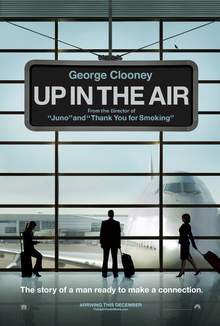
Behind the film
- Year
- 2009
- Director
- Jason Reitman
- Writers
- Jason Reitman, Sheldon Turner
- Genres
- Romantic comedy, Drama
- Production
- DreamWorks, The Montecito Picture Company
- Country
- United States
- Cast
- George Clooney, Vera Farmiga, Anna Kendrick, Jason Bateman, Danny McBride, Melanie Lynskey, Sam Elliott, J. K. Simmons
About the film
Contains story spoilers.
Ryan Bingham travels for a company that delivers layoffs in person and measures his life by frequent-flyer miles. At Omaha headquarters, new hire Natalie argues that dismissals can move online; Ryan objects and takes her on the road, where she sees the human difficulty of the work. He also meets Alex, a fellow traveler with whom he arranges casual encounters. At his sister's wedding, he helps the reluctant groom proceed and begins to question his distance from family. Hoping to make his connection with Alex lasting, he visits her, discovers she is married with children, and learns she saw him as an escape. An employee later dies by suicide after a dismissal, Natalie resigns, and the remote program ends. Ryan supports her job search and transfers miles to his newly married sister, but finishes at the airport facing a destination board with no plan.
The film’s central image is not simply a plane in the sky; it is the small, repeatable choreography that makes constant travel feel like home. Ryan’s bag, shoes, laptop, boarding pass and practiced passage through a terminal form a portable apartment. Each action has a right order, so he can turn travel into a private craft and regard possessions or obligations as unnecessary drag. The backpack metaphor in his speeches makes that preference sound like wisdom, but the film keeps the metaphor attached to ordinary practical choices. His minimalism is not a neutral philosophy floating above the story; it is a system that rewards him every time he avoids having to stay in one place long enough for another person to make a claim on him.
Reitman sets that self-invention beside the less elegant reality of job loss. The dismissal scenes are direct conversations in plain offices and conference rooms, where workers have to absorb a decision that the employer has chosen not to deliver. The camera gives these exchanges enough room for pauses, frustration and uncertainty to register. Their scale is deliberately different from Ryan’s smooth travel routine: he can leave the room after the script is complete, while the person losing a job must work out what the decision means next. The directness gives the encounters a texture of immediate consequence, making economic upheaval feel specific without requiring every character to become a symbol.
Natalie is not just the young employee who has to learn Ryan’s airport tricks. She enters with a management idea that appears efficient because it treats the layoff as a process that can be standardised and delivered from a distance. Ryan’s objections begin as professional defensiveness, since remote terminations could make his travel-heavy role obsolete, but the film gives them a human basis too: a difficult message requires attention to the person hearing it. Natalie’s own quick, planned path through life meets disruption in a way that her scripts cannot resolve. Her story gives the film a second version of Ryan’s problem, as both have to test the neat rules they use to keep vulnerability manageable.
Alex initially feels like Ryan’s mirror because she understands the attractions of a life organised around airports, hotel rooms and brief reunions. The film lets their rapport develop through the language of travel, including playful comparisons of status and convenience, so their connection seems unusually fluent. That fluency is also a limit: they share a lifestyle and an arrangement, but not necessarily a common idea of what the arrangement means. Ryan can misread ease as intimacy because it asks so little of him. When that confidence breaks, the change is not a sudden lesson delivered by a stranger; it is the recognition that his apparent freedom has depended on keeping emotional consequences outside the frame.
The family wedding offers a different kind of performance. Ryan is accustomed to addressing strangers whose immediate future he cannot control, yet he struggles to speak as a brother among people who remember his absences. His brief role in helping the groom reconsider the wedding uses the same reassuring language that makes him effective at work, but here the words have to attach to an ongoing relationship. The scene lets his skill become useful in a setting where he cannot simply collect a fee, close a conversation and board another flight. Family is not presented as a perfect antidote to loneliness; it is a web of history and expectation that he has to choose whether to enter.
The comedy often grows from the precision of small routines rather than from elaborate punchlines. Ryan's practiced luggage packing, choices at security and careful management of status privileges make abstract independence visible as a set of habits. The film can let a terse exchange or a minor travel inconvenience puncture his polished confidence without changing its conversational scale. That tonal lightness matters beside the firings: the story can move between workplace discomfort and social comedy while keeping both attached to the same question of how people cope with uncertainty. Its restraint leaves space for awkward pauses and half-formed thoughts, instead of insisting that every emotional turn arrive as a speech.