
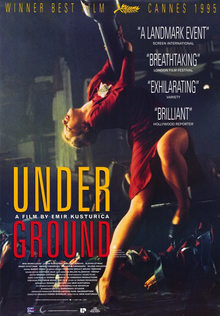
Behind the film
- Year
- 1995
- Director
- Emir Kusturica
- Writers
- Dušan Kovačević, Emir Kusturica
- Runtime
- 2h 43m
- Genres
- Tragicomedy, Drama, Comedy, War
- Production
- Ciby 2000, Eurimages
- Country
- France, Germany, Bulgaria, Hungary, Czech Republic, Federal Republic of Yugoslavia
- Cast
- Miki Manojlović, Slavko Štimac, Lazar Ristovski, Mirjana Joković, Srđan Todorović, Mirjana Karanović, Milena Pavlović, Danilo Stojković
About the film
Contains story spoilers.
Underground, Emir Kusturica’s 1995 film, begins in Belgrade during the Second World War, where Marko Dren and Petar “Blacky” Popara turn disruption into a livelihood. They trade on the black market, help the resistance and compete for Natalija, an actress whose loyalties shift with the men around her. Marko is practiced at reading a room and making himself useful; Blacky is a bolder fighter whose trust can be exploited. The film moves between street violence, drinking songs and public ceremony, so an act can look like courage in one moment and performance in another. Their friendship gives the story a route through several decades, but it also makes Marko’s later deception intimate: he knows which hopes and habits will keep Blacky and the others obedient.
When the occupation makes Belgrade dangerous, Marko hides refugees in a cellar. Vera, Blacky’s pregnant wife, joins the group while her husband remains outside. She dies giving birth to their son, Jovan. Marko later rescues Blacky after his capture and torture by the Germans, taking him into the cellar too. Once peace returns, Marko keeps the community making weapons by telling them the war continues. He grows powerful in the Communist Party while selling what they produce. For the people below, his promised final battle remains in the future, keeping them dependent on his account of events.
Above ground, Marko becomes an honoured resistance figure, while the weapons made below continue to supply his political and financial power. A state-backed film based on his memoir turns his exploits into an official story. The production is being made in the world outside the cellar, but its scenes mirror what the trapped group believes about itself. When actors repeat wartime gestures for the camera, the film’s two performances meet: Marko has managed both the events and the account that will replace them. The movie set is not an escape from his lie; it has become another instrument of it.
The story returns to the cellar in 1961, as Blacky’s grown son Jovan prepares to marry. Blacky decides to leave and fight for the country, taking Jovan with him. Outside, they find the movie production based on Marko’s memoir. The actors dressed as German soldiers look like the enemy Blacky still expects, so father and son attack the set and kill several people. During their escape, Jovan drowns in the Danube. The son who has spent his life underground dies soon after reaching the outside world, while Blacky survives with a belief about the war that the intervening decades have made disastrously wrong.
In the 1992 section, Ivan is reunited with Soni and comes across Marko brokering an arms deal in the war zone. When the deal collapses, Ivan catches Marko and beats him unconscious before taking his own life. Natalija reaches Marko, but militants capture them as arms dealers. Their commander is Blacky, who has ordered his fighters to execute people selling weapons. The order is carried out before he recognizes the two captives. Blacky then leads his people back to the cellar and takes Soni with him. He sees Jovan’s image in a well and falls in while reaching for it. The vision follows the film’s earlier account of Jovan’s drowning; it belongs to Blacky’s final return rather than a reunion between living father and son.
The final scene moves into a dreamlike wedding feast, bringing Blacky, Marko, Vera and the others together on land beside the water. Their reunion follows the violence that has separated or killed members of the group. As they celebrate, the ground detaches and floats away. The image gives the film’s crowded parties one last setting, now removed from the country through which the story has travelled. The feast supplies an imagined gathering after the historical narrative has ended, with the living and dead sharing the same space. The floating land turns that gathering into a final separation as well as a reunion.
Kusturica described the film’s emotional register as a movement between tears and laughter. In an interview, he connected those abrupt changes to his understanding of the region’s unstable history. He also discussed the use of wartime and Tito-era archive footage as a historical framework around the fictional story. Speaking about Yugoslavia’s breakup, he described losing the culture in which he had grown up and the secure sense of identity it had given him.
The film’s performance motif begins before the movie set. Natalija acts on a theatre stage before German officers, while Blacky’s intervention turns a staged scene into a confrontation. The underground wedding gathers people whose lives revolve around Marko’s false account of the war. Once the community reaches the outside, uniforms and staged violence still look real to them. The different kinds of spectacle therefore have consequences within the story: theatre offers cover for power, the cellar celebration precedes escape, and the film production becomes the site of killings. Natalija’s profession and Marko’s deception both feed Blacky’s fatal confusion.